Update On "Homelessness" In New York
/Recently (May 2026) I did an update on the “homelessness” situation in San Francisco. The title was “The Homeless Industrial Complex Eats San Francisco For Lunch.” I have taken a particular interest in “homelessness” in San Francisco ever since that city had a big referendum back in 2018 to pass a special payroll tax supposedly to solve the “homelessness” problem once and for all. The result in San Francisco, you will not be surprised to learn, was that the Homeless Industrial Complex has since swallowed up all the new funding and much more, while the number of people identified as “homeless” has only gone up, and then up some more.
But how about New York? In recent years the City hasn’t exactly been bragging about its success in this area, so data have been a little hard to come by. However, a few days ago (September 5) the New York Post had a story that gives an idea of the overall picture. The headline is “Land of the freeloader: Number of NYC homeless shelters surged by 50% in four years.”
The focus of this particular article is on the number of shelters, which has indeed surged to a remarkable extent. But the number of shelters gives a pretty good indication as to other important data, like the sheltered population and the budget of the Department of Homeless Services.
The number of homeless shelters across NYC exploded nearly 50% in the last four years from 333 to 499. . . . Shelters set aside for single adults – which critics say are the most problematic facilities because they are more likely than family shelters to bring violent criminals to neighborhoods – surged 35%, from 155 to 209, a Post review of Department of Homeless Services data found.
To be fair to new Mayor Zohran Mamdani, the surge in numbers of shelters occurred before he took office about eight months ago. Initially, the increase in shelter capacity was driven by the explosion in the numbers of illegal aliens who came to New York during the open border period of the second half of the Biden presidency. However, the so-called “migrant crisis” has now passed; but the number of shelters remains at the peak level, and the budget of the Department of Homeless Services continues to increase.
The number of shelters soared from 333 in fiscal 2022 to 496 by fiscal 2024 as the city’s daily homeless population surged to an average of 86,321, including 20,468 single adults. At the time, the city was still dealing with a migrant crisis so overwhelming that the number of vagrants on some days reached above 130,000. The brunt of the crisis is largely behind the Big Apple, [yet] the total number of shelters has remained steady since 2024. . . .
Did you notice in that paragraph the Post using the word “vagrants” to describe the unhoused population? It’s the first crack I’ve noticed in the wall of enforced euphemism around the word “homeless.”
What has happened to the population living in New York City homeless shelters over, say, the past quarter century? I can’t find a complete series of population by year, but several data points give the overall picture. The Office of the New York City Comptroller issued a Report in July this year titled “Charting Homelessness in NYC.” Two data points from that Report:
The nightly population in NYC Department of Homeless Services (DHS) shelters [as of] January 2000 [was] 22,955.
The nightly population in NYC Department of Homeless Services (DHS) shelters [as of] January 2020 . . . [was] 62,679.
The growth in the shelter population over that 20-year period represented an increase of 175%. According to the Comptroller’s Report, the number of sheltered homeless then shot up to well over 100,000 during the Biden open-border period from 2022 to 2024, and has fallen back somewhat since then.
The New York Post piece then has the most recent figure: “As of Thursday [September 3], DHS reported 83,407 residents in its shelter system.”
The increase is relentless, and we are now at well over triple the numbers that prevailed back in 2000, for a City where the population, according to Census data, has declined somewhat over that period, from about 8.8 million to about 8.6 million. The current shelter population of 83,407 represents almost exactly a full 1% of the City’s current population.
Even more dramatic is the rate of increase in the budget of the Department of Homeless Services. Here, from New York’s Independent Budget Office, is a chart showing expenditures of the Department of Homeless Services from 1994 to 2024:
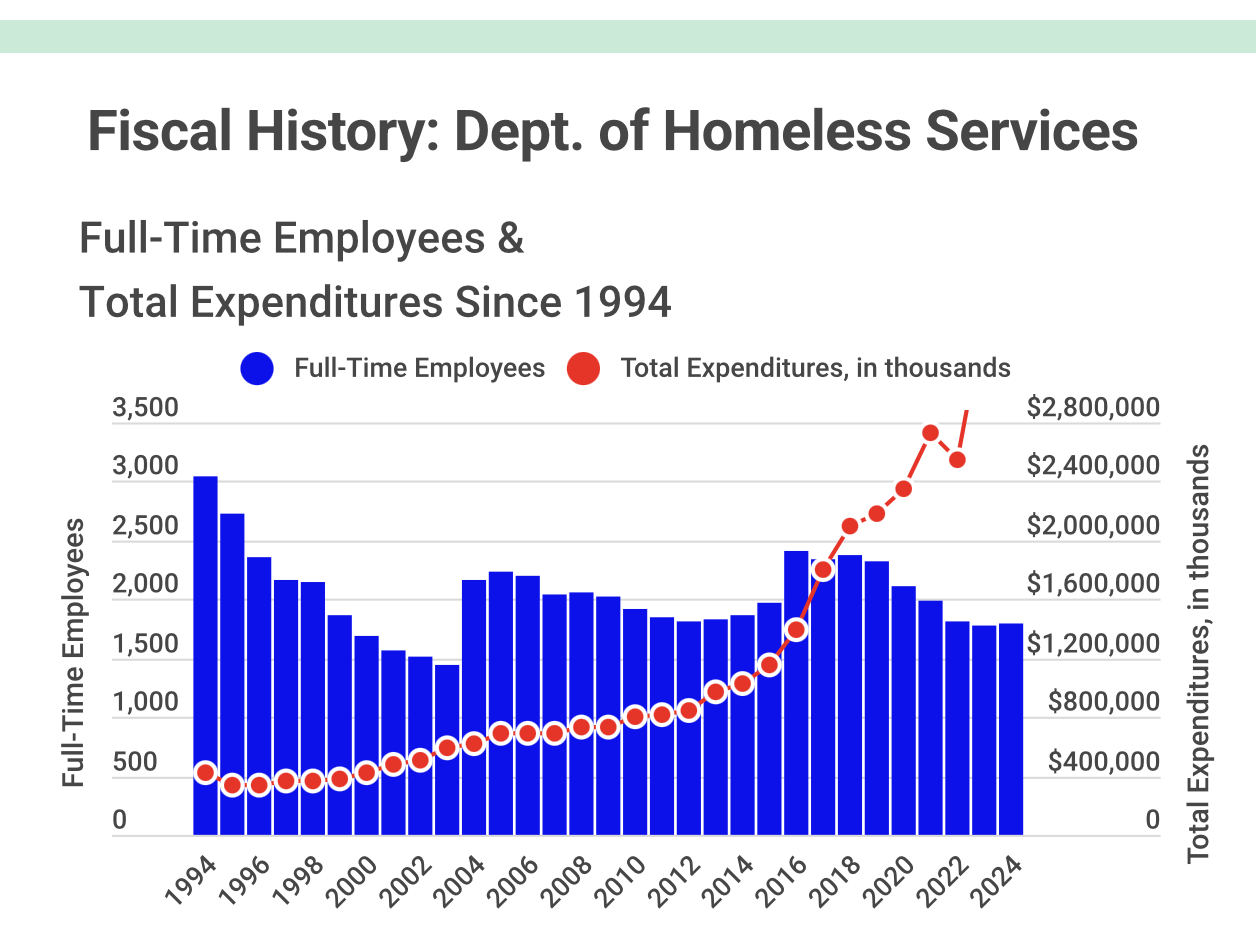
The chart makes clear that during Mayor Mike Bloomberg’s three terms (2002-2013) the expenditures of this Department remained relatively stable, just reaching about $1 billion per year by the time Bloomberg left office. Then, during Bill de Blasio’s two terms (2014-2021) the spending took off; and the rapid increases continued during the term of Eric Adams (2022-2025), although to be fair to Adams he was the guy who got stuck dealing with the crisis of Biden’s open border.
The chart ends a year before current Mayor Mamdani took office in January 2026. But the Post helpfully reports on Mamdani’s budget for the fiscal year that began on July 1, 2026:
Mamdani’s DHS budget is a whopping $4.2 billion, up $700 million from the previous year and $100 million more than in 2024, when the agency was slammed hardest by asylum seekers.
Notice that the number of employees in the Department has actually declined since 2016, even as the budget has about tripled. In other words, most of the money must be going to some group of NGOs/contractors, otherwise known as the Homeless Industrial Complex.
So, we didn’t have a referendum about homelessness, or pass a special payroll tax, the way San Francisco did. But the Homeless Industrial Complex is eating our City government for lunch in very much the same way. I fully expect that by the time Mamdani’s term comes to an end, the numbers of homeless will have increased yet again, and the money thrown away to solve the problem will have increased even more.