Ideologues Try Their Hand At Ordering Up An Electrical Grid Powered Only By "Renewables"
/In my post several days ago on October 18, I recounted the story of how ignorant Chinese Communist Party ideologues in the late 1950s convinced themselves that they knew how to achieve limitless agricultural production by just ordering each community to produce large, arbitrary amounts of food. Do you want to double grain production? Then just plant twice as many seeds in the same acreage! The ideologues had no idea how agriculture actually worked in the real world. Within a couple of years, there was widespread famine, probably the largest in world history. Tens of millions died horrible deaths of starvation.
At the end of that post I noted that, here in the West, equally ignorant ideologues were engaged, actually for a few decades now, in ordering up an energy transition to replace electricity generation by fossil fuels with generation mostly by intermittent wind and sun. Today’s energy transition ideologues have a lack of knowledge of how an energy grid works that is comparable to the ignorance of the Chinese ideologues of agriculture. How is this one working out?
In the arena of the energy transition, various entire countries, and U.S. states, have offered up their whole populations as guinea pigs for this grand experiment conducted by people who have no idea what they are doing. Germany, the UK, California and New York are prominent examples. And then at the other end of the scale, we have a small island named El Hierro off the coast of Spain. El Hierro only has about 11,000 people, but in 2008 it set out to show the world how to do a full transition to an electric system powered only by wind turbines backed up by a hydro-electric energy storage system.
I have reported on the progress of the El Hierro system multiple times, for example here in 2022, here in 2023, and here in 2024. But it has been more than two years since my last update. So let’s check in.
What makes El Hierro significant is that the promoters actually thought they were going to make a full-time grid based just on the wind turbines and storage. We know that because they have said so repeatedly. But somehow, in their quasi-religious devotion to the cause, they never took time to do the straightforward arithmetic calculations that would have revealed what makes this unworkable.
The El Hierro wind/storage electricity system has the name Gorona del Viento. The system started operating in 2013. The Gorona del Viento entity has a website with large portions in English where you can go to see their claims, and measure those against the actual performance in real life. From the opening page:
An island 100% renewable energy. . . . Gorona del Viento El Hierro, S.A.´s Wind-Pumped Hydro Power Station is designed to supply the Meridian Island with electrical energy derived from clean, renewable energy sources such as water and wind. The Wind Farm has capacity to fully meet El Hierro´s demand for electricity. The surplus wind energy which is not consumed by the Island´s population is used to pump water from a lower reservoir to a higher reservoir. This water is stored in the upper reservoir and used to produce electricity by means of a hidraulic jump at times when the wind power is inadequate.
(Emphasis added.). They explicitly brag that the island will have “100% renewable energy,” and that the wind farm “has the capacity” to fully meet the demand for electricity. The wind farm actually has well more than that “capacity” — if nameplate “capacity” were the relevant factor in determining if a generation system can supply demand as it appears. Read on in the website, and you find out that the wind farm has a nameplate capacity of 11.5 MW, whereas average electricity demand on the island is less than 5 MW. So there is well more than a 2x “overbuild.” With a big elevated pumped reservoir to store energy for when the wind isn’t blowing, surely that should be sufficient to meet the goal.
After the first few years of operation, in 2018 Gorona del Viento started putting out some detailed statistics on the performance of the system. This link goes to a page containing further links to individual pages with the statistics for 2018 and succeeding years. In the first year reported, 2018, the wind/storage system provided 56% of the electricity for the island, with the remainder provided by a diesel generator that they had (thankfully) kept as backup. But then it never really got better. In 2019 it was 54%; in 2020, 42%; in 2021, 48%; in 2022, 48%; and in 2023, only 35%; for 2024 45%; and for 2025, 44%. Here is their bar chart for 2023:
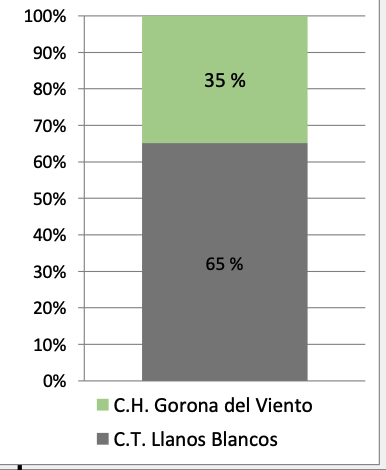
“Llanos Blancos” refers to the backup diesel system.
So the headline page brags about “100% renewable energy,” but in actual performance the best they have ever achieved over a full year is barely over 50%, and the last time they broke 50% was in 2019.
Why can’t they get more than that from this seemingly overbuilt system? Because there are long stretches where the wind does not blow. During those stretches the storage reservoir gets emptied and can’t be refilled. My 2022 post mentioned above linked to a calculation by a guy named Roger Andrews at the Energy Matters website showing that, to reach self-sufficiency with just a wind/storage system, El Hierro would need about double the wind turbine capacity and some 40 times the storage capacity (to deal with worst-case wind droughts). Even if they could afford such a reservoir, they have no place on the island to put it.
Meanwhile, in the face of the experience of El Hierro, places like New York, California, Germany and the UK continue to plow forward as if wind/solar/storage electricity systems can work. It’s as if it’s not possible to learn from experience.