The New York Times Shows Democrats How To Run On "Energy Affordability"
/In my post of October 7, I asked “How Can Democrats Possibly Run On Affordability?” The post specifically focused on energy affordability, and on consumer electricity prices, because, for reasons that I don’t understand, the price of electricity seems to be a big issue for Democrats in the upcoming elections. The post cited easily-available data from the federal Energy Information Administration showing that, among the contiguous 48 states, there is a sharp divide between states run by Democrats — which have the highest prices — and those run by Republicans — which have the lowest prices. The six states with the highest prices consist of California plus five Northeastern states that have joined the Regional Greenhouse Gas Initiative in an effort to intentionally drive up their consumer electricity prices. The twelve states with the lowest prices are all solidly Republican with the sole exception of purple Nevada (where the Governor is a Republican). Prices per kWh in climate-obsessed California and the Northeast are double and more the prices in many Republican-run states. If you study the issue even a little, it becomes obvious that the higher prices in the blue states are driven in part by higher taxes and more regulations, but particularly by so-called “climate” policies that in practice greatly drive up costs.
So how can you possibly turn this into an issue that somehow favors Democrats in the election on the issue of “affordability”? For the answer, I take you to the front page of yesterday’s print New York Times, where the main headline, spread across four of six columns, is “Americans Staggering as Their Power Bills Skyrocket.” The sub-headline is “In Oklahoma, a Record-Hot Summer Exposed an Affordability Crisis.” The front page also features a large photo of two obviously suffering Oklahomans, said to be sleeping in their living room in order to save on electricity. Here is a screenshot from the front page:
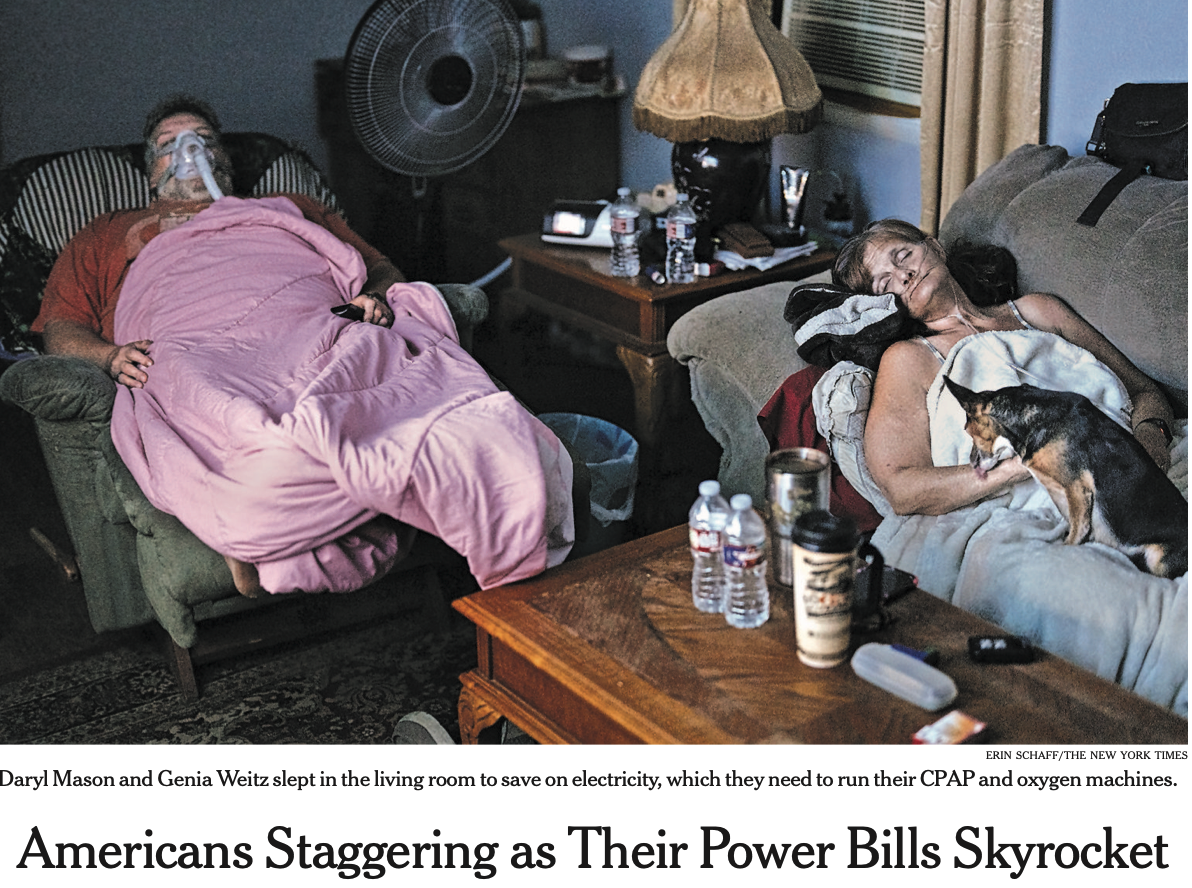
Here’s the Times’s technique. The article is mostly a personal tale of woe, focusing on a single Oklahoma couple, Daryl Mason and Genia Weitz, who live in the town of McAlester. It seems that Mason and Weitz are facing completely unaffordable electricity bills in the wake of this summer’s heat wave. See if this doesn’t tug at your heartstrings:
The worst of the heat was just beginning to lift when Genia Weitz, 58, walked into the stubborn Oklahoma sun last month and found the next emergency waiting in her mailbox. “Disconnection notice,” the letter began. She scanned her electric bill and saw a total balance of $1,340.96, far more than her monthly income. State rules prevented the power company from shutting off someone’s electricity when the heat index was above 101 degrees, but now it had dropped to 99 in September, and Weitz had nine days to pay.
She went back inside, where the window shades were drawn and heavy blankets hung across the halls and doorways to trap cool air. The house had three bedrooms and two bathrooms, but for the past several months Weitz and her husband, Daryl Mason, had mostly confined themselves to their 300-square-foot living room, letting the rest of the house bake to save money on electricity. They had an air-conditioner mounted to the window that rattled all day. They had her oxygen machine plugged into the wall and his CPAP machine for sleep apnea hooked up in the corner.
As to what the costs of electricity are for Mason and Weitz, we get this:
Weitz studied her bill and saw she was paying nearly $500 each month to live in a single room. “Turn the lamp off, Daryl,” she said. “Stop running the ceiling fan.”
And the cause of this? If you believe the New York Times, it’s Climate Change:
As fall sets in across the country, the bill is coming due for the hottest summer on record in the United States. The last three months were about three degrees above average, hotter than the Dust Bowl summer of 1936 and the heat dome of 2021, and tens of millions of people can’t afford to pay for the air-conditioning that helped keep them safe in the deadly heat.
Besides the three columns on the front page, the story covers a full interior page (A14) and runs to around 3000 words. As you get further into the article, you find a few more tales of ordinary people facing $500/month electricity bills, and another interviewee saying “Everybody’s getting turned off lately.”
But is anything missing from the article? Here are a few questions that occur to me:
What are the actual consumer electricity rates in Oklahoma, and how do those compare to the national average and to rates in blue states like New York and California? Have there been any noticeable recent increases?
Is the claim of $500/month electricity bills for Mason and Weitz to live in a 300 square foot room with one air conditioner remotely credible?
Was the summer of 2026 really significantly hotter in Oklahoma than earlier years?
None of the answers to these questions can be found in the article. Let’s take them one at a time, adding some easy independent research.
Consumer electricity prices in Oklahoma
The EIA chart gives a figure of 14.35¢/kWh as the average “residential” electricity rate in Oklahoma. That’s for the month of July 2026, which is the latest month for which data are provided.
Did rates suddenly go up after that? Actually, it looks like the July rate reflects an increase that took effect on July 1, and there have been no increases since. Here is a press release from the Oklahoma Attorney General on June 30 announcing that the rate increase (that took effect July 1) represents a settlement between the state and the utility of a prior larger rate increase requested by the utility. And here is a page from something called ElectricChoice.com setting out Oklahoma rates, and stating that residential rates for all three major utilities in Oklahoma (including Public Service of Oklahoma serving Mason and Weitz) are 14.33¢/kWh.
By comparison, the EIA rate page gives average residential rates of 33.61¢/kWh for California, and 29.90¢/kWh for New York — both well more than double the rates in McAlester, OK.
How much can consumers in Oklahoma expect to spend for electricity?
Mason and Weitz, and others interviewed by the Times for its article, claim to have electricity bills of $500 or so per month. Is that remotely plausible?
At 14.33¢/kWh, $500 represents almost 3500 kWh of usage. The EIA has a “frequently asked question” page on this very subject, headed “How much electricity does an American home use?” Their answer is, on average, 899 kWh per month, or 10,791 kWh per year. Usage of 899 kWh in a month at 14.33¢/kWh will cost $128.83, not $500. Are we really to believe that Mason and Weitz use almost four times the amount of electricity used by an average household, while supposedly cramming themselves into one room, using a single air conditioner, and turning off the light and the ceiling fan to save on electricity, all as described in the article? It’s completely absurd.
OK, it was hot this summer, so let’s assume that they ran their air conditioner continuously for the entire three months of July to September. How much electricity does an air conditioner use that is of sufficient capacity to cool a 300 square foot room as they describe in the article? Looking around the internet, I get a variety of answers, but all within a narrow range of around 500 kWh per month. Here is one such estimate at something called EnergyBot.com. At 14.33¢/kWh, that will cost about $72 for a month, if you never turn the air conditioner off for the whole month.
And that’s going to be the largest part of the electricity cost. Mr. Mason uses a CPAP. Could that be a significant contributor? This page from Hart Medical gives the typical electricity cost to run a CPAP as about $5 per month — and the cost in Oklahoma will be lower because its electricity costs are less than the average. Ms. Weitz uses some kind of oxygen machine, as to which the article gives no details. Those come in a variety of power levels where costs for electricity can vary widely. Vitality Medical at this site gives a range of monthly electricity costs for different devices ranging from about $17/month to $69/month. None of this explains how Mason and Weitz can get to a monthly electricity bill of anywhere near $500 with the lifestyle described, even at the peak of summer heat, with the air conditioner running non-stop.
And of course the implication of this is that the overdue bill of $1340 described in the article cannot have been run up just in the summer. To get to that level of arrears, Mason and Weitz must have been failing to pay the electric bill all the way back to the spring or even the beginning of the year, when without big air conditioning charges it is unlikely that their bill could approach even $200/month. (If we are to believe that Mason and Weitz engage in extreme measures to economize on electricity usage, as described in the article, then their monthly bill outside the summer months should be substantially less than the $128/month that an average level consumer would pay.)
Was the summer of 2026 really significantly hotter in Oklahoma than earlier years?
Since Oklahoma’s electricity rates barely went up and are well below average for the country, the claim of the article’s headline that American families are “staggering” as their energy bills “skyrocket” appears to rest entirely on an assertion that this past summer was much hotter than previous summers. Interestingly, when the Times gets to discussing temperatures, they immediately drop Oklahoma specifically, and talk only about the country as a whole, asserting (as quoted above) that this was the “hottest summer on record” in the “United States,” and that “[t]he last three months were about three degrees above average.” No source for that figure is cited. According to the UAH satellite record, for the 48 contiguous U.S. states the months of July, August and September 2026 were respectively 1.14, 0.60, and 1.32 deg C above the 1991-2020 mean. The average of those three is 1.02 deg C, which would be 1.836 deg F — rather substantially less than the three degrees above average claimed by the Times.
More importantly to the article, Oklahoma temperatures this summer did not set all-time highs. According to the Oklahoma Climatological Survey at this page, the warmest summer in Oklahoma history was not this year, but rather 2011, with an average temperature of 86.9 deg F across the state. And the record high temperatures, all 120 deg F at four different locations, were all set in 1936.
So essentially all of the key facts asserted in this New York Times piece are incredible and implausible. There is no evidence of “skyrocketing” electricity bills in red states like Oklahoma. The idea that a couple making efforts to economize and has only one running air conditioner gets $500/month electricity bills in Oklahoma is completely preposterous. The Times is treating its readers like fools, as usual.
How can Democrats possibly run on the issue of “energy affordability.” It’s easy — by focusing on emotional stories that in reality have nothing to do with “skyrocketing” energy prices, and by leaving out (or lying about) all the key facts.
Meanwhile, there absolutely is evidence of skyrocketing electricity bills in blue states like New York and California, but for obvious reasons the New York Times chooses to ignore that evidence. After all, we wouldn’t want to slow down our “climate leadership” agenda.