The Homeless Industrial Complex Eats San Francisco For Lunch
/It’s been a long time since I have done an update on the homelessness situation in San Francisco. The reason is that I have avoided the issue until sufficient evidence had accumulated to make the obvious conclusion completely definitive and undeniable.
It was all the way back in 2018 that some of San Francisco’s foremost do-gooders, led by billionaire Salesforce founder Marc Benioff, organized a referendum to implement a new payroll tax to raise the revenue to solve the homelessness problem once and for all. The referendum was designed to raise some $300 million per year, on top of San Fran’s already generous homelessness spending. All of the new spending was to be dedicated to the task of ending the homelessness crisis. On October 24, 2018 — just a few days before the referendum was scheduled to take place — Benioff got an op-ed published in the New York Times advocating for its passage. The gist of the op-ed was that it was time for San Francisco’s business community to step up and get this done. It was the classic appeal to progressive guilt:
The business of business is no longer merely business. Our obligation is not just to increase profits for shareholders. We must also hold ourselves accountable to a broader set of stakeholders: to our customers, our employees, the environment and the communities in which we work and live. It’s time for the wealthiest businesses and business owners to step up and give back to the most vulnerable among us.
I wrote a blog post a couple of days later on October 26. My take was somewhat more negative:
[I]t is not within the capability of a government bureaucracy tasked with solving a human problem to actually solve the problem and put itself out of business. The essential and unavoidable dynamic of a bureaucracy is to find a way to expand its mission and grow its budget and staff. It will be the same in San Francisco, because it is always the same, and must be the same. If the bureaucracy gets the annual [incremental] $300 million, the scope of the “homeless” problem will only expand. Benioff doesn’t know this. He may know a lot about his Salesforce business but, like all progressives, he is fundamentally ignorant of the basics of how the world works.
The referendum took place on November 6, 2018, and passed with 61% of the vote. Full implementation of the new tax and associated spending was delayed by litigation, but all litigation hurdles were cleared by early 2021, by which time the City was fully able to collect the revenue and spend it on the intended purpose. It is now 2026, and an additional five years have passed. So, what does the evidence show?
To measure the extent of its homeless population, San Francisco does periodic comprehensive surveys called “point in time” or PIT counts. They pick a night and send swarms of volunteers out to comb the streets to find every single homeless person on that night. Judging from the published data, they appear to undertake this exercise once every two years, except that they skipped a year during the pandemic. But here is their chart for the PIT surveys from 2005 to 2024. The chart is from sf.gov. I have inserted a red arrow to indicate when the referendum took place and the extra tax started.
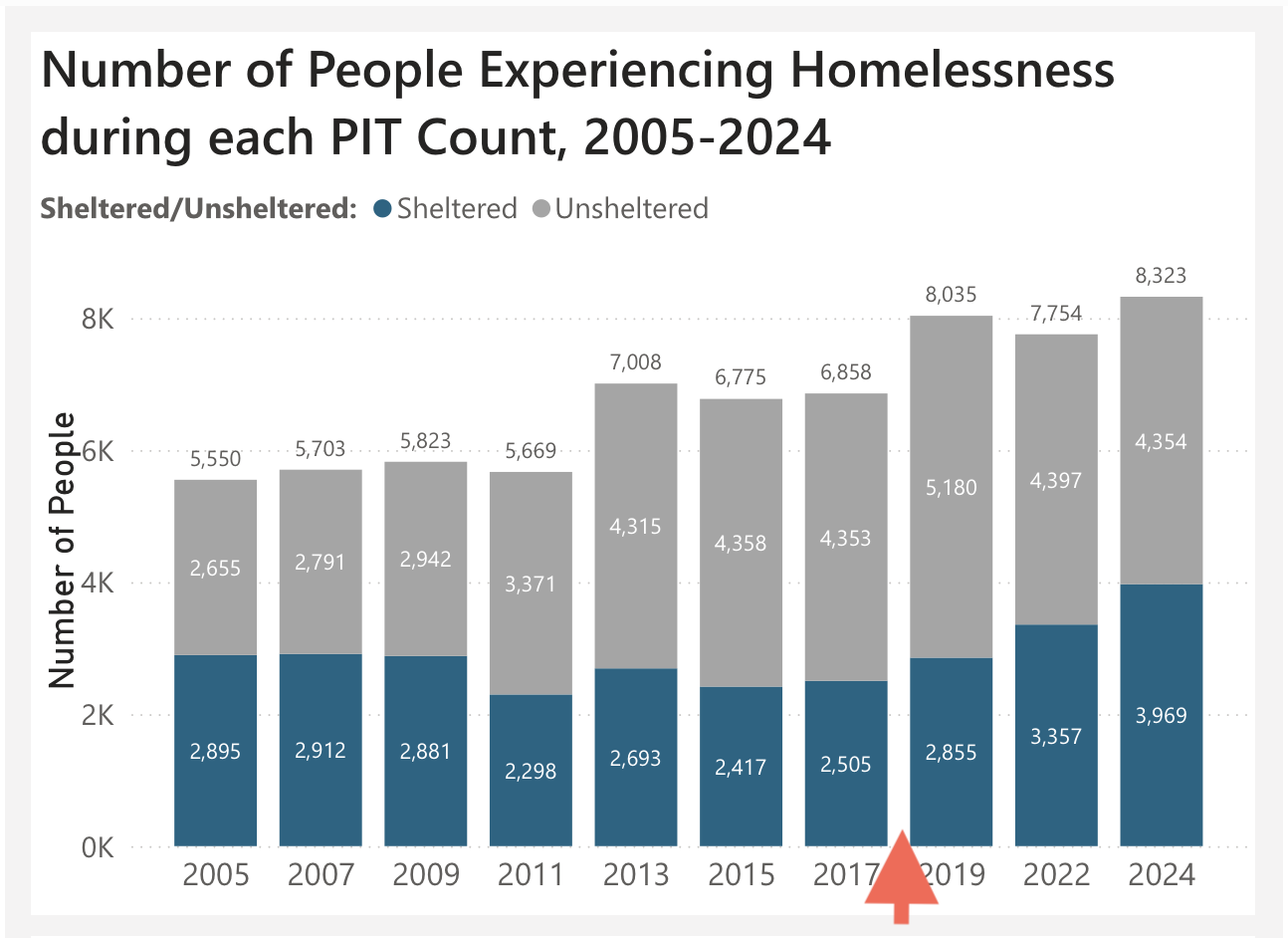
There was then an additional PIT count in January 2026. I can’t find that they have updated the chart to add the 2026 results, but those results are reported here. The headline at that link says that there was a “significant decline” in the number of homeless people counted in 2026, but in fact the total count was 7,973, which represents only a 4.2% decline from the 8,323 of 2024. Also, they changed the methodology rather significantly, by conducting the count on a morning in 2026, whereas previous counts had been conducted in the evening. I strongly suspect that that methodology change had a significant effect, because in the morning many “homeless” people might get up and do something that makes it less obvious that they are homeless. But that’s impossible to know.
However, the bottom line is completely unambiguous. Following the 2018 referendum, the number of people counted as homeless promptly went up, from under 7,000 to about 8,000, and has remained at about the 8,000 level, or more, ever since. The additional funding provided by the new voter-approved payroll tax has not made the slightest dent in the problem, and if anything has had a negative effect. Sadly, it is as I predicted.
But meanwhile the spending has soared. San Francisco has a Department of Homelessness and Supportive Housing, known as HSH, that administers to the homelessness situation. Here is a page from sf.gov detailing the budget of that Department for the two-year period 2025-27. The budget allocation for the Department is stated to be $785.6 million for FY 2025-26, and $705.2 million for FY 2026-27. Of the two year budget of close to $1.5 billion, some $665.3 million is said to come from what they call the “Our City, Our Home” fund, that is, the dedicated dollars from the special payroll tax passed in the 2018 referendum.
With 7,973 people counted as homeless in the latest PIT survey, the current level of spending comes to just under $100,000 per homeless person per year. As a point of comparison, a family of four with an annual income of $400,000 would be just below the top 2% of the income distribution in the U.S.
So if the spending never reduces the level of homelessness, where does all the money go? The answer is that it disappears into the homelessness industrial complex, a blob that finds ways to spend any given level of budget on itself without ever reducing, or even making a dent in, the supposed problem at hand. That’s how it works.