As Annual Medicaid Spending Approaches $1 Trillion, How Much Of It Is Legitimate?
/Medicaid is the joint federal/state program that provides free medical care to the poor and near-poor in the U.S. Who could be against that?
A website called Statista collects data on various subjects of interest and presents them in useful charts. One subject is the total federal plus state spending on the Medicaid program by year since inception of the program back in the 1960s through the latest year of 2024. Here is that chart:
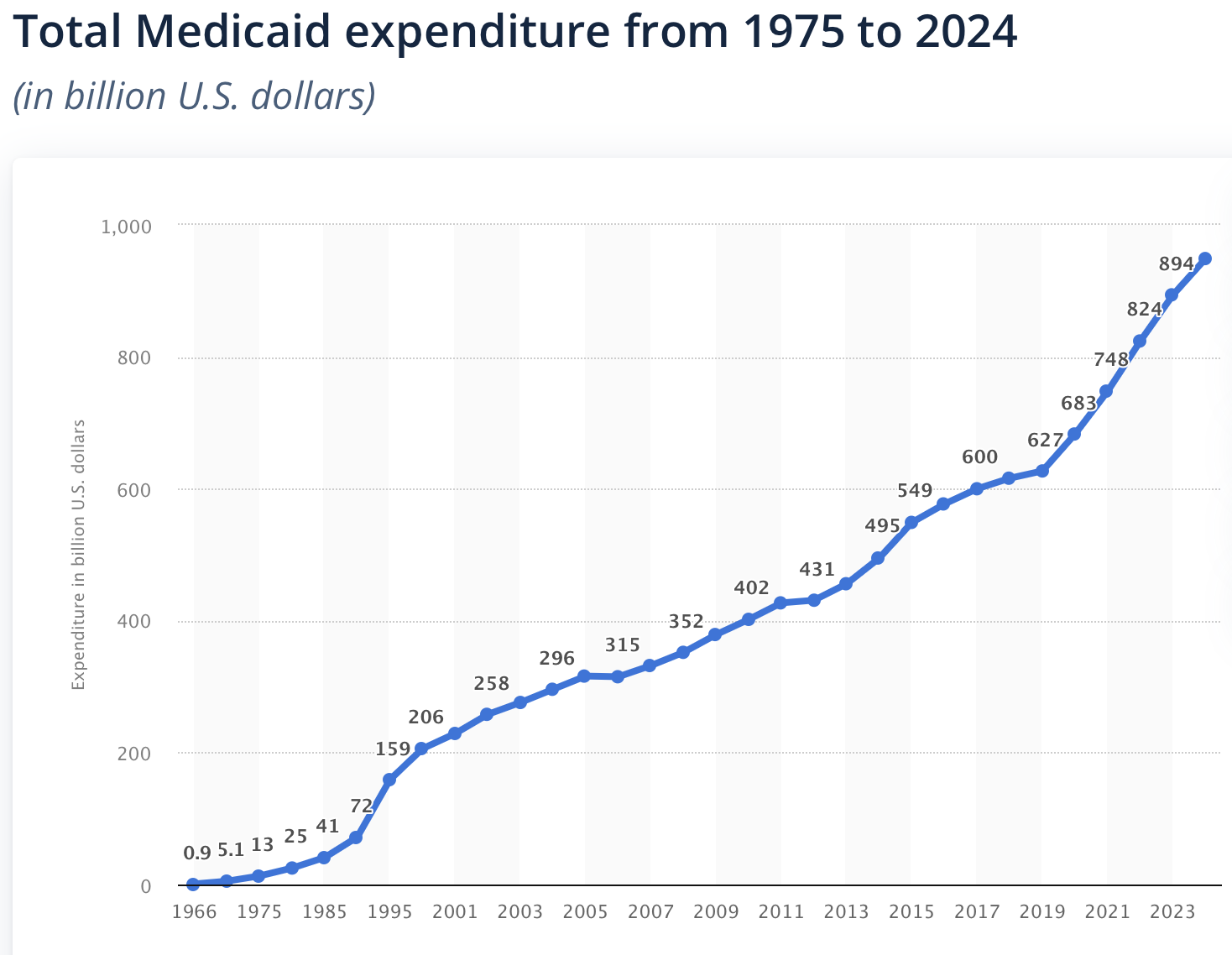
Looking at the chart, a few things leap out. One is rapid and unbroken growth year after year from the beginning up to the most recent year. Another is two particularly rapid periods of growth, first in the 1990s (Bill Clinton was President), and then again in the most recent period of 2020-2024. That last five-year period began in the last year of Trump’s first term (the pandemic year), but then continued throughout the four years of the Biden term. Between the end of 2019 through 2024 the program grew from $627 billion to $949 billion. That’s more than a 50% increase in 5 years, and more than an 8% compound annual rate of growth. The word “unsustainable” doesn’t begin to describe it.
When you think of medical care for the poor, you likely have a mental picture of what all this money is paying for. Probably, your mental picture involves hospitals, doctors, nurses, injuries, diseases, treatments and pharmaceuticals. But how much of the Medicaid spending — and particularly of the recent explosion in Medicaid spending — falls in those categories?
We are recently learning that much or even most of the recent cost explosion falls into other categories that have come under the Medicaid spending umbrella by reason of various “waivers,” and that do not involve hospitals or doctors or medical professionals or medical treatments. Major examples include: in-home assistance, often provided by family members, for things like cooking and housekeeping; transportation to medical appointments; palliative end-of-life care, again often provided in the home (sometimes called “hospice”); autism counseling; and more.
Any of these services could well be legitimate in many cases. But as people have started to look at and publicize exploding expenditures in these categories over the past several years, we learn of one situation after another where the spending appears to exceed anything that could possibly be legitimate. And almost all of the provision of these services is supposedly taking place in homes or other personal spaces where it is difficult to impossible to check if the service is actually being provided.
For today I’ll provide just a few examples recently in the news.
In about 2023 initial news reports indicated that somehow there were some 1800 hospices operating in the Los Angeles area, constituting approximately 6 times the per capita level of such businesses elsewhere in the country. In March, CBS News investigated what they called “ground zero for hospice fraud” in Los Angeles. Excerpt:
Three years ago, California’s state auditor sounded the alarm that Los Angeles County had seen a 1,500% increase in hospice companies since 2010 – more than six times the national average relative to its elderly population. . . . The state says it proceeded to investigate and revoke the licenses of 280 hospices. But since then, the problem has continued to fester. CBS News examined the business and financial records of every hospice currently operating in LA County, applying the same indicators identified by the state. Indications of fraud have not stopped. In fact, they’ve grown.
(Note that the hospice fraud issue involves the Medicare program, as well as Medicaid.)
In the area of in-home personal services, a reporter named Luke Rosiak at the Daily Wire is just out with a three-part series involving what appears to be widespread fraud in the Columbus, Ohio area. Here are links to Part 1 (May 4), Part 2 (May 5), and Part 3 (May 7). This alleged fraud, like the Minnesota free-meals scandal, involves a large community of almost entirely Somali-Americans. The entire series is well worth your attention. Besides revealing specific instances of fraud, the series goes into how the level of spending is completely implausible given the population to be served. Here is an indicative excerpt from Part 2:
The seven buildings along East Dublin Granville Road in Columbus, Ohio, are filled with hundreds of office suites, all owned by a company named Cordoba Real Estate. A large majority of the tenants in the buildings bill Medicaid, the taxpayer-funded medical program for the impoverished, as a “home health care” business that provides low-skilled, usually non-medical care to elderly or disabled people. The Daily Wire has spent weeks analyzing Medicaid data released by the Trump administration’s Department of Government Efficiency in an effort to weed out wasteful government spending. The buildings owned by Cordoba stuck out, each housing dozens of businesses that bill Medicaid. In all, the Cordoba-owned buildings in Columbus housed 288 businesses registered with Medicaid, The Daily Wire investigation found. Together, they charged taxpayers more than a quarter of a billion dollars between 2018 and 2024. That’s in a city where only 6,273 people 75 or older are on Medicaid.
And don’t get the idea that explosive growth of Medicaid spending on home health aides is confined to a few Somali communities in the Midwest. New York State has one of the most out-of-control Medicaid-funded home health aide programs. Here is an April 2025 report on the issue from the Empire Center. Excerpt:
New York’s home health employment is continuing to soar, growing by 57,000 jobs or 10 percent from 2023 to 2024, according to newly released data from the U.S. Bureau of Labor Statistics. The state’s workforce of home health and personal care aides grew to an estimated 623,000 as of May 2024, according to BLS’s Occupational and Occupational Employment and Wage Statistics, an annual survey posted Tuesday. That equated to 171 aides per 1,000 residents aged 65 or older, which was the highest rate in the U.S. – 153 percent higher than the national average and 24 percent ahead of the No. 2 state, California.
New York State has only about 10 million jobs total, so 623,000 of these home health aide jobs is more than 6% of all jobs in the state. Are all these people doing legitimate work, or are they just taking advantage of the taxpayers to get paid for hanging out at home with mom? How could you tell?
Autism counseling is another big area. Autism is something without any clear definition, or any good metric for determining if counseling does any good. As one example among many, here is a January 2026 report from the HHS Inspector General about improper payments in the small state of Maine. Excerpt:
The U.S. Department of Health and Human Services Office of Inspector General (HHS-OIG) has released an audit report revealing that Maine made at least $45.6 million in improper fee-for-service Medicaid payments for rehabilitative and community support (RCS) services provided to children diagnosed with autism. . . . In the span of five years, Medicaid payments for RCS services in Maine grew significantly, from $52.2 million in 2019 to $80.6 million in 2023.
While we have barely been looking, the Medicaid program has morphed from medical care to widespread payments for aides and personal services provided by non-professionals. Cooking? Housecleaning? No problem, the taxpayers will pick that up.