What Will The Future Look Like After Louisiana v. Callais?
/On April 29, the Supreme Court decided Louisiana v. Callais. That’s the case where the Court held that the Voting Rights Act did not require Louisiana to create a second “majority-minority” Congressional district because “[t]he Constitution almost never permits a State to discriminate on the basis of race, and such discrimination triggers strict scrutiny.”
A “majority-minority” district is one that has been gerrymandered to include sufficient numbers of the designated minority group as to make it nearly certain that a member of that group will be elected to represent the district.
The case arose out of the redistricting process following the 2020 census. Louisiana initially came up with a map containing only a single such “majority-minority” district. Plaintiffs who claimed that their voting rights were being infringed challenged the map, and a District Court judge in Louisiana entered a preliminary injunction requiring Louisiana to create a second such district. After the case went into what Justice Alito’s opinion describes as a “legal limbo,” Louisiana then adopted a new map with a second “majority-minority” district; but that map was then promptly challenged by another group of plaintiffs who claimed that their voting rights were being infringed. This second challenge then became the Callais case.
Here (from the Supreme Court’s opinion) is the Louisiana map that was successfully challenged in Callais:
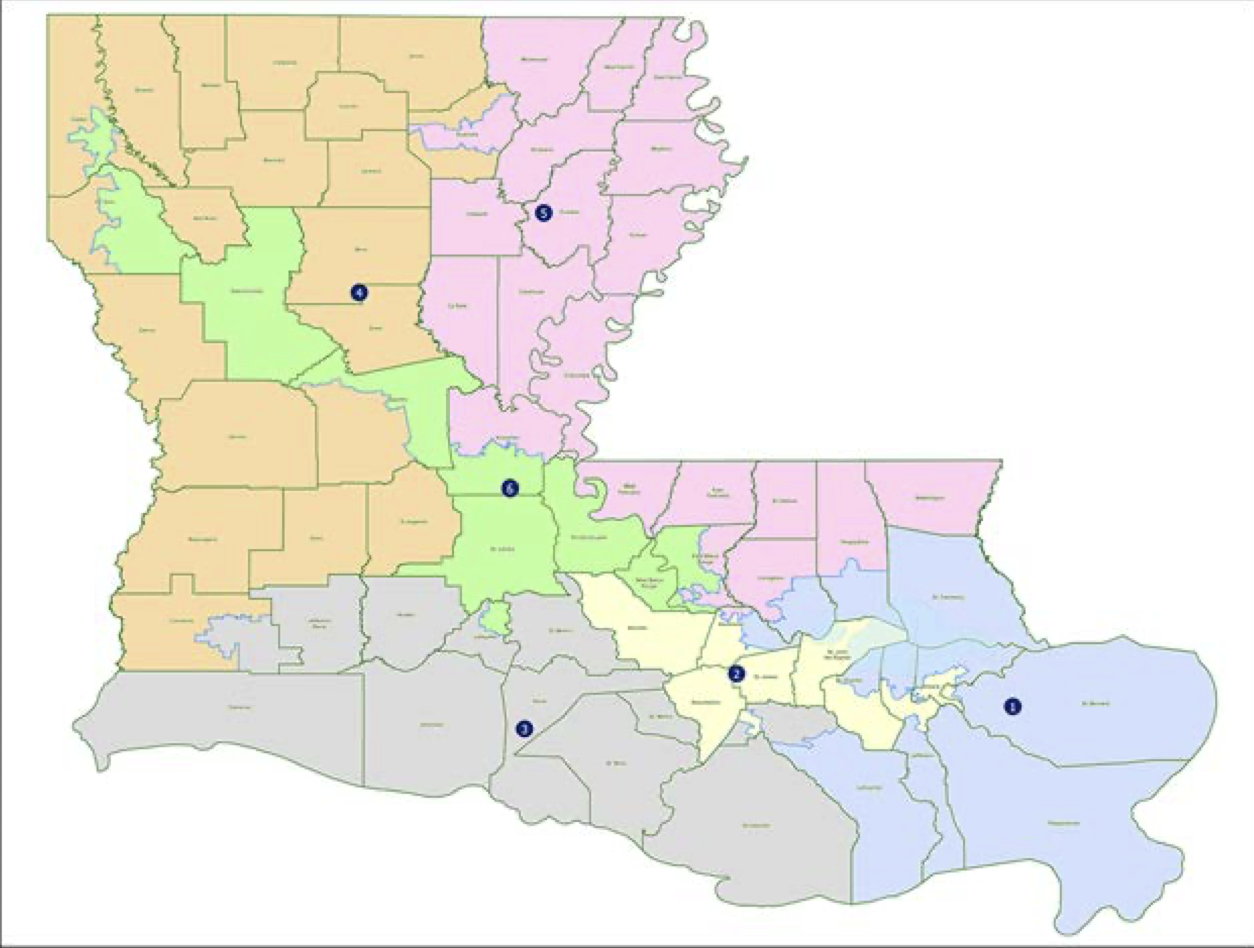
The yellow district at the lower right, including most of New Orleans, was the first “majority-minority” district; and the green district snaking across the state from the center to the northwest corner is the second such district that provoked the challenge.
The left-wing press has gone into apoplexy over the Callais decision. The New York Times has probably run a dozen or more articles since the decision, attacking it from every imaginable perspective. Among the many hostile pieces, my favorite is the one that appeared in the front page of the print edition on May 1 with the headline “Ruling on Map May Clog Pipeline of Black Leaders.” The thesis is that without this critical avenue of getting elected to represent these “majority-minority” districts, an entire generation of the black leaders of the future will be held down. Excerpt:
Across the South, Republican officials are ready to quickly redraw legislative districts, seizing upon the Supreme Court decision on Wednesday that struck down a voting map in Louisiana and further weakened the landmark Voting Rights Act, which for decades helped usher in generations of Black leaders. Critics of the decision expect that any reconfiguration will not only endanger Black incumbents, some of whom have held office for decades, but also threaten a rising generation of Black Democrats in the South, who already have few avenues for ascending in politics.
Is that a fair concern? What are the changes that the Callais decision is actually likely to bring about?
Here are two things that I suggest are likely: (1) the incentives for blacks running for Congress could change significantly, and greatly for the better, as they are required to appeal to large numbers of white (and other) voters in order to get elected, and (2) the Republicans could gain several seats from the process.
In my view, the regime of having certain Congressional districts specifically engineered to favor designated racial and ethnic groups has had a very negative and noxious effect on our politics that few appreciate. Justice Roberts famously wrote in a 2006 case called League of United Latin American Citizens v. Perry, “It is a sordid business, this divvying us up by race.” If anything that’s an understatement. The process of the creation of these “majority-minority” districts in practice leads to safe seats that turn into lifetime sinecures for the incumbents. And since they have no incentive to appeal to moderate or dissenting voters, they make a career of constantly playing the race card and claiming victimhood and oppression.
Perhaps we are always going to have a few of these types hailing from the blue states. But the litigation under the Voting Rights Act, up to now, has also forced the creation of these “majority-minority” districts in even the reddest of states. And those districts have produced some of the very most toxic members of Congress. Consider a few examples: Al Green and Jasmine Crockett (and previously Sheila Jackson Lee) of Texas; Bennie Thompson of Mississippi; James Clyburn of South Carolina; Hank Johnson of Georgia; Sheila Cherfilus-McCormick (and previously Alcee Hastings) of Florida. If these are the kind of “black leaders” that (in the view of the New York Times) could be held back by the aftermath of the Callais decision, I can’t think of a much better result for America. And also for the black people who have had the misfortune of being represented by these politicians for so long.
The fall-out from Callais also presents the prospect of a gain of several seats for Republicans in the House. I have seen estimates that the number could be as many as 12, although it is unlikely to be that many in the imminent 2026 mid-terms. Nevertheless, a rather obvious consequence of pre-Callais voting rights litigation and its mandates for these “majority-minority” districts has been that red states have been forced to create one or more such districts — which always go to Democrats — while blue states have never had any comparable mandate to carve out a few safe seats for Republicans. And thus, for example, Massachusetts, which gave 36% of its votes to Trump in 2024, somehow has a Congressional delegation consisting of 9 Democrats and no Republicans. Or there’s Maryland, where Trump got 34% of the 2024 vote, but the Congressional delegation is 7 Democrats and 1 Republican.
The New York Times can spin it any way it wants, but the use of race-based gerrymandering to get a dozen or so extra seats for Democrats is rather clear corruption of the system. It’s long overdue for this to be ended.