Why Government Can't Solve All Human Problems: A Health Care Example

  • Here’s something nearly everyone can agree on: healthcare in the United States is too expensive. Private health insurance premiums rise inexorably well above the rate of inflation, and so do the costs of government subsidized healthcare like Medicare and Medicaid. And if you face a big medical issue without insurance, the bills could well come to more than you could ever pay.

  • So what’s the answer? To the Left, it’s easy: a “single payer” system, sometimes called “Medicare for all.” In simple terms, the federal government pays for all the medical expenses of everybody. The money comes out of the infinite pile of federal loot. No individual ever has to worry about a medical bill. Prominent backers of the “single payer”solution to healthcare costs include the likes of Bernie Sanders and Elizabeth Warren, as well as organizations like Physicians for a National Health Program.

  • The flaw in this approach is something that is not intuitive to most people.

Read More

Is There Any Fraud In The Medicaid Program? Here's A Place To Start Looking

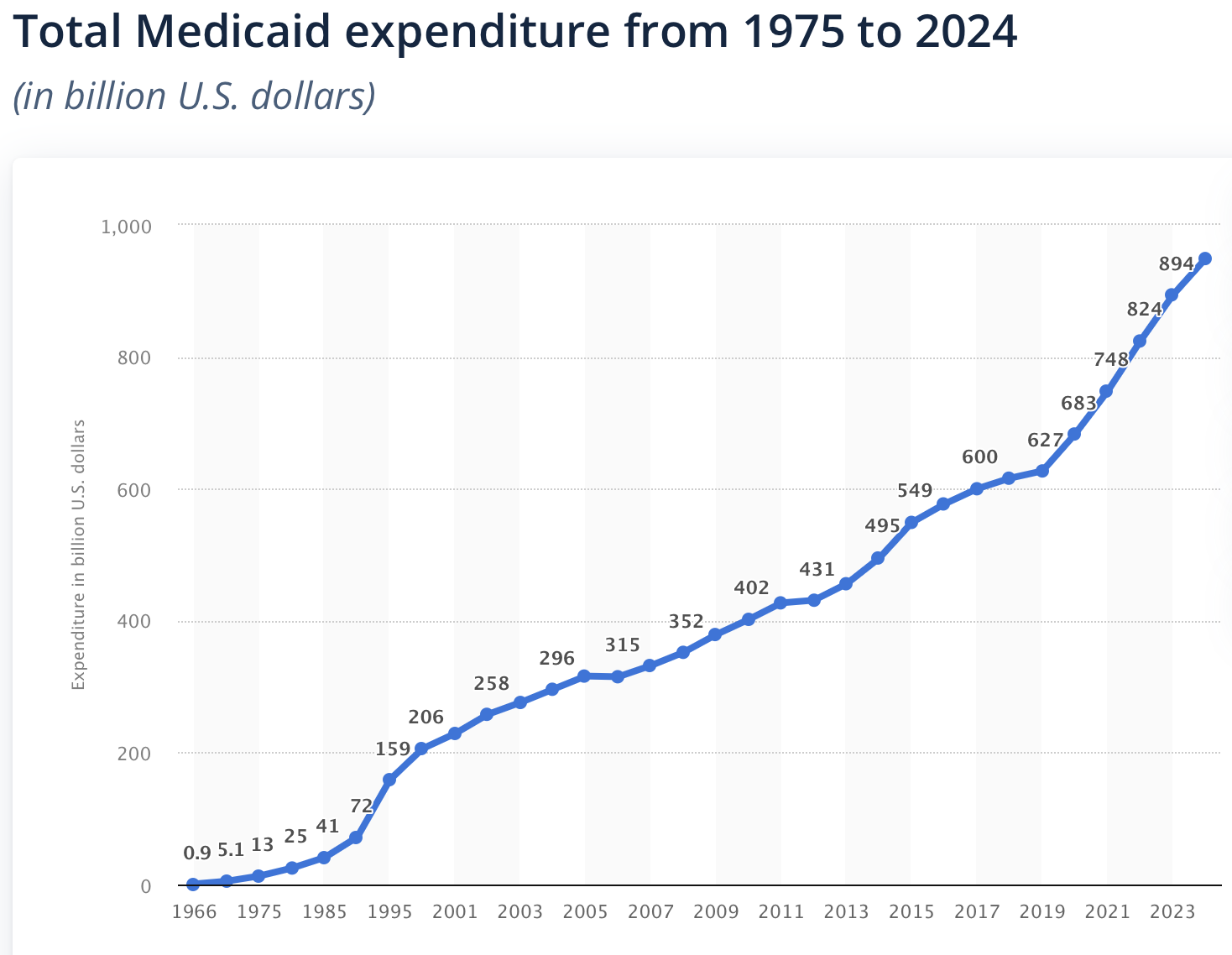
  • Elon Musk, of the Department of Government Efficiency, has asserted that his goal is to cut some $1 trillion of “waste and fraud” from annual federal spending.

  • Skeptics of the effort say that that’s just not possible, mainly because almost half of federal spending constitutes the “entitlements” — Social Security, Medicare, Medicaid, and some smaller health insurance programs — and President Trump has pledged not to cut those. Add something close to $1 trillion for defense, and another close to $1 trillion for interest on the national debt, and the remainder (less than $2 trillion) doesn’t leave nearly enough room for a trillion of cuts.

  • But here’s the missing piece: What if there are large amounts of fraud in the entitlement programs? Trump hasn’t pledged not to go after that. Could the amounts of such fraud be significant in the context of the huge numbers at issue?

  • I don’t fully know the answer to that question; but today I’ll look at one example involving very big numbers where obvious fraud is hiding in plain sight.

Read More

Manhattan Contrarian Public Service: The Easy Solution To "Surprise" Medical Bills

In the long list of unintended consequences of Obamacare, the latest one to attract attention is the so-called “surprise medical bill.” They have given you to think that your all-beneficent government has bestowed upon you that holy grail of healthcare “coverage.” Then you have to go to the hospital. No problem — you have “coverage.” But upon getting home you suddenly get hit with a completely unexpected bill for $2000 or $5000, or even $10,000 or more, and you are told that it is not covered by the “coverage.” What the hell is going on here?

I guess you didn’t read the fine print. The geniuses behind the design of Obamacare insisted that they could mandate both “affordable” premiums, and simultaneously third-party payment for every conceivable health issue (e.g., free birth control for eighty-year-olds). But something had to give. The remaining escape valves have turned out to be high deductibles and narrow networks in the healthcare policies. Thus, for your hospital visit, you may find that your deductible makes you responsible for the first $3000, or even $5000, of the bills. Or, even worse, you may find that even though you carefully selected a hospital that was “in network,” the doctor who treated you was “out of network,” and sends you a bill for $6000 that your “coverage” won’t pay.

This “surprise medical bill” issue has recently attracted enough attention that the Congress has swung into action. When Congress swings into action, it follows the fundamental principal that all human problems are to be solved by some kind of program, regulation, or mandate emanating from the federal government. This principal applies most particularly to solutions to those human problems that were caused by the last round of programs, regulations and mandates emanating from the federal government. And thus we have something called the Lower Health Care Costs Act, recently introduced in the Senate by Lamar Alexander (Republican of Tennessee) and Patty Murray (Democrat of Washington). Writing in the Wall Street Journal on Wednesday, in a piece titled “Get Rid of Surprise Medical Bills” (probably behind pay wall), Benedic Ippolito of the American Enterprise Institute calls the proposed LHCCA the “most consequential bipartisan health-care reform of the ObamaCare era.” . . .

As a public service to our readers and to the Congress, the Manhattan Contrarian wishes to state that there is a far, far better and easier solution to this “surprise medical bills” thing than any of the three proposals in the LHCCA. And it is a solution that is already present in existing law. The solution is, . . .

Read More
Get Ready For The Democratic "Pragmatists"

Yesterday the Wall Street Journal ran an op-ed with the headline “Are All Democrats Socialist? Don’t Believe the Hype.” The authors are Gregg Hurwitz and Jordan Peterson. I hadn’t previously heard of Hurwitz (he is identified as the author of a series of “thriller novels”); but Peterson is the guy who has shot to great fame in recent years as a YouTube star who advocates for leading a life of personal responsibility and hard work as the route to success. From what I had previously seen of Peterson, I had been quite impressed. With this op-ed, he just sank about 7 notches out of 10 in my estimation.

The central assertion of the op-ed is that the “social media warriors” and explicit advocates of socialism, like Alexandria Ocasio-Cortez and Ilhan Omar, who might seem to be the current stars of the Democratic Party, are not actually “representative” of its views. Rather, we should look to the views of those Democrats, here characterized as “quieter pragmatists,” who won the Congressional seats gained by the party in the last election. Among the 2020 candidates for President, our authors state that “voters would do well” to look to the “passionate moderate voices” ascending in the party. Like who? They name two: Pete Buttigieg and Amy Klobuchar.

Are any of the Democratic candidates, and most particularly Buttigieg and Klobuchar, fairly characterized as “pragmatists” or “moderates”? . . .

Read More

Is New York's "Safety Net" A Success?

One of the many specialized publications here in New York is something called “Crain’s New York Business.” As its title suggests, Crain’s covers mostly the affairs of the business community, although from time to time it also dabbles in political and policy matters. Sometimes it even has some sensible things to say. And sometimes not.

This week’s issue of Crain’s is dominated by a cover story titled “The State of Inequality: A Program for Every Problem.” The article has the byline of Crain’s head editor Greg David (although I doubt he actually wrote it — it’s not his usual style at all). It purports to be a review of the state of the “safety net” and its many subsidiary programs here in New York, together with, to some degree, a comparison of same to similar programs in certain other states (Georgia, Texas, Washington).

This lengthy piece is a serious embarrassment to Crain’s. It could not be worse if they simply had published verbatim a pile of campaign propaganda fed to them by a Cuomo or a de Blasio — which may very well be what this actually is. I’ll first take you through what the article says, and then I’ll go over a few of the elephants standing around here that they have somehow missed.

The basic theme of the piece is that New York has the most extensive array of social safety net programs in the country, and THEY’RE WORKING !!!!!! And how do we know that THEY’RE WORKING !!!!! ? Because we have followed the basic journalistic technique of interviewing some of the beneficiaries of the programs, and some of the bureaucrats who run the programs. And, remarkably, those people are unanimous in declaring the great success of the programs that they benefit from and/or administer. QED! Now, has anyone thought to maybe go out and collect some data as to, for example, how New York compares to other jurisdictions in actually reducing poverty, or reducing income inequality, or (in the case of medical programs) extending life expectancy? Of course, you will not find any of that in this article. . . .

Read More

The Cruel, Heartless Expansion Of Medicaid Under Obamacare

You have undoubtedly noticed that the official Democratic talking point about any and all efforts to repeal or even modify Obamacare is that this is "cruel."  OK, sometimes it's "heartless."  Or maybe "a human tragedy."  You are taking away "healthcare" from the people and leaving them to suffer in the streets!  People will die!!!!

Just to warm you up for this post, here is a small roundup:

  • Sen. Richard Blumenthal (D-CT), commenting on the Graham-Cassidy bill on September 20:  "We are on the precipice of one of the most cruel and outrageous legislative acts in recent history."
  • Washington Post, July 20, commenting on the then-current Republican "repeal only" plan:  "CBO again confirms the cruelty of GOP’s ‘repeal-only’ plan."
  • The New Republic, March 14, commenting on another earlier version of Obamacare repeal/replace known as the American Health Care Act:  "[T]he incredible cruelty of the Republican legislation didn’t become clear until Monday, when the Congressional Budget Office . . . estimated it would undo nearly all of the coverage gains we’ve seen under the Affordable Care Act, creating human tragedy on a scale far greater than even pessimistic analysts imagined.
  • New York Magazine, September 5:  "[Trump's position on immigration] contains the same mix of cruelty and desperate incompetence as his position on repealing Obamacare."

Etc., etc., etc., etc.  I mean, isn't it completely obvious that people who have "healthcare" are going to have superior health outcomes to those who don't?

Well, some things that seem like they obviously must be true turn out not to be true at all.  I have linked many times to the famous randomized study from Oregon published in the NEJM in 2013 that spectacularly failed to demonstrate any health gains from putting people on Medicaid.  Then in a post from March of this year, I went through the then-just-published neighborhood-by-neighborhood health data for New York City for 2015 to examine whether those neighborhoods with very high Medicaid participation rates had better or worse health outcomes than the other neighborhoods in the City.  Uniformly and without exception, the high-Medicaid-participation neighborhoods had worse health outcomes, and by large amounts, and on every metric considered.  

And finally, in a post in August of this year, I noted that the full implementation of Obamacare in 2015 and 2016, instead of being accompanied by an increase in life expectancy, had been accompanied by a decrease in life expectancy.  How could that have happened?  I asked:

Could it be because expanded Medicaid is paying for opioids for the vulnerable?  That's a very reasonable hypothesis, although there are not yet enough data to prove it.

It's only been a little more than a month since that post, but some data are starting to trickle in.  And sure enough, those data strongly suggest that large numbers of new Obamacare Medicaid recipients are using their "healthcare" to obtain and use (or maybe sell) opioid painkillers, with very bad follow-on health effects.  An op-ed by Allysia Finley in Monday's Wall Street Journal, "Does Medicaid Spur Opioid Abuse?", collects some facts and figures, which were originally put together by CDC at the request of Senator Ron Johnson (who lost a nephew to a heroin overdose).  Some particularly dramatic examples:

Data from the Centers for Disease Control and Prevention show that overdose deaths per capita rose twice as much on average between 2013 and 2015 in states that expanded Medicaid than those that didn’t—for example, 205% in North Dakota, which expanded Medicaid, vs. 18% in South Dakota, which didn’t. . . .  Between 2010 and 2013, overdose deaths rose by 28% in Ohio and 36% in Wisconsin. Between 2013 and 2015, they climbed 39% in Ohio, which expanded Medicaid, but only 2% in Wisconsin, which did not.

I wouldn't call it definitive proof yet, but all data I have seen so far indicate that a big use of expanded Medicaid has been to obtain prescription painkillers.  Some -- indeed, many -- of those prescriptions will inevitably be abused.

Of course there has been some push back.  Here is an example from the AP, August 31, "Medicaid fueling opioid epidemic? New theory is challenged.":

[U]niversity researchers say Medicaid seems to be doing the opposite of what conservatives allege.  “Medicaid is doing its job” by increasing treatment for opioid addiction, said Temple University economist Catherine Maclean, who recently published a paper on Medicaid expansion and drug treatment. “As more time passes, we may see a decline in overdoses in expansion states relative to nonexpansion states.”

Seems like Ms. Maclean has no data to support her position, but speculates with great confidence that the government program will end up having a positive effect since, I guess, all government programs must inevitably have positive effects because their proponents are such great experts and such good people and so well-meaning.  Right!

Or there's the theory that people do much better in life striving to make it on their own than they do by accepting government handouts.  Anyway, if deaths keep going up more in the Medicaid expansion states than the others, then which one is "cruel" -- Medicaid expansion or not?