The "Standing" Doctrine And The White House Ballroom Case
/Non-lawyer commenters at this site often express befuddlement at the doctrine in the federal courts known as “standing.” Where did that come from?
In practical application, the “standing” doctrine seems like a tool of left-wing control. Left-wing litigants seeking an expansive role for the government seem to always succeed in establishing this “standing,” and thus they are always granted access to the federal courts to have their claims adjudicated; and if they can find their way to a friendly judge, they can get whatever policies they are challenging of the Trump administration (or other Republican administration) overturned. Meanwhile, right-wing litigants challenging government actions often get thrown out for lack of “standing.” How could that be?
Given the often one-sided application of the standing doctrine, it might be surprising to learn that I think that the doctrine is fundamentally a good thing. Without it, the situation of judicial overreach could be far worse than it is. The problem is that so far we have been missing oversight from the top to assure that the standing doctrine gets applied in a neutral manner. The recent Supreme Court decision in the White House ballroom case (National Park Service v. National Trust for Historic Preservation) suggests that we may finally be getting some oversight in this area.
The origin of the “standing” doctrine is not complicated. It derives from Article III, Section 2 of the Constitution:
The judicial power shall extend to all cases, in law and equity, arising under this Constitution, the laws of the United States, and treaties made, or which shall be made, under their authority;--to all cases affecting ambassadors, other public ministers and consuls;--to all cases of admiralty and maritime jurisdiction;--to controversies to which the United States shall be a party;--to controversies between two or more states;--between a state and citizens of another state;--between citizens of different states;--between citizens of the same state claiming lands under grants of different states, and between a state, or the citizens thereof, and foreign states, citizens or subjects.
As you can see, each instance of what a federal court has jurisdiction to determine is described as either a “case” or a “controversy.” That leaves out some very large categories. Most important, there is no constitutional authority for a federal court to issue what is called an “advisory opinion.” If someone just wants to know what the law is on a particular subject, that is not a “case” or “controversy,” and the federal courts don’t have any jurisdiction to provide an answer, unless and until there is come concrete dispute that puts the question at issue. This puts our courts at a sharp distinction from many courts in Europe and (as another example) Israel, which have explicit advisory jurisdiction. That type of authority has provided the opportunity for courts in those countries to engage in endless mischief.
The problem with the standing doctrine is that the entire text on which the doctrine is based is what I have just quoted above. There are no detailed statutes setting out any further information as to what it takes to constitute a “case” or a “controversy.” So the courts have been left on their own to fashion rules on what is sufficient to meet the test. During the era of left-wing ascendancy in the judiciary (roughly 1960s to early 2000s) that provided an opportunity to make rules favorable to left-wing litigants.
Probably the most notable example is in the area of environmental litigation. What kind of stake in an environmental issue is sufficient to give an environmental activist (individual or group) “standing” to challenge a government action? Is a mere aesthetic interest in a pretty environment sufficient? A 1965 case from the Second Circuit Court of Appeals called Scenic Hudson Preservation Conference v. FPC held that that was enough. Key quote:
In order to insure that the Federal Power Commission will adequately protect the public interest in the aesthetic, conservational, and recreational aspects of power development, those who by their activities and conduct have exhibited a special interest in such areas, must be held to be included in the class of "aggrieved" parties under § 313(b). We hold that the Federal Power Act gives petitioners a legal right to protect their special interests.
Since that time, there have been numerous cases granting standing to environmental groups or their members to challenge regulatory actions on what are basically aesthetic grounds. The cases are often long and complex, and I won’t go into detail here. But here is one notable example from the U.S. Supreme Court, Friends of Earth v. Laidlaw (2000).
Well, the White House ballroom case sought to take things to the absolute limit. To try to establish standing, the National Trust for Historic Preservation submitted an affidavit from a single member, one Alison K. Hoagland, asserting that she was offended by the prospective aesthetics of the new ballroom. From the Court’s Opinion:
To establish its standing to bring this case, the Trust relies on a declaration from a single of its members, Alison K. Hoagland. Hoagland says that she lives in Washington, D. C., and expects to visit the neighborhood around the White House “about once a month.” App. to Application 73a–74a. She asserts that having to view the finished ballroom the government is constructing would cause her to suffer “injuries” to her “aesthetic, cultural, and historical interests” because she finds the “scale,” “height,” and “massing” of the government’s design distasteful.
Here is a picture of the prospective ballroom structure (from the New York Times, not the Court’s opinion):
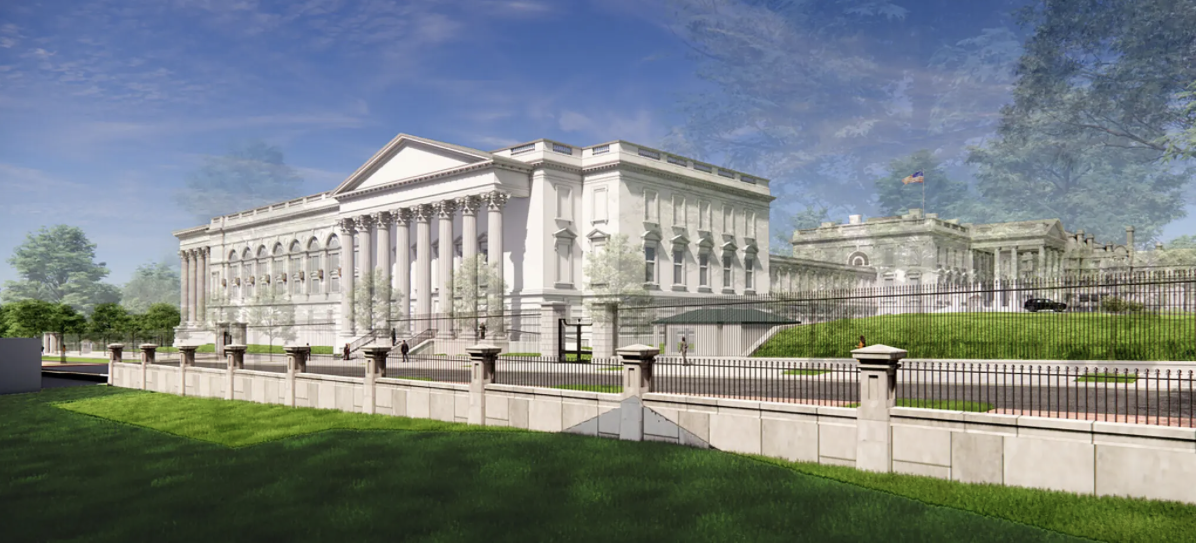
My own view is that I would probably have preferred something a little less grandiose, but basically this is not too bad. Especially when you compare it to a lot of the other federal buildings in Washington, which are positively hideous. For example, here is a picture of the FBI building:
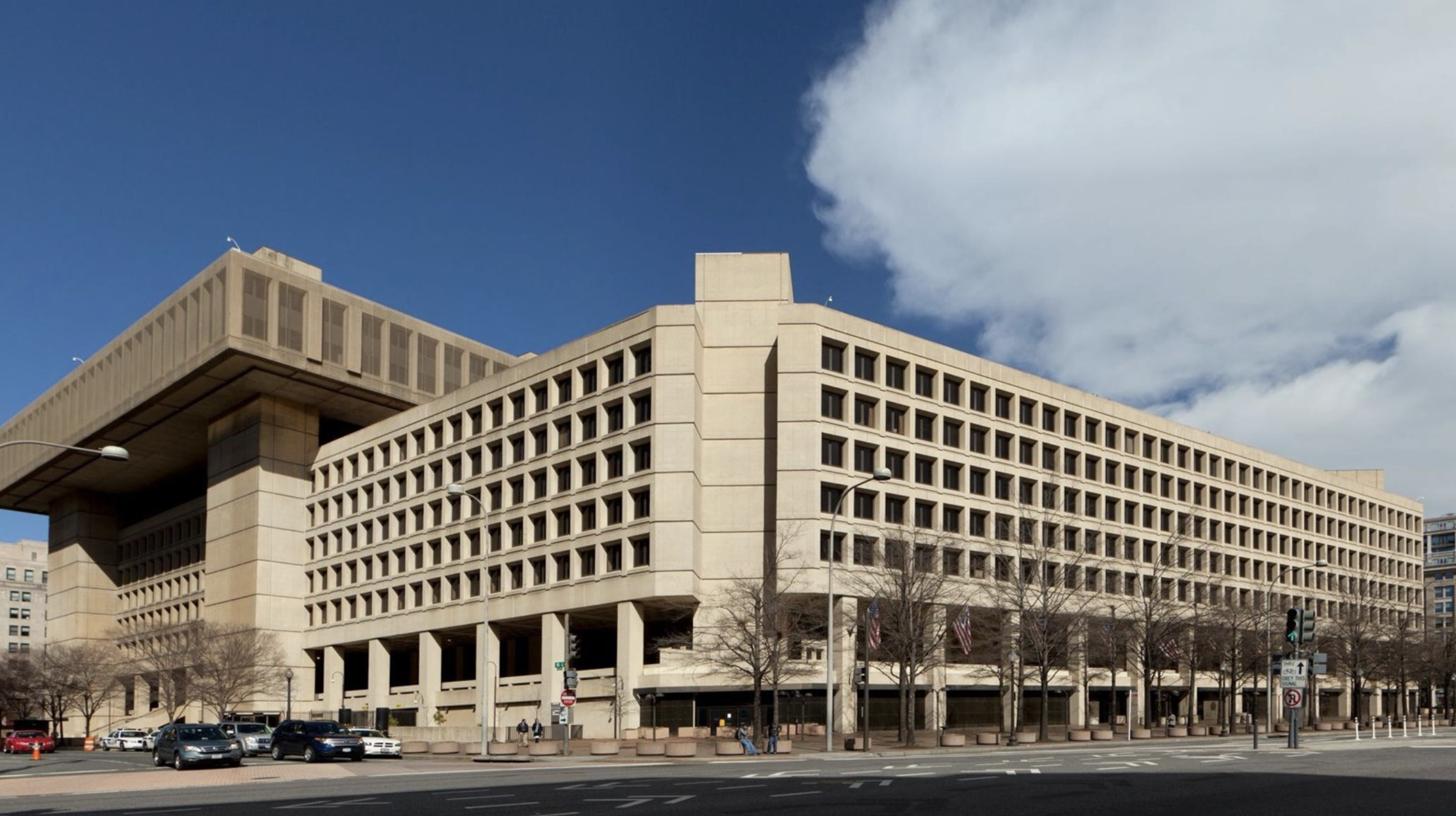
Somehow, Ms. Hoagland never saw fit to object to that one.
Anyway, with the Supreme Court’s decision in the ballroom case, the bare assertion that “I don’t like this” appears now to be insufficient to confer standing to become a federal litigant. With any luck, that will stick, and will start to move the needle on standing somewhat back toward a reasonable balance. That is a positive development.