Another Candidate For Stupidest Litigation In The Country

Last month I wrote a post on the "Stupidest Litigation In The Country," which I identified as the litigation brought in Oregon by a group of minor children seeking a nationwide injunction forcing the phase-out of all use of fossil fuels in the United States.  Admittedly it was a brash move on my part, picking this one case as the very stupidest out of many thousands without having actually reviewed all of the others.  But I did ask readers to ponder whether it was "even remotely possible that there could be any case even stupider."   

Unfortunately, shortly after that post I became aware of a group of cases filed by California municipalities in state courts out there, blaming the major oil companies (BP, Chevron, Exxon Mobil, ConocoPhillips, Royal Dutch Shell) for some collection of speculative future calamities supposedly related to "climate change."  Those lawsuits could definitely be candidates for the title of "stupidest," but I had no way to check because I don't have access to whatever filing system they may have.  Then, on January 9, New York City decided to pile on to this bandwagon by filing its own case against the same group of oil companies, this one brought in the federal court in New York.  In this case I have come up with a link to a copy of the Complaint that is not behind a pay wall.  So we can all now read this new complaint and form our own judgments.  Is this case a bona fide candidate for stupidest litigation in the country?  Yes!  

I should note at the outset that the lawyer at the New York City Law Department who signed the Complaint, one Susan Amron, is one of my former associates!  I taught her everything she knows -- not!!!  Also named as among plaintiff's counsel is ubiquitous environmental activist attorney Matthew Pawa.  (I also understand that Pawa is the eminence grise behind the California municipality lawsuits.)

In evaluating this new case, the first question you might ask is, what exactly are they trying to accomplish here?  In a civil litigation, the only things you can hope to get at the end are (1) money damages, or (2) an injunction of some sort.  If you read the Complaint, it certainly looks like money is the principal thing they are after.  ("[T]he City respectfully requests a judgment against all Defendants awarding the City: . . . 2. Compensatory damages in an amount according to proof, of the costs of actions the City is currently taking and needs to take to protect City infrastructure and property, and to protect the public health, safety, and property of its residents from the impacts of climate change.")  But then, if you have a skeptical mind, you might ask, if it's money they're after, why don't they just impose a tax on gasoline (and any other products made from oil) in an amount sufficient to generate the money they are looking for?  Oh, wait a minute, they already have that.  Well, they could double it!

If damages aren't the real goal, how about an injunction?  The Oregon children's lawsuit explicitly asks for an injunction doing away with all use of fossil fuels in the U.S.  How about demanding that, New York City, at least as to your own residents?  Don't worry, New Yorkers will never miss the light, heat, air conditioning, refrigeration, transportation, computers, etc., etc., etc.  You won't be surprised to learn that the City has stopped short of demanding that relief.  They do ask for an injunction, but only "to abate the public nuisance and trespass that would not be effective unless Defendants fail to pay the court-determined damages for the past and permanent injuries inflicted" (whatever that means).

In other words, this lawsuit makes no sense whatsoever on its own terms.  Another theory of what this lawsuit may be about was advanced by Exxon in the Petition it filed in Fort Worth, Texas state court on January 8, and which I reported on in this post on January 10.  Here is Exxon's theory:

A collection of special interests and opportunistic politicians are abusing law enforcement authority and legal process to impose their viewpoint on climate change. This conspiracy emerged out of frustration in New York, Massachusetts, and California with voters in other parts of the country and with the federal government for failing to adopt their preferred policies on climate change. But rather than focusing their efforts in the marketplace of ideas and adopting a strategy of persuasion, the members of this conspiracy chose to advance their political objectives by imposing unlawful burdens on perceived political opponents.      

It may be difficult for you to believe that your own government officials could engage in such a level of abuse of the legal process, but then, try to come up with any other explanation for what is going on here that makes any sense.

Anyway, suppose that is the explanation.  As abusive and improper as it may be, does it really qualify as "stupid"?  Maybe not by itself.  But then, look at what passes for the supposed scientific basis for what is said in this Complaint to be a claim for "nuisance" against these oil companies.  There's way too much to cover in a short blog post, but let me give you a couple of examples:

  • From paragraph 40 of the Complaint: "According to the NPCC, the expert committee convened by the City to provide scientific advice, guidance, and projections on climate change and relied upon by the City in its sustainability and resiliency efforts, climate change is already affecting New York City. The average annual temperature in New York City has increased at a rate of 0.79°F per decade over the last 30 years."  0.79 deg F per decade!  Wow!  That sounds like a lot!  But wait a minute -- they don't cite any source, or mention that there have been tremendous downward adjustments to older temperatures, nowhere more dramatic than in New York City itself.  Are they even aware of the definitive 17-part Manhattan Contrarian series, The Greatest Scientific Fraud Of All Time?  If they had read Part XVI of that series (July 19, 2017), they would know that for the very prominent measuring site at Belvedere Castle in Central Park, the official temperature records for the period 1950 to 1999 have been "adjusted" downward by a uniform 6 deg F; and then the adjustments become smaller and smaller in the more recent years to create an artificial warming trend.  Oh, wait, divide the 6 deg F downward adjustment by the 6.8 decade period and you get just about exactly the 0.79 deg F per decade that they are claiming as "warming" and trying to blame on oil companies!
  • There could not be any more discredited piece of work in climate science than the Michael Mann "hockey stick" of 1998.  They wouldn't really try to rely on that as proof of global warming, would they?  Absolutely!  There it is prominently featured in paragraph 36.  Hey, it's from "peer reviewed literature."  Is there any mention here that no one has been able to reproduce Mann's work without access to his data and code, which have never been produced in 20 years?  Any mention that Mann has refused multiple times to produce the data and code underlying this paleoclimate reconstruction, and currently is being held in contempt by a Canadian court for failing to produce same in defiance of a court order?  Any mention of the mathematical flaws in the methodology uncovered by Canadian auditors McIntyre and McKitrick? Any mention that the reconstruction relies for critical periods almost entirely on a couple of tree ring cores from trees that have been demonstrated not to reflect actual temperatures in recent years?  Of course not.  This is pseudoscience of the most transparent, and only intended for the most uninformed and gullible as its audience.

Do they mention that the world is in the process of building some 1600 new coal power plants to provide electricity to those who have previously not had it?  Do they mention that the emissions from those coal power plants will swamp any possible reductions in emissions from oil that might conceivably be achieved in our lifetimes?  Do they mention that New York State is in the process of closing down the nuclear power plant that supplies some 25% of the power to New York City, with nothing on the horizon other than fossil fuels that could possibly replace that source?  No, no and no.  Really, it's embarrassing.

Yes, definitely a strong candidate for the stupidest litigation in the country. 
What Would Happen To You If You "Lose" 50,000 Emails You Should Have Kept?

It seems that our moral betters at the FBI have now "lost" some 50,000 or so Strzok/Page texts and/or emails sent in the period of December 2016 to May 2017.  The mysterious disappearance follows a series of other well-known such disappearances, including the Lois Lerner/IRS emails and the Hillary Clinton/Benghazi emails, let alone the entire Hillary Clinton private email server said to have contained some 30,000 documents.  The Wall Street Journal yesterday quotes the FBI as attributing its latest "loss" to "misconfiguration issues related to rollouts, provisioning, and software upgrades.”  Sure.  At this point, does anyone on the planet believe a word they say?

Meanwhile, Lois Lerner retired with a full taxpayer-funded pension, Hillary is off making speeches and selling books, and Strzok continues to work for the FBI in the Human Resources Department. Prosecution?  What's that?  But perhaps you are wondering, what would happen to a non-Washington-insider like you if you had suffered a similar "loss" of emails or texts that were obviously of the highest interest to government or Congressional investigators?

For guidance, you could look to the famous story of the Arthur Andersen accounting firm.  Andersen had been the auditor for Enron.  In 2001 Enron revealed various financial problems that led to its collapse.  At a time when no subpoenas or document requests were outstanding, Andersen employees were then alleged to have shredded documents relating to the Enron audits (these were hard copy documents back in those ancient days).  Then Deputy Attorney General Larry Thompson was quoted as saying "At the time [the documents were destroyed], Andersen knew full well that these documents were relevant."  In 2002 Andersen was indicted for obstruction of justice for the document destruction.  Almost immediately the firm collapsed.  About 85,000 people -- nearly all of whom had nothing to do with the Enron audit or document shredding -- lost their jobs.  Andersen was then convicted of obstruction for the document destruction.  In 2005 the conviction was overturned by the Supreme Court, but by that time it was irrelevant -- the firm was long gone.

Or consider the case of Frank Quattrone.  During the time of the "dot com bubble" at the beginning of the millennium, he was the highest-flying investment banker on Wall Street -- the guy who took Amazon.com public!  Obviously he was a guy with a target on his back for ambitious federal prosecutors.  Here is a comprehensive write-up of the Quattrone prosecution from the Atlas Society in 2004 (sympathetic to Quattrone).  The case arose out of events in late 2000, when the "dot com" stock bubble was just starting to burst.  Federal prosecutors had begun an investigation of so-called stock "allocation" practices in the securities industry (that is, which firm gets to sell how much of a hot IPO), a subject that involved Quattrone little if at all.  Certainly, he was never charged with any substantive wrongdoing for anything relating to "allocation" practices.  But at this time, Quattrone was alleged to have authorized a colleague to send an email to his team encouraging them to use the end-of-year slow period to purge files on closed deals of things like "notes,  . . . drafts, . . . valuation analysis, . . . copies of the roadshow, . . . markups, . . . selling memos, . . . IBC or EVC memos, . . . [and] internal memos."   The specific context of the prospective file purge was not the federal investigation, but rather anticipated private lawsuits arising out of the stock price declines, none of which had in fact been commenced.  Quattrone was indicted for obstruction of justice.  His first trial ended in a hung jury, but at a second trial he was convicted, and sentenced to 18 months in jail.  However, again the Supreme Court ultimately reversed.  Needless to say, all of this threw a monkey wrench into Quattrone's previously high-flying career.

Then there's the case of Morgan Stanley.  In September 2001, its headquarters was in the World Trade Center.  When the towers collapsed, it lost large amounts of its hard-copy files, which were much more important then than today.  That's about as legitimate a reason for losing documents as you could come up with!  But not to petty and vindictive regulators.  When many litigants with claims against MS complained that MS was not producing documents, the financial industry regulator FINRA investigated.  It ultimately found that MS had substantial amounts of the missing documents on "back-up tapes" (possible to search, but only with great difficulty and expense) and imposed a fine of $12.5 million on MS

You might wonder why I'm reaching back to the early 2000s to come up with these examples.  I have looked for some more recent instances, but haven't found them.  I think that's because, in today's era, emails just don't disappear, even if you try to make them disappear.  That's certainly how my email accounts work.  Nor are major corporations, and particularly banks and securities firms, about to take any chances with this.  The default has become that everything is kept, which can be done at almost no cost, and handled by the outside providers like Google or Apple or Samsung or Verizon or AT&T or maybe all of them at the same time.  The old rule that you are allowed to destroy documents as long as they are not subject to a subpoena or document demand is long, long gone.  For a private entity -- such as you -- everything will be found, even if you have tried very hard to obliterate it.  

But the applicable rules sure do seem to be different for the government insiders, don't they?  Somehow, every time there's some collection of emails or texts of a government agency like the IRS or State Department or FBI that the public really, really would like to see, they have been "lost" through some quirk or accident.  If you believe them.  

And, by the way, for these purposes, neither President Donald Trump nor any high-ranking member of his administration should be considered a "government insider."  That designation is reserved for those who follow the official Washington, D.C. political groupthink.

Venezuela Useful Idiots Reminder

You don't see much news coming out of Venezuela these days.  The government there has stopped releasing most economic data, and then, what reporter wants to ferret out the facts by volunteering for the Venezuela beat?  But yesterday the Wall Street Journal ran a big front-page story with the latest economic news from Caracas.  Maybe you thought Venezuela had hit rock bottom a year ago, but as you will see, it has in fact gotten yet far worse.  Still, they probably have some ways to go before achieving the final end game of socialism, à la North Korea.

Today I'm going to combine some passages from the WSJ report with a reprise of a post I wrote a little over a year ago, December 2016, titled "Venezuela: Useful Idiots Roundup."   In that post I collected a good sampling of quotes from progressive idiots uttered between 2007 and 2015, each praising the great success of the Venezuela/Chavez economic model.  The quotees include the likes of Bernie Sanders (of course) and of Hillary's favorite economic advisor, Nobel Prize-winning economist Joseph Stiglitz.  Many of the quotees hold out Venezuela as a model for the U.S.  Really.  Nor have I seen a one of them later walk back their words.  They just move on to other causes and hope the whole thing will be forgotten.  In the New York Times and Washington Post and ABC/NBC/CBS/CNN/MSNBC, it will be forgotten.  But not at the Manhattan Contrarian.

The WSJ article, by Anatoly Kurmanaev and Kejal Vyas, is headlined "Venezuela's Oil Production Is Collapsing."   Start with the subject of the oil, the mainstay of the Venezuelan economy:

Crude oil production fell 12% in December from the month before, according to government figures released Thursday. Over all of 2017, output was down 29%, among the steepest national declines in recent history, driven by mismanagement and under investment at the state oil company, say industry observers and oilmen.

So what is wrong at the oil company that they can't just crank up the pumps and produce more of the stuff?  Maybe it's that socialist-style management:

The decline has been exacerbated by a management purge at state-run PdVSA by Mr. Maduro that has paralyzed the oil giant. Seventy senior managers have been jailed on graft allegations in the past three months. Generals with no industry experience have been named to run the firm.

And how's the rest of the economy doing?

Over the past four years, the country’s economy has shrunk by about 40% and inflation has surged—topping 2,600% last year, according to the National Assembly. Nearly one in four factories didn’t reopen after Christmas, according to a local industry association.

And the overall picture for the people?

Malnutrition is spreading among the young and elderly, while health officials report a resurgence of illnesses ranging from malaria to diphtheria. Meanwhile social stability is fraying. At least four people have died during outbreaks of looting in recent weeks.

By all means go to the link and read the whole thing.  Now, here's my useful idiots roundup from a year ago:

Linda Poon in Wired, April 25, 2016 (!) ("Venezuela's Economic Success Fueled Its Electricity Crisis"):

Earlier this April, . . . president [Maduro] called on women to stop using hairdryers, and to save them only for “special occasions.” He also asked citizens to hang their clothes instead of using dryers and to embrace the heat. . . .  The current crisis is essentially what [Professor Victor] Silverman [of Pomona College] calls a problem of the country’s own economic success. . . .  “The Venezuelan economy reduced poverty at one of the most rapid rates in the world, and certainly one of the most rapid rates in Latin America over the past 20 years,” he says. “That meant people had the money to buy refrigerators, air conditioners, and … hairdryers.”

Ben Norton in Salon, December 7, 2015 (!) ("13 years after failed U.S.-backed coup, right-wing opposition wins Venezuela election"):

For 17 years, the PSUV has enjoyed enormous popularity in Venezuela. Its economic and social programs drastically reduced poverty, created universal healthcare, and promoted widespread literacy and education. Compared to its Latin American neighbors, Venezuela has consistently led the region in reducing poverty.

Peter McLaren (of Chapman University) and Mike Cole (of University of East London) in Truth-Out.org, June 11, 2014 ("Austerity/Immiseration Capitalism: What Can We Learn From Venezuelan Socialism?"):

While democratic socialism may sound utopian in the European context, and positively unimaginable in the United States, there is [in Venezuela] a viable alternative to the neoliberal model in existence. It is incumbent on the left to think seriously about what can be learned from the Bolivarian revolution. That revolution can provoke us to imagine an alternative to capitalism, whether through forms of freely-associated producers planning and allocating the social wealth, syndicalist and Marxist forms of socialism, or self-governing popular assemblies or autonomous communities.

Mark Weisbrot in the Guardian, November 7, 2013, ("Sorry, Venezuela haters: his economy is not the Greece of Latin America"):

For more than a decade people opposed to the government of Venezuela have argued that its economy would implode. . . .  How frustrating it has been for them to witness only two recessions: one directly caused by the opposition's oil strike (December 2002-May 2003) and one brought on by the world recession (2009 and the first half of 2010). However, the government got control of the national oil company in 2003, and the whole decade's economic performance turned out quite well, with average annual growth of real income per person of 2.7% and poverty reduced by over half, and large gains for the majority in employment, access to health care, pensions and education.

David Sirota in Salon, May 6, 2013, "Hugo Chavez's Economic Miracle":

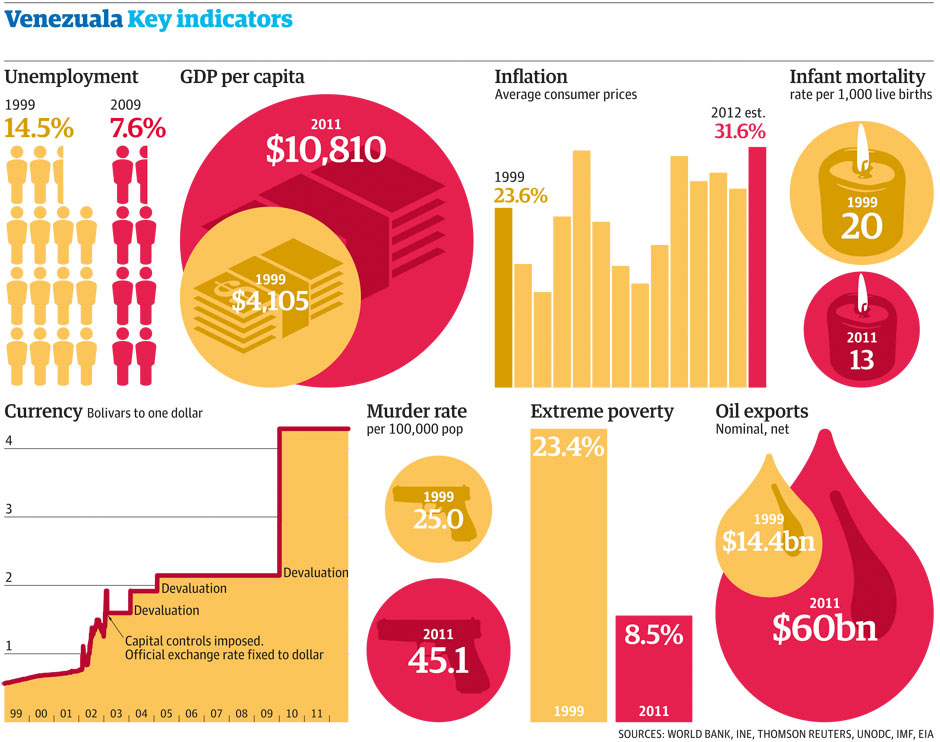
[A]ccording to data compiled by the UK Guardian, Chavez’s first decade in office saw Venezuelan GDP more than double and both infant mortality and unemployment almost halved. Then there is a remarkable graph from the World Bank that shows that under Chavez’s brand of socialism, poverty in Venezuela plummeted (the Guardian reports that its “extreme poverty” rate fell from 23.4 percent in 1999 to 8.5 percent just a decade later). . . .   Additionally, as Weisbrot points out, “college enrollment has more than doubled, millions of people have access to health care for the first time and the number of people eligible for public pensions has quadrupled.”

Richard Gott in the New Statesman, January 30, 2013 ("Hugo Chavez: Man against the world"):

[Chavez] brought hope to a continent. . . .  [H]e has not only helped to construct and project Venezuela as an interesting and important country for the first time, at ease with itself and its historical heritage, he has reimagined the continent of Latin America with a vision of what might be possible.

Sean Penn in the Huffington Post, August 5, 2011 ("A State Department That Can"):

The American people have grown accustomed to hearing the Venezuelan president referred to as a dictator, not only by media representatives but by members of the leadership in both parties. This is a defamation, not only to President Chavez, but also to the majority of Venezuelan people, poor people who have elected him president time and time again. This is not a dictator supported by the wealthy classes, but rather, a president elected by the impoverished and at the service of the Venezuelan constitution, a document not unlike our own. He is a flamboyant, passionate leader.

Bernie Sanders in Valley News (Vermont), August 5, 2011 ("Close The Gaps: Disparities That Threaten America"):

These days, the American dream is more apt to be realized in South America, in places such as Ecuador, Venezuela and Argentina, where incomes are actually more equal today than they are in the land of Horatio Alger. Who's the banana republic now?

Nobel Prize-winning economist (and economic advisor to Hillary Clinton campaign) Joseph Stiglitz, quoted in Venezuela Analysis, October 11, 2007 ("Joseph Stiglitz, in Caracas, Praises Venezuela's Economic Policies"):

Venezuela's economic growth has been very impressive in the last few years. . . .  Venezuelan President Hugo Chavez appears to have had success in bringing health and education to the people in the poor neighborhoods of Caracas, to those who previously saw few benefits of the countries oil wealth.

I have checked the links, and they are all still good.  

So how could it have been that everything seemed to be going so well for so long for the "Bolivarian Revolution," and then it all fell apart?  The short answer is that the government controls the economic statistics.  It can pretend for a decade or more that the economy is growing when it is not, generally by a combination of (1) hugely increasing government spending and counting that as a 100 cents on the dollar increase in GDP and (2) outright fraud.  When the collapse becomes too obvious to paper over any more, they just stop putting out economic information.  For a longer explanation of how the "socialist death spiral" works, see my post here.

New Jersey's New Governor About To Get Mugged By Reality

At this blog, when not commenting on events in my home town of New York, I've tended to look more toward Connecticut than New Jersey.  But New Jersey has just elected a new Governor, by the name of Phil Murphy, in the off-year 2017 election; and he took office on Tuesday.  Here is a link to his inaugural address.  So perhaps it's time for a brief look to the West.  

In terms of major aspects of public policy, New Jersey's recent history bears a great resemblance to that of Connecticut.  When I first moved to New York in 1975, New York had top combined State and New York City income tax rates approaching 19%, while New Jersey had no income tax.  New Jersey was booming.  It seemed that on a weekly basis some securities firm was announcing its move to the Jersey City waterfront, right across the river.  But New Jersey had a budget shortfall, and in 1977 then (Democrat) Governor Brendan Byrne proposed a "temporary" 2% income tax to close the gap and avoid increases in already-high property taxes.  Forty years later, the property taxes are still just as high or higher, and New Jersey still has the income tax, with the top rate all the way up to 9%.  Meanwhile, New York's top rate, including the New York City tax, has been reduced to a little under 13%, but only on income over $1 million; for income between $500,000 and $1 million, New Jersey now has less than a 2% income tax advantage over New York.  I can't remember the last time I read about a business picking up and moving to New Jersey to save on taxes.

Also during the same period, a string of mostly Democratic governors and legislatures entered into a string of wildly overgenerous pension promises to the state workforce.  (Republican Governor Christine Todd Whitman, 1994 - 2000, bears a small portion of the responsibility.)  When the budget was tight, they "solved" the problem by just skipping the pension contributions.  Today New Jersey competes with the likes of California, Illinois and Connecticut for having the most irresponsible and worst-funded public pensions.  A report out in December from the American Legislative Exchange Council put the funding level of New Jersey's public pensions (at a risk-free interest rate) at 25.6%, 46th worst among the states.  This is way, way beyond the level where miraculous increases in the stock market or hedge funds can ever bail you out, and is deep into a death spiral.

And yes, like any decent blue state, New Jersey has a seemingly perpetual budget "crisis."  As not the least part of it, it has been underpaying its required pension contributions by up to about $3 billion per year -- this on a budget of about $36 billion per year.  And New Jersey's bond rating has been cut 11 times in the past 8 years, most recently to A3 by Moody's.  Hey, it's better than Illinois's rating!

Enter new Governor Murphy.  He is a Democrat.  And what credentials!  Harvard College!  Wharton Business School!  Goldman Sachs!  This guy is really, really smart!  And he may actually be "smart" in some sense.  I'll bet he had great SATs.  However, on the record of his campaign promises, you could be forgiven for inferring that he would have difficulty adding two plus two.

I should mention that Murphy is a complete standard-issue progressive, in the mold of an Obama or a Hillary.  Perhaps not quite as far off the scale as a Sanders or a Warren.  He is facing a nearly hopeless budget situation, with an immediate need for about $3 billion per year (almost 10% of the budget) to pay for past pension promises -- payments that will deliver absolutely nothing in the way of new or better services for the people.  What to do?  So far, his answer has been a collection of totally pie-in-the-sky promises of new and additional spending that can have no possible relation to reality.  Here is a list of just some of the items from his campaign web site:

And so forth.  And then, how about my perennial favorite -- infinite oodles of fresh cash to "Combat Climate Change & Make New Jersey A National Leader in Clean Energy"?  Yes, Murphy is pledging to wipe out all use of fossil fuels by 2050 -- not just the paltry 80% reductions promised by his confrères across the river and in California:

Murphy committed, within his first 100 days in office, to starting the process of creating a new State Energy Master Plan to set New Jersey on a path to 100 percent clean energy by 2050.  

This guy -- and remember, he went to Harvard and the Wharton Business School, and worked at Goldman Sachs for decades -- actually believes, or claims to believe, that spending oodles of government money to force a switch from less expensive to more expensive sources of energy somehow makes the people richer rather than poorer:

Murphy noted that moving to a clean-energy economy would encourage innovation and create jobs, as every $1 spent on early-stage clean energy research and development generates an additional $1.60 in output from other sectors of the economy. He said his plan would maximize this potential, in large part, supporting innovation and R&D in higher education.   

And don't forget the importance of "climate justice"!

Murphy said he also would ensure that the benefits of clean energy reach all communities as a matter of environmental and economic justice.  “Too often, conversations about climate change have ignored the disproportionate impact on lower-income and politically vulnerable communities, yet the environmental concerns in these communities are staggering,” said Murphy, noting that, in Newark, as many as one in four children have asthma. “We must ensure environmental justice as a core principle.”

Once you get into this groupthink, you're just not allowed to realize that tripling the cost of energy for the poor is the opposite of "climate justice."

All this (and lots more) with a budget already hopelessly under water.  Does he have any proposal to pay for it all?  Of course, there is the usual call for higher taxes on the top 1%.  ("In New Jersey, the wealthiest 1% continue to pay a far lower share of their income in state and local taxes than the lowest-income residents. Phil strongly believes that is unacceptable in 2017.")  Good luck with that.  Here's NJ Senate President Steve Sweeney on Fox Business today basically saying that the "millionaire's tax" is not going to work any more in the wake of the federal tax reform.  OK, the only other suggestion I can find in Murphy's stuff is the bright idea of getting the pensions out of investing in hedge funds in order to save on investment fees.  That might produce about 1% of the money Murphy is looking for.

New Jersey has come to the blue state dead end.  The new Governor, living in fantasyland, doesn't realize it yet.  Maybe he never will.  But he is about to get mugged by reality.  Meanwhile, his state will continue its long-term relative decline.  Maybe the voters will just keep voting for more and more of the free stuff while the decline continues and accelerates.

Surprise: Progressive "Anti-Poverty" Programs Increase Measured Poverty

The Sunday Los Angeles Times on January 14 published an op-ed titled "Why Is Liberal California the Poverty Capital of America?"  The author is Kerry Jackson of the Pacific Research Institute.  I have seen the article picked up and/or cited at many locations.  

Mr. Jackson notes that liberal California -- home to more and more generous welfare and "anti-poverty" programs than just about anywhere else in the country -- somehow comes out with the very highest measured "poverty" rate of all the 50 states.

Guess which state has the highest poverty rate in the country? Not Mississippi, New Mexico, or West Virginia, but California, where nearly one out of five residents is poor.

Funny, isn't it?  Here at Manhattan Contrarian, my focus is more on my home turf of New York, but we have exactly the same phenomenon:  far more and more generous welfare and "anti-poverty" programs than other places, and yet a higher measured "poverty" rate.  The New York City official poverty rate was 18.9% for 2016, the latest year available.  the official full-U.S. rate for the same year was only 12.7%.  How could the most progressive places, the places that do the very, very most to "fix" poverty, end up with far more poverty as the government measures and defines it than those other places that do far, far less?

Here is Mr. Jackson's take:

[Despite the welfare reform of the 1990s] the state and local bureaucracies that implement California's antipoverty programs . . . resisted pro-work reforms. In fact, California recipients of state aid receive a disproportionately large share of it in no-strings-attached cash disbursements. It's as though welfare reform passed California by, leaving a dependency trap in place. Immigrants are falling into it: 55% of immigrant families in the state get some kind of means-tested benefits, compared with just 30% of natives.

Self-interest in the social-services community may be at fault. As economist William A. Niskanen explained back in 1971, public agencies seek to maximize their budgets, through which they acquire increased power, status, comfort and security. To keep growing its budget, and hence its power, a welfare bureaucracy has an incentive to expand its "customer" base. With 883,000 full-time-equivalent state and local employees in 2014, California has an enormous bureaucracy. Many work in social services, and many would lose their jobs if the typical welfare client were to move off the welfare rolls.

Well, first, I would like to welcome Mr. Kerry Jackson and the Pacific Research Institute to the small band of people in this country who have been pointing out the shocking counter-productiveness of our "anti-poverty" programs.  Also, Mr. Jackson makes some good points.  However, he is much too nice.

Self-interest in the social-services community "may be" at fault?  I'm sorry, but a far more accurate statement is that the whole idea of government anti-poverty programs is to increase measured poverty and make absolutely 100% sure that it can never go down.  If that were not the case, it would be completely impossible for the U.S. as a country to spend in excess of $1 trillion each year on "anti-poverty" efforts, year in and year out, and never see the rate of poverty decline by even a smidgeon.  And, indeed, go up in very the places that spend disproportionally large amounts of the money.

If you are somehow thinking that the "social-services community" can't possibly be that venal and cynical, I'll just give you a couple of points to ponder:

  • Nearly all "anti-poverty" handouts are provided to the beneficiaries either as in-kind distributions (housing assistance, food stamps, other nutrition programs, Medicaid, cell phones, clothing assistance, energy assistance) or as refundable tax credits (EITC).  But the official poverty measure only counts "cash income" in the definition, and therefore excludes all of these things.  A given family could get $100,000 or more per year in the in-kind benefits and tax credits (and many do, such as those here in Manhattan, where a spot in public housing in a desirable location can by itself be worth over $100,000 per year), and still be counted as "in poverty."
  • When critics demanded that the in-kind handouts and tax benefits be counted, the bureaucrats came up with an alternative so-called "Supplemental Measure" of poverty.  The Supplemental Measure does count most of the in-kind handouts, but at the same time it does away with any absolute standard of poverty, and substitutes a relative standard that keeps going up as the country as a whole becomes wealthier.  Today, the government reports both numbers.  (Note that the measure that Mr. Jackson cites in his article about California is the Supplemental Measure of poverty, rather than the traditional one.  Funny, but the two numbers are about the same.  Reverse engineering by cynical bureaucrats?  Definitely!)  Anyway, think about the Supplemental Measure for two minutes, and you will realize that the whole idea of a relative rather than absolute measure of poverty is to keep it from going down as the country gets richer.

What, were you expecting that hundreds of thousands of bureaucrats, given a trillion annual dollars to "fix" the problem of poverty, would come back after a year or two and say, "Problem solved, we fixed it.  We don't need the money any more, so go ahead and zero out our budget and we'll go off and work on solving something else"?  Of course, that has never happened in the history of government problem solving.

There is a serious collateral consequence of this situation.  As Mr. Jackson points out, the social service bureaucrats need the poor to remain poor in order for the budgets and the spending to continue at current levels and increase.  They have a tremendous incentive to trap the poor into dependency and keep them there as long as possible.  This is a huge problem in this country that needs far more attention.     

Climate Science And The Process Of Orthodoxy Enforcement

Recently several of my posts on the subject of climate change -- including one last week titled "In Climate Science, Predictions Are Hard, Especially About The  Future" -- have attracted large numbers of comments.  Most of the comments have been supportive, but many have been critical -- which is not surprising.  Among the critical comments, several of the most thoughtful have raised similar questions, that go something like this:  If there is really nothing to this global warming scare, then how and why have so many people calling themselves climate scientists gotten together to conspire to promote this story to the public?  After all, how would such a conspiracy even work?  Do hundreds of them hold clandestine meetings where they recognize each other with some kind of secret handshake?

As examples of relatively balanced comments raising this point, there are two from a guy named Steven Wangsness.  Excerpts:

What I want to know is why 95 percent or more of the world's climate scientists, most of whom drive gasoline-driven cars and probably own oil stocks in their 401Ks and IRAs, are engaged in a massive, world-wide conspiracy to push the idea of global warming. What is the incentive for all these presumably normal, well-educated folks to engage in such a pernicious hoax? . . .  

You also assume that thousands of PhDs around the world are engaged in a massive conspiracy and not one of them has broken ranks and busted the hoax.     

It just seems implausible to Mr. Wangsness, and many others, that such a "conspiracy" could be formed.  And perhaps, if thought of as a conspiracy, they are right.  But now think about the processes by which orthodoxies are created and enforced.  There are many, many examples in human affairs of large numbers of people -- even into the billions -- agreeing on the precise details of a complex belief system, otherwise known as an orthodoxy.  What processes lead to such huge numbers of people to enter into such an agreement?  Clearly part of the process relates to specific rewards and punishments handed out by the people who run the orthodoxy system.  But I would suggest that a far bigger part of what makes orthodoxies work is the universal human desire for peer acceptance.  If you don't go along with our official belief system, we will ostracize you!

Consider what is undoubtedly the archetypical example of a strictly-enforced orthodoxy system, namely the Catholic Church.  As background, I should mention that I was raised as a Catholic.  I continue to have large numbers of friends who are practicing Catholics, and I respect them both as people and for their beliefs.  I also have great respect for the Catholic Church as an institution (less so for its current head).  I do not regard Catholics as stupid or evil for having signed on to the Church's orthodoxy.  But, here we have a perfectly clear and, you will have to admit, somewhat quirky orthodoxy to which some 1.2 billion people have subscribed in great detail.

The bishops of the early Catholic Church gathered in 325 AD in the city of Nicaea, and agreed upon something called the Creed that states the fundamental beliefs of the religion.  With some minor modifications made in later years (mostly in 384 AD), every Catholic recites this list of beliefs at every mass, under the leadership of a priest.  Do they really all deeply believe every detail of this statement?  They certainly say that they do, at least once a week.  It's a basic requirement of being a practicing Catholic.  

For those who are not Catholics, I'll give you some examples of what's in the Creed.  I'm including the relevant Latin text, as well as the English translation:

  • "I believe in one God."  (Credo in unum Deum.).  This is a monotheistic religion.  
  • Oh, but it is one God in three persons, the Holy Trinity -- Father, Son and Holy Spirit.  Is this a contradiction?  We all agree that it is not.
  • The Son was initially "born of the Father" (ex patre natum) at a time "before all ages" (ante omnia saecula), by a process described as "begotten not made" (genitum non factum).
  • Later, the Son "became flesh" (incarnatus est) by a process in which the Holy Spirit impregnated a virgin (de Spiritu Sanctu ex Maria Virgine).
  • The Holy Spirit "proceeds" not just from the Father, but also from the Son (Et in Spiritum Sanctum . . . qui ex Patre Filioque procedit).  The business about the Holy Spirit proceeding "also [from] the Son" (Filoque) is the basis of the rift between Roman Catholicism and the Eastern Orthodox religions.  The Eastern guys insisted that the Holy Spirit "proceeded" only from the Father.    

There are plenty of other items.  Does every Catholic actually fully understand and believe each of these precepts?  It doesn't really matter.  In return for regularly expressing these beliefs, they get to participate in the religion, which includes being part of a community of family, friends and peers, of ceremonies and sacraments, and of a promise of a happy afterlife.  The rewards are almost entire mental and spiritual, rather than material.  And on that basis some 1.2 billion people subscribe.  In the case of priests, adherence to the orthodoxy is further enforced by a hierarchy that controls access to the jobs, as well as promotions to positions of Monsignor, Bishop, Archbishop, and so forth.  If you demand a change to the Creed, you can't be a priest, period.

The Catholic Church is just one example of a detailed orthodoxy subscribed to by a huge number of people.  The Islamic religion is another example of comparable size, although I don't know the details of what they have agreed to as their orthodoxy.

Now apply the principles of orthodoxy creation and enforcement to the field of "climate science."  A commenter responding to Wangsness made this point:  "The answer is simple. Follow the money."  I'm not saying there's nothing to that, but note that in the case of the Catholic Church (and for that matter Islam and any other religion) money has little to nothing to do with why people subscribe; and yet huge numbers do.  The main factor is peer pressure and acceptance; the second major factor is the forcible exclusion of heretics.  So consider what surrounds you if you want to be in the field of "climate science" today:

  • In order even to start out, you need to get a job at an academic institution.  If you let it be known that you are even slightly skeptical about "climate science," you get branded as a heretic, and in all likelihood you will never get hired.
  • To advance in academia, you need to get articles published in prestigious academic journals.  The most prestigious journals in the fields of science are Science and Nature.  In recent years those journals have been controlled by global warming zealots who have made it their business to be sure that no even slightly skeptical article in the climate field can see the light of day.  From 2013 to 2016 the editor of Science was one Marcia McNutt.  McNutt published an editorial in her magazine in 2015 that said about climate science: "The time for debate has ended. Action is urgently needed. . . .  [D]eveloped nations need to reduce their per-capita fossil fuel emissions even further. . . ."   In 2016 McNutt was elected as the head of the National Academies of Science. As a young, skeptical climate scientist, how are you going to buck this?
  • For more examples of ruthless orthodoxy enforcement as to climate change in the academic world, see my posts here and here.

But here's the amazing thing:  given the relentless peer pressure to conform in climate science, and the ruthless exclusion of heretics from rights to publish and from awards and recognition in the field, in fact the level of subscription to the climate orthodoxy among people in relevant areas is far less than the 95% that Mr. Wangsness cites.  The frequently-made claim of a "97% consensus" among climate scientists famously originated in an article by Cook, et al., in 2013, that was then quickly debunked in multiple places, for example here and here.  

When Wangsness says that "not one of them has broken ranks and busted the hoax," he is wrong.  There are scores of top scientists in relevant fields like atmospheric physics and meteorology who have broken ranks and scream as loudly as they can on a daily basis that there is nothing behind this alarm.  Just last October I was involved in submitting a letter to EPA from 65 top scientists demanding a reconsideration of EPA's "Endangerment Finding" because of lack of scientific basis for climate alarm.  The list of skeptics among the very top people in physics includes the likes of Freeman Dyson ("My first heresy says that all the fuss about global warming is grossly exaggerated. Here I am opposing the holy brotherhood of climate model experts and the crowd of deluded citizens who believe the numbers predicted by the computer models.") and Will Happer of Princeton, Richard Lindzen of MIT, and Ivar Giaever of RPI.  It is truly an embarrassment to the profession of journalism that a relatively well-informed citizen like Mr. Wangsness can be unaware of this.