New York "Climate" Policy Approaching The Cliff
/For a few years now, it has been blindingly obvious that New York had over-promised and over-committed on impossible “climate” goals that could not be achieved. In various posts I have referred to this as an approaching “cliff,” or perhaps as the “green energy wall.” It has been entertaining to ponder what the final disaster might look like.
This week has had a lot of developments. Most interesting is the growing split among the governing Democrats between, on the one hand, those who see disaster coming and are looking for some kind of graceful exit and, on the other hand, those pushing full speed ahead to go over the cliff. It may already be too late for New York to have any graceful exit from its self-inflicted predicament. Nevertheless, my official position is that I am advocating for New York to take the most graceful possible exit while it still can. But I have to admit that secretly I am hoping for the most aggressive advocates to get their way and take New York over the cliff. Hey, I’ll wait out the blackouts somewhere else, and maybe a critical mass of the voters will finally wake up.
So let me just give you some straight reporting on the latest developments.
As background, we are in the thick of budget season in New York State, with a final budget due to be enacted by April 1. The Governor is in the midst of negotiations with the two houses of the State Legislature. In recent years it has become common for the most important legislation in the year to get wrapped somehow into the budget; and the legislative situation with respect to “climate” mandates is undoubtedly important. So while it might at first seem that climate and energy legislation is extraneous to the budget, it is now inherently a part of the budget process.
Looming out there we have the so-called Climate Leadership and Community Protection Act (CLCPA) of 2019. The CLCPA sets incrementally tightening statutory mandates for achieving “net zero” by 2050. First up is a mandate for 70% of electricity from “renewables” by 2030. Also mandated is what they call the “cap and invest” program, under which large emitters must buy allowances if they wish to continue emitting, and the allowances become scarcer and more expensive with passing years. The CLCPA had a deadline of January 1, 2024 for the State to issue regulations to implement the cap and invest program, but the State blew off the deadline. Environmental activists sued to force the issuance of the regulations, and a court granted an injunction. But the State has appealed, and has taken advantage of the right to an automatic stay. So for now the deadline for these regulations is on hold. However, the statute is clear that the regulations must be issued, and a ruling from the appeals court will come in a few months. In other words, it is unlikely that this game can go on much longer.
Into this mix on February 26 there dropped a three-page memo from Doreen Harris to the State’s Operations Director, Jackie Bray, with the subject line “Likely Costs of CLCPA Compliance.” Doreen Harris is President and CEO of an agency called the New York State Energy Research and Development Agency (NYSERDA) — the agency that is supposedly leading our glorious transition to green energy. Readers of this blog may remember that in November 2023 I attended a confab which I named the “Krazy Klimate Konference,” where Ms. Harris had given the keynote address. I took the following picture of Ms. Harris as she began her address.
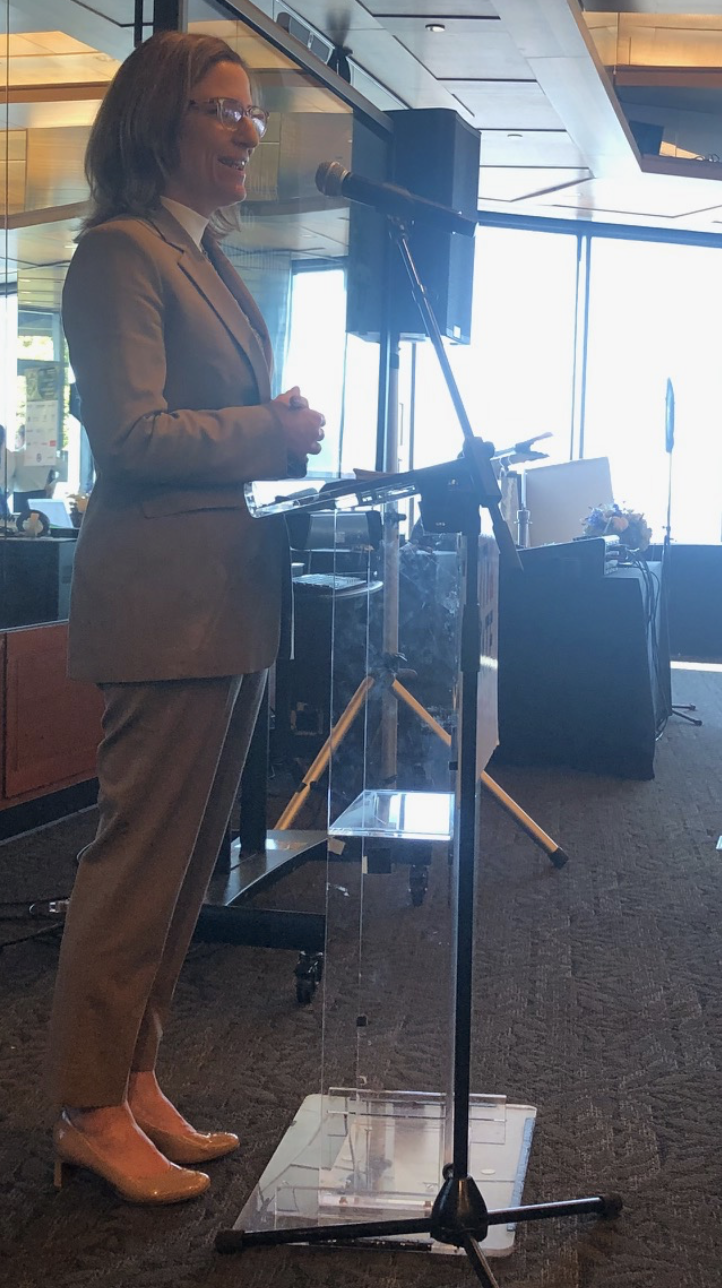
Before going farther on the latest memo, it will be worthwhile to recall what I had to say about Ms. Harris and her address at the time:
[The Konference] was essentially all mindless happy talk. . . . As I took the picture, Ms. Harris was uttering the words “I co-chaired our Climate Action Council.” That’s the Council that last December issued the so-called “Scoping Plan” telling us how to achieve carbon-free energy — a “Scoping Plan” that in 700 or so pages couldn’t even figure out that energy storage needs to be measured in watt-hours rather than watts. To an endeavor that cries out for hard-headed engineering expertise, Ms. Harris brings a head full of air. Here are a few scattered excerpts that give the flavor of her presentation: “We are leading the nation. . . . We see industry responding in an extraordinary way. . . . There are near term challenges [no mention of what those might be]. . . . We’re looking at a massive build-out of the grid. . . . We need lots of wind and solar. . . . We have a 10-point plan to see these challenges through. . . .”
Well, it seems that in the intervening two and a half years, Ms. Harris has discovered that there are costs associated with this energy transition. Or, at least, she has discovered some of the costs. Her memo in particular contains figures from some modeling done by NYSERDA as to how much the “cap and invest” program, should it be implemented, is likely to drive up the costs of oil and gas in New York State. This introductory paragraph is highlighted in Ms. Harris’s memo:
Absent changes, by 2031, the impact of CLCPA on the price of gasoline could reach or exceed $2.23/gallon on top of current prices at that time; the cost for an MMBtu of natural gas $16.96; and comparable increases to other fuels. Upstate oil and natural gas households would see costs in excess of $4,000 a year and New York City natural gas households could anticipate annual gross costs of $2,300. Only a portion of these costs could be offset by current policy design.
Those numbers should certainly be enough to get someone’s attention. The “cap and invest” program, after all, is nothing more than an arbitrary system to create artificial scarcity to drive up prices of fossil fuel energy in order to reduce consumption. It’s just intentional impoverishment of the people. Who ever thought this could be a good idea? The projected incremental cost of gasoline here would represent a near 70% increase from a current average price of about $3.25/gallon; and the incremental natural gas price of almost $17/MMBtu would represent more than a 500% increase over the current price of around $3.20.
And dare we tell Ms. Harris that these incremental costs are only a small fraction of the vast agglomeration of extra costs that the CLCPA would seek to inflict on New Yorkers. Her memo contains no mention of incremental costs for things like building a second system of electricity generation from wind and sun without being able to get rid of any of the fossil fuel generation; for additional transmission; for overbuilding; for grid-scale battery storage; and on and on. Elsewhere I have estimated that these things together could raise the cost of electricity for New Yorkers by a factor of ten or more.
Ms. Harris’s memo then drew a prompt and sharp response, dated March 5, from a group of some 29 Democratic State Senators. The Democrats hold a big majority in the State Senate, and this 29 represents about 2/3 of them — but still just short of a majority in the 63 member body. These people are all serious advocates, and also seriously innumerate. They don’t want anyone going wobbly on the CLCPA commitments. Excerpt:
[W]e, the undersigned senators, categorically oppose any effort to rollback New York's nation-leading climate law, the Climate Leadership and Community Protection Act, and urge you to stand strong in the face of misinformation that seeks to blame the CLCPA for the energy affordability crisis that fossil fuels have created.
To these ideologically committed State Senators, it is obvious that the issues of energy affordability are entirely the fault of the evil fossil fuel companies, notwithstanding the fact that the states with the biggest pushes for “renewables” (California, New York) have the highest electricity prices. Again from the letter:
In reality, rolling back the CLCPA will not save our constituents money because it is not the cause of increasing costs. It is the fossil fuel status quo that has created the affordability crisis New Yorkers are now suffering from, and it is bold action to deliver renewable energy and energy efficiency that will give them relief, saving money for individuals in the immediate-term and for all utility customers in the medium- and long-term.
They are completely delusional. However, nothing but an actual disaster, if that, will ever convince them that they were wrong. We have to recognize that if we successfully take a somewhat graceful off-ramp from the green energy delusion, these people will go on believing that the CLCPA would have worked if only it was really tried. (Like Socialism.). So maybe we are better off going off the cliff.