Could There Be Any Idea More Ignorant Than Government-Run Grocery Stores?
/When I consider our new Mayor Mamdani and his legions of committed followers, the thought I can’t get away from is “How is it possible to be this ignorant?”
Right now here in New York, Mamdani is moving forward with his plan to open a chain of government-owned grocery stores, at least one for each of our five boroughs. The underlying concept is that groceries have become too expensive for low income people to buy, undoubtedly due to evil capitalists siphoning off vast profits somewhere in the system. In the latest iteration of his proposal, Mamdani has said that the government stores will sell “basic” products like bread, milk and eggs at “guaranteed cheaper” prices. From the New York Post, April 14:
“When it comes to the products that we will be selling at the city-run grocery stores, there will be an essential basket of goods that will be guaranteed a cheaper price, and cheaper than what they’re being sold at currently,” Mamdani said during a news conference at La Marqueta in Harlem.
And yet, in the collection of real world evidence that has been accumulated over the last 100 years or so as to whether socialism can ever work, there is no case of more overwhelming evidence of socialism’s failure than the case of grocery stores. Do Mamdani and his sycophants not know about this?
The Soviet Union was famous for its sad empty grocery stores, often with little or even no inventory, and long lines that would form every time there was a rumor that some food would be available. This was universally known (among those who paid attention) to be the case into the 1980s, going on seventy years since the Communist state had been formed on the promise of abundance for all.
In 1989 Boris Yeltsin — then a rising star in Soviet politics and a new member of the Politburo, just as the state was beginning to fall apart — made a trip to Houston, Texas. The main purpose of the trip was to visit the Johnson Space Center, but somehow Yeltsin made an impromptu visit to a Randall’s supermarket. Pictures of that visit were widely circulated at the time. Here is one:
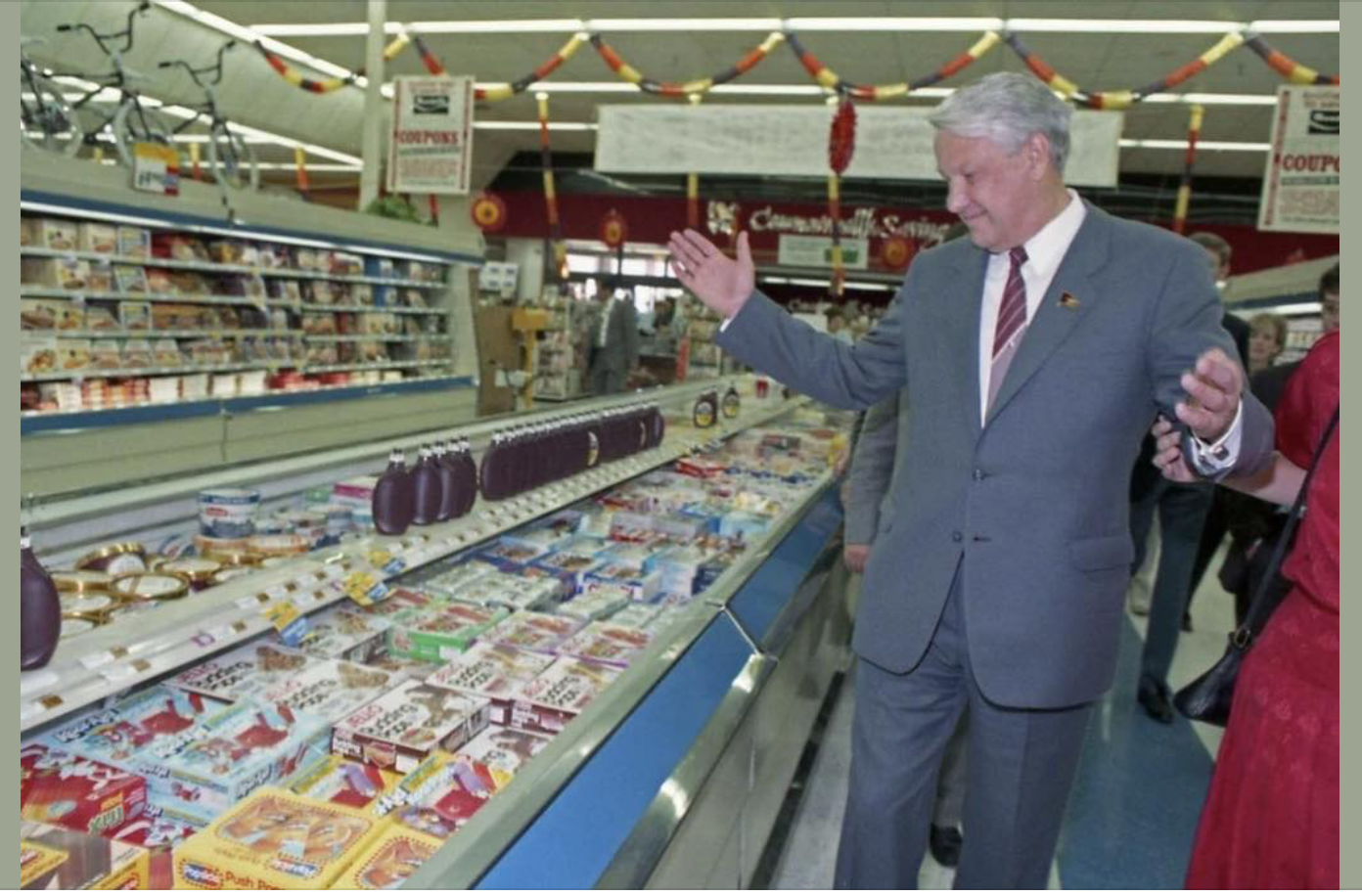
In his autobiography “Against the Grain” published the next year (1990), Yeltsin wrote:
“When I saw those shelves crammed with hundreds, thousands of cans, cartons and goods of every possible sort, for the first time I felt quite frankly sick with despair for the Soviet people. . . . That such a potentially super-rich country as ours has been brought to a state of such poverty! It is terrible to think of it.”
OK, Mamdani was born in 1991. But can he just maintain complete ignorance about everything that happened before that year, even universally-known things that happened just two years previously?
And it’s not like the phenomenon of empty grocery stores in socialist countries has gone away. Look around on the internet, and there are hundreds upon hundreds of images available of empty grocery store shelves in socialist paradises like Cuba and Venezuela. But even that’s nothing compared to North Korea, where they have periodic famine years where hundreds of thousands of people (or maybe it’s millions) starve to death.
It’s no mystery why goods disappear from grocery store shelves when the prices are subsidized. As soon as goods are being sold for below-market prices, then everybody who works in the system can enrich themselves by buying at the subsidized prices (before the public gets a chance) and re-selling on a black market. All the store clerks, delivery people, cashiers, shelf stockers, and so forth, get to the goods before the public can, and the goods disappear. The system insiders then consume the goods themselves, or sell to their friends. This is natural human behavior, and nobody has yet figured out a way to stop it. Mamdani won’t do better than anyone else.
For more on this subject, I recommend my post from August 2016 titled “Why Capitalism Works And Socialism Doesn’t: Arbitrage.” Excerpt:
If you can buy something cheaply and immediately turn around and sell it for more, chances are you will do it. Why shouldn't you? Is there something wrong with that? This is completely normal and pervasive human behavior. This behavior is also a source of a very large percentage of the wealth in wealthy countries where such behavior is permitted. It is also the reason why, in market economies, comparable things almost always trade for very comparable prices.
It goes on from there. I would recommend the piece to Mamdani, but of course he won’t read it.