Today's Entry In The Fight To Preserve All Government Spending Everywhere

As reported here on Friday, the battle is on to protect every last dollar of government spending everywhere.  Tomorrow President Trump will make his first speech to a joint session of Congress.  The buzz is that much of the speech will be about major spending cuts in certain departments.  How to head this off?

At the New York Times, today's contribution is a big unsigned editorial about the travails of Kansas, headline "Kansas' Trickle-Down Flood of Red Ink."  The gist is that the state of Kansas has already tried this ridiculous idea that tax cuts can spur economic growth, and all it has to show for the effort is a big $1.2 billion two-year projected budget deficit -- a "flood of red ink."  Tax cuts are a proven failure!  The editorial reports on the recent noble efforts of some Kansas legislators to close the budget gap by undoing tax cuts dating from 2012-13, an effort just now thwarted by a veto from Governor Sam Brownback.  As usual for a Times editorial, it drips with scorn for the idiots who think that tax cuts might ever be a good idea.  Excerpt:

[Kansas Governor Brownback] made his state an experimental showcase for the driving philosophy of supply-side theorists like Paul Ryan, the House speaker, who served as a staff acolyte when Mr. Brownback was in the Senate. . . .  The result [in the Kansas legislature] was less a victory for Mr. Brownback than a rebuke to his leadership, in particular his near-suicidal clinging to his trickle-down obsession when he should be engineering a compromise with the Legislature. Kansas faces a $1.2 billion budget gap across the next two years that must be dealt with.

Somehow though, in the editorial and elsewhere in this edition of the rag, the Times does not mention anything about our neighboring state of Connecticut, or how it is doing relative to Kansas.  I'm not saying they have to, but then, Connecticut is a state quite similar to Kansas in some respects.  For example, the population of Kansas is just under 3 million, while Connecticut's is just under 3.6 million.  However, Connecticut's state budget, at about $20.5 billion (about $5900 per capita) is noticeably higher than that of Kansas, which is about  $16 billion (about $5300 per capita).  

Kansas and Connecticut in recent years have adopted opposite approaches to dealing with the demands of government constituencies for more spending.  In Kansas, as the Times notes, there have been income tax cuts.  Until 2013, there was a top rate of 6.25%, but the cuts at that time lowered the rate to 4.9%, and also put into effect further scheduled cuts.  The top rate for 2017 is 4.6%.  The Times attributes Kansas' projected deficit of $1.2 billion to those cuts.  In Connecticut, top income tax rates have only gone up.  The Connecticut income tax only began in 1992, at a top rate of 1.5%; the most recent increase was from 6.7% to 6.99% in 2015.

So how have the ever-increasing income tax rates done in ending Connecticut's budget deficits?  According to the Connecticut Mirror from November, "nonpartisan analysts" who had been given a look at Connecticut's numbers were projecting a deficit of $1.5 billion for 2017, and $1.8 billion for 2018 -- a total of $3.3 billion over the two years.  That's close to triple Kansas' projected deficits over the same period.  Funny that Pravda doesn't mention this.  (I'm old enough to remember when in 1991 then Connecticut Governor Lowell Weicker pitched his 1.5% income tax as a temporary measure to deal with a one-time budget "emergency.")

Meanwhile, how is Kansas faring versus Connecticut in the area of economic growth?  I would preface this by pointing out that the effects of either good economic policy or bad take effect slowly and can only be noticed over a number of years.  For an example on the "bad" side, note that Venezuela was reporting an economic "miracle" of spectacular growth as late as 2013, some 15 years after the ascendancy of Chavez, supposedly as a result of blowout government spending of the socialist regime.  Then the bottom fell out.  On the reverse side, Kansas' income tax cut of 1.65% over several years is not nothing, but is relatively small when viewed against a federal top rate of about 39% that applies nationwide.  Gov. Brownback has rather exaggerated his case by calling the cuts "revolutionary" at some times (although perhaps it is the direction of the change, rather than the magnitude, that he is referring to).  Anyway, can we find anything noticeable in the numbers?  In summary, not much.

The unemployment rate from the U.S. Labor Department for Kansas for December 2016 was 4.2%.  For Connecticut it was 4.4%.  (Not a big deal.)  A chart from the federal Bureau of Labor Statistics here shows that Kansas gained about 60,000 jobs from 2012 to 2016 (on a base of about 1.4 million), but then promptly lost about 30,000 of them back in 2016.  That loss of 30,000 jobs came without any noticeable increase in the unemployment rate.  Was it even real, versus a quirk of the statistics?  A chart here from the Connecticut Department of Numbers shows Connecticut employment growing about 40,000 from 2012 to 2016 on the employer survey.  Overall, on these two measures, the results of Kansas and Connecticut over the past few years cannot really be distinguished.

On the other hand, I would point out that the state of Connecticut was booming back in the 70s and 80s, when New York income taxes were higher than they are today and Connecticut had no income tax at all.  Then Connecticut put in the income tax in 1992, and they have had essentially no job growth at all in the 25 years since.  Moreover, in the most recent three years, Connecticut has seen population declines.  There could be other causes for this kind of long-term stagnation, but the ever-increasing income tax stands out as a major one.  The other big ones are aggressive public sector unions and an associated massive pension debt.  Is this what the New York Times would recommend for Kansas?  And how about for the federal government?

UPDATE, March 1:  In the comments, mvs4000 suggests comparing real GDP growth of Kansas versus Connecticut from economic data published by the St. Louis Fed.  For those interested, the answers are:  Connecticut real GDP for 2012 was $228.2 billion, and for 2015 (latest) $225.5 billion, a decline of $2.7 billion, or 1.2% over those three years.  Kansas real GDP went from $131.3 billion in 2012 to $134.3 billion in 2015, growth of 2.2% in three years.  Not great, but hey, way better than Connecticut.  Also, as Michael Moran points out in the comments, two of Kansas' main industries, energy and agriculture, had downturns in the period; Connecticut does not have the same excuse.  Out there in the rest of the states, there is not a perfect correlation between top income tax rates and economic growth, at least in this particular relatively short window, but there definitely is a general trend in favor of the lower-tax states.  Highest-tax California saw respectable growth over the same 2012-15 period of 10.5% ($2,013.6 billion to $2,225.4 billion), while next-highest-tax New York saw not-so-respectable growth of only 1.8% ($1,231.8 billion to $1,254.8 billion).  At the other end of the tax scale, zero income tax Texas had growth of 15.2% ($1,310.5 billion to $1,509.8 billion) -- and that's even with the collapse of oil prices in 2014-15.  Zero income tax Florida had growth of 9.0% ($729.4 billion to $795.0 billion).  If you want to check out any other states, go to fred.stlouisfed.org.

What It Takes To Cut The Government Even A Little

I do not disagree with the proposition that political debate in the United States has become as polarized as at any time in my life.  But, as I have observed on multiple occasions, severe polarization is the inevitable result of the rise -- finally! -- of a movement seeking significant reduction in the role of the federal government.  There is no obvious "compromise" between the basic principle of the progressive left, which is that government can and should solve all of the personal problems of the people with government taxing, spending and regulation, and the basic principle of the economic right, which is that government is incapable of solving the personal problems of the people and only makes things worse when it tries.  The one principle says that the government should grow, and the other says that it should shrink.  

What's the "compromise"?  Certainly, neither side finds it acceptable to leave everything as is, in permanent stasis.  The progressive left has a long list of new and expanded spending and regulatory programs that it proposes in order to fix every last personal problem and eliminate all downside risk of life:  more anti-poverty spending (the current $1 trillion per year being woefully inadequate), "green" energy subsidies and "clean power" regulations to "save the planet," single payer health care, free college, free childcare, etc., etc.  We just need to muster the political will to get it done!  The right has a similar list of spending and regulatory programs to be cut or even eliminated:  Obamacare subsidies, "green" energy subsidies and regulations, Dodd-Frank financial regulation, education subsidies to failing unionized schools, public and "affordable" housing subsidies, the national endowments, and plenty more.

Always before the issue on the table was how much the government would grow; the "compromise" was that it would grow a little slower than the left wanted, and some of the new programs would have to wait for a few years.  Now, we have advisor to the President Steve Bannon saying at the CPAC conference yesterday that the administration plans to begin a "deconstruction of the administrative state."  What?  In an era of shrinkage of the government's role, do you actually expect progressives to sign on to a "compromise" to shrink things, but just a little slower?  The whole concept challenges the very legitimacy of their enterprise.

For an analogy, consider the long-deceased Soviet dictator Leonid Brezhnev.  I guess a good half of the population is too young to have personal memory of him.  Here is a picture:

This guy ruled the Soviet Union with an iron hand from 1964 to 1982.  He had plenty of time to award himself gazillions of medals and honors!  For everybody else in the Soviet realm, it was a long period of stagnation and decline, not to mention repression.  Brezhnev is most famous for the "Brezhnev Doctrine," which held that any piece of territory once in communist hands must forever after remain in communist hands.  The underlying rationale was obvious, although it generally went unstated:  if any piece of territory, no matter how seemingly small or insignificant, were to leave the communist sphere, that would call into question the fundamental legitimacy of the whole project.  And if that ever happened, the entire house of cards could collapse very quickly.  In the end, that is exactly what happened.  From the fall of the Berlin Wall in November 1989 to the final collapse of the Soviet Union in December 1991 was barely over two years.  Right up until the final collapse, there was no possibility of "compromise."

And that, I suggest, is exactly what is going on with the crazed resistance of the left to the new Trump administration.  He's hardly done anything yet!  Why the insanity?  The lead article in the New York Times today describes the demands from the Democratic Party "base" for "all-out war" against the Trump administration:

Democratic Party leaders will gather in two cities this weekend to plot strategy and select a new national chairman with the daunting task of rebuilding the party’s depleted organization. But senior Democratic officials concede that the blueprint has already been chosen for them — by an incensed army of liberals demanding no less than total war against President Trump. . . .  [S]purred by explosive protests and a torrent of angry phone calls and emails from constituents — and outraged themselves by Mr. Trump’s swift moves to enact a hard-line agenda — Democrats have all but cast aside any notion of conciliation with the White House.

The answer is that the entire legitimacy of the enterprise is at stake.  What happens if taxes and financial and energy regulation get cut and economic growth actually increases?  What happens if green energy subsidies and climate regulations get cut and rescinded and world temperatures remain steady or even decline?  What happens if "anti-poverty" spending is cut and poverty actually declines, or if education spending is cut and educational results actually improve?  If any of these things are allowed to happen, the floodgates will open!  Literally half or more of the federal bureaucracy could be exposed to elimination.  

So I'm not sure that Trump himself has a whole lot to do with this.  We're just seeing what we need to go through to cut back the government, even by a little.   

The Greatest Scientific Fraud Of All Time -- Part XIV

The Daily Caller reported over the weekend that Congress is about to pass a bill zeroing out the budget of NASA's "Earth Sciences" division for global warming research:

Republicans plan to end the more than $2 billion NASA spends on its Earth Science Mission Directorate.  “By rebalancing, I’d like for more funds to go into space exploration; we’re not going to zero out earth sciences,” Texas Republican Rep. Lamar Smith, who chairs the House Committee on Science, Space and Technology, told E&E News. 

Well, this couldn't come soon enough.  These NASA bureaucrats are the people who, under leader Gavin Schmidt, engineer just enough "adjustments" to world temperature records each year to make it possible to claim that this year has just set a new "record" for high temperatures.  Always, the "adjustments" seem to make the past cooler and the present warmer.  For lots of detail on this subject, see parts I through XIII of this series, available at this link.  

I come back to this topic today because a guy named John Mauer has a post today at Watts Up With That about NASA adjustments to temperatures at a weather station near and dear to myself, namely the one at Falls Village (Town of Canaan), Connecticut.  I own a house in the adjacent town of Salisbury, about 3 miles from this weather station; and I pass it regularly.  Mauer has collected the details of recent adjustments made by NASA to the temperatures at Falls Village, as well as NASA's stated rationale for the adjustments.  It couldn't be more preposterous.

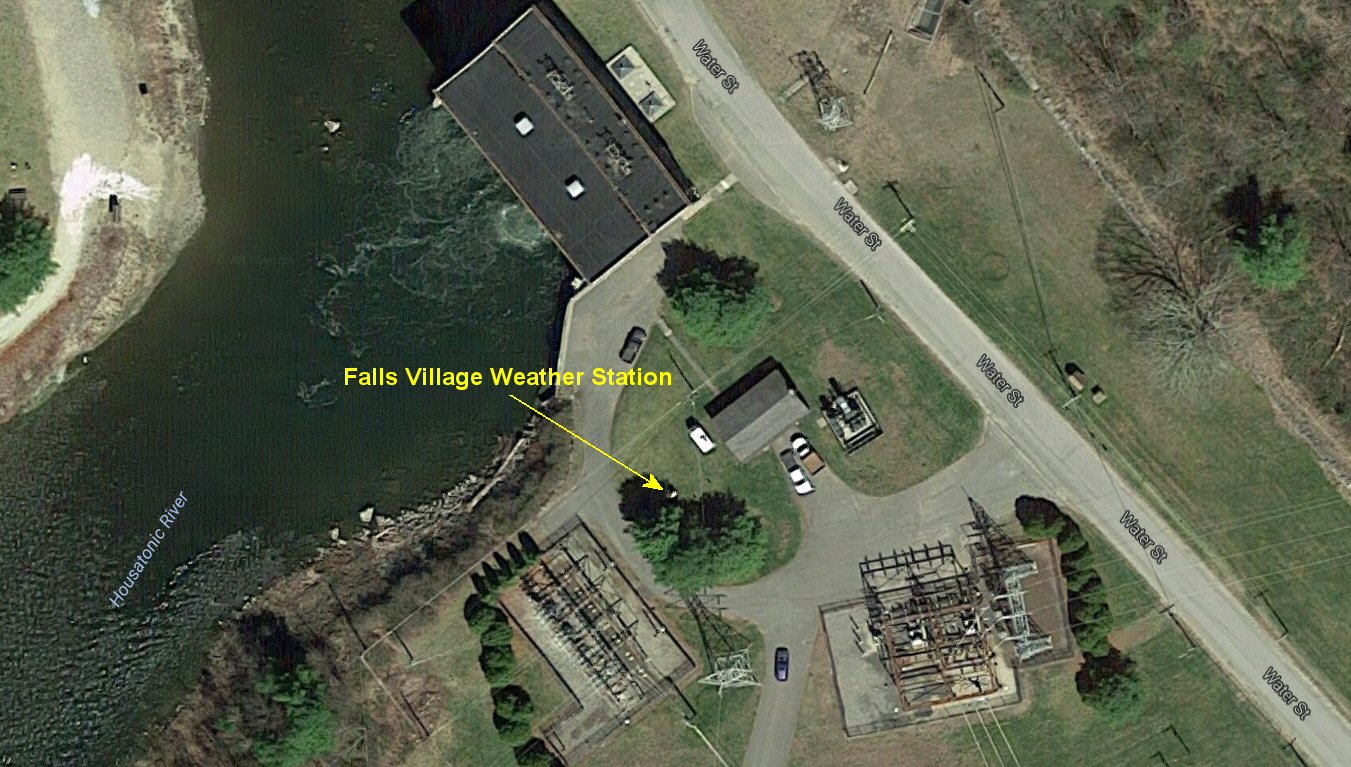
Here's Mauer's picture of the aerial view of the siting of the weather station.  It's next to the Falls Village power station, and right down by the Housatonic River, which is visible in the view.  The river forms the border between Canaan and Salisbury, so the small piece of land visible in the picture on the other side of the Housatonic is actually in the Town of Salisbury.

Falls Village aerial view

The temperature record for this station goes back 101 years, to 1916.  You might think that the power station might affect the record some, but it was actually built in 1914.  Also, it's not very big (11 MW), and is a hydro plant associated with the waterfall on the river that's just out of view.

Mauer points out that NASA chose to make some substantial adjustments to the historical temperature record at this station in 2015, conveniently timed to be shortly before the big Paris climate conference at the end of that year.  You won't be surprised that the adjustments are completely typical for NASA adjustments at all weather stations:  the past has gotten substantially cooler when compared to the raw data, while the recent years to the present have either stayed the same or gotten a little warmer.  NASA itself actually provides a graph demonstrating the changes, and Mauer has copied that graph in his post:

Mauer has then backed the adjustments out of this graph and compiled them into this new graph of his own:

Suddenly what might have seemed like some sophisticated scientific work when you looked at NASA's graph is revealed as not so sophisticated at all.  From 1916 to 1924, they have just lowered all annual average temperatures by a flat 0.8 deg C.  Then, after a gap of a few years in the adjusted series (unexplained), they lower all temperatures from 1927 to 1939 by a flat 0.6 deg C.  In the 70s they seem to have gone for a negative 0.6 deg C adjustment, while for the 80s they went for negative 1.2 deg C.  But suddenly in the 2000s, the adjustment became + 0.4 deg C.

OK guys, can you kindly explain.  This time I will quote from the NASA website:

GHCN-adj-homogenized is the adjusted, cleaned data with the GISTEMP removal of an urban-only trend.

"Removal of an urban-only trend"?  Really?  In Falls Village, Connecticut?  I can't even start to figure out what this means.

First of all, Falls Village is about the opposite of "urban."  It is approximately 100 miles from New York City.  The latest Census estimate of the population of the Town of Canaan is 1195 people in 33 square miles.  (Adjacent Town of Salisbury has 3665 people in 60 square miles.)  In my only quibble with Mauer, he says that the Town of Canaan is "mostly farmland."  Actually not -- it is about 80% forest, and of the unforested part, much is lawns or fields that are not farmed.  There are very few farms left.  This part of Connecticut has been reverting to forest for a good century and a half.  See my famous Defunct Agriculture Tour of the area here.  The population of the Town of Canaan actually peaked in 1850 at 2627, and hasn't remotely recovered.

But even if the Town of Canaan were an "urban" area, or even semi- or partially-urban, how could it make sense to adjust temperatures from 50 and 100 years ago down by half a degree or more? If Canaan had become an urban "heat island," wouldn't that mean that you should adjust recent temperatures down (to account for distortions coming from buildings or pavement or whatever), while leaving the past the same?  Well, that's not the way it works at NASA.  I think that the game plan is to bury this stuff in lots of details and hope that nobody has the time or inclination to get into the weeds and ask any difficult questions.

Again, they can't fire these guys fast enough.  But I'll still believe it when I see it.  Meanwhile, they could use about 100 new people to go in and audit what's been going on for the last 20 years.


Which Will Collapse First: North Korea Or The New York City Housing Authority?

Sadly, blogs had not been invented in the 1980s.  That's when I regularly predicted the collapse of the Soviet Union, to anyone who would listen.  My wife, and plenty of other people, thought I was crazy.  Unfortunately, I have no written record to prove my prescience.

In fact, it's a pretty safe bet to predict that any economy, or piece of an economy, organized on a socialist model will sooner or later collapse.  That's because socialism reverses the virtuous incentives of a private ownership/free exchange system (sometimes known as "capitalism").  In a private ownership/free exchange system, individuals can improve their economic well being by working a little harder or a little smarter.  In a socialist "to each according to his needs" system, individuals cannot improve their economic well-being by hard work, and often can improve their economic well-being by doing nothing and waiting for handouts.  As a result, in capitalism you have continuous economic growth; but in socialism you have productivity decline, and the people get poorer and poorer year after year.  This is what I've called the "socialist death spiral."  It's only a matter of time until the collapse.

But unfortunately, no one knows when the collapse will come.  It could be tomorrow, or a year from now, or ten years, or fifty.  Which is what makes betting on the timing of any particular collapse an interesting sport.  When will the Castros finally give up the ghost in Cuba, or Maduro in Venezuela?  Put your money down!

Today's challenge is to try to guess which will collapse first as between North Korea and the New York City Housing Authority (NYCHA).  The question is tricky because both entities have survived well past any date on which they could reasonably have been expected to collapse absent massive outside support to prop them up.  So far both have received just enough outside support to keep going.  Might that end in either case?

North Korea has been surviving on fumes for decades.  Even in between periodic famines and mass starvation, defectors still report living by eating grass and tree bark.  The economy produces next to nothing, and night time satellite photos show a country in total darkness while adjacent South Korea is ablaze with light.  Surely this cannot continue much longer!  

A publication called The Diplomat from January 27 has some history of this subject, titled "The Long History of Predicting North Korea's Collapse."  You won't be surprised to learn that the predictions started shortly after the Soviet Union went under, with another spike after the death of Kim Jong-Il:

Predicting the end of North Korea has a long history marked by countless false dawns. Claims of impending collapse gained prominence after the death in 1994 of North Korea’s founder Kim Il-sung, the current leader’s grandfather, only for his son, Kim Jong-il, to smoothly take the reins of power. Former President Bill Clinton was reported to have agreed to an ill-fated denuclearization deal with Pyongyang that year largely out of a belief the regime’s end was near. Nearly a decade and a half later, Kim Jong-il’s sudden death again sparked predictions of regime implosion, only for his son to successfully assume power and keep the system intact.

But miraculously, they are still around.  Actually, it may not be so much of a miracle, but rather the result of backing from their one kind-of ally in the world, China.  Although nobody knows the exact amounts, China has clearly been helping the Norks by buying some of their stuff, let alone by providing enough border enforcement assistance to keep the entire population from escaping.  But is some or all of that about to end?  According to the Washington Post on Saturday, China has suspended its purchases of coal from North Korea as of yesterday, and will keep the suspension in place at least until the end of the year.  The suspension is seen as a punishment to the Norks for their recent missile test, and as a tightening of compliance with the U.N. sanctions regime.

China will suspend all imports of coal from North Korea until the end of the year, the Commerce Ministry announced Saturday, in a surprise move that would cut off a major financial lifeline for Pyongyang and significantly enhance the effectiveness of U.N. sanctions.  Coal is North Korea’s largest export item, and also China’s greatest point of leverage over the regime.

This is not a small change.  Coal to China constitutes around a third of all of North Korea's exports, around $1 billion out of a total of about $3 billion, according to an MIT website here.  Seems like Mr. Xi might be a little upset, maybe by the recent nuclear and missile tests, or maybe by the assassination of Kim Jong-Nam (who had been living in China and under its protection).  Are the Norks getting to the end of their rope?  Place your bet!

Or, you can bet on NYCHA.  NYCHA is not a full sovereign economy, but just a small piece.  Nonetheless, it is run on the full classic socialist model.  Prove yourself to be poor and incapable of providing housing for yourself, and qualify for deeply a deeply subsidized apartment for life, many of them now located in highly desirable areas.  In this post last May I characterized NYCHA as being in the "terminal phase" of a socialist death spiral.  Their rents cover barely a third of their operating costs, and they have a backlog of some $17 billion of capital repairs, with no source of the money anywhere on the horizon.

But here they are about 10 months later, still going on as if nothing is wrong.  Hey, none of the buildings has collapsed yet!  In this instance, the New York Post has joined the Manhattan Contrarian as finally noticing that something is badly wrong.  They had a lead editorial devoted to NYCHA yesterday, titled "The slow death of New York's public housing."  Excerpt:

New York City’s public housing is slowly sinking into decrepitude as its oldest developments creakily approach 80 years in age. It’s long past time to set ideology aside to fund vital repairs — and to think about a future without public housing. Nearly half the New York City Housing Authority’s properties won “troubled” or “low-performing” ratings in the most recent federal inspections. . . .  The clear truth is that time will inevitably spell the end of all current NYCHA properties — with no hope that new ones will replace them. A rational city would face those facts . . . .

My only quibble is with the Post's assertion that it is "time to set ideology aside to fund vital repairs."  If NYCHA is in the terminal phase of a death spiral, and if "the clear truth is that time will inevitably spell the end" of its properties, then isn't the right answer to get this over with sooner rather than later, before we throw more tens of billions of dollars down the hopeless rathole?  The right answer to the miseries of NYCHA, and of its tenants, as proposed many times here, is to give away the projects to the tenants and make them owners.

In the case of NYCHA, the mystery financial backer that has kept it going long past its sell-by date is the Federal Department of Housing and Urban Development.  HUD in recent years has been sending some $2 billion of annual operating subsidies to NYCHA.  As far as I know, it's all subject to annual appropriation from Congress.  (When they built these things, nobody seems to have thought that they might need to do capital improvements some day.)  

As of today, Ben Carson is still awaiting his confirmation as HUD Secretary, and of course, HUD's budget for the coming year has not begun to be considered.  But if they focus on this a bit, it could all unravel very quickly.

So, which do you bet will collapse first, North Korea or NYCHA?  Put your money down!

Are Climate Alarmists Glassy-Eyed Cultists?

Will Happer is an eminent physicist at Princeton who has chosen (along with his colleague Freeman Dyson) to plant a flag on the skeptic side of the climate debate.  I've had the pleasure of meeting Happer on a couple of occasions.  Recently his name has been floated as a potential candidate for the position of Science Advisor to President Trump.  (This is the position that has been held by eco-fanatic John Holdren during the Obama presidency.)  Although it is not final, and others remain in the running, Happer has said that he will take the position if offered.

Yesterday Happer gave an interview to the Guardian newspaper.  When it came to the issue of "climate change," Happer didn't pull any punches.  Here is my favorite quote:

“There’s a whole area of climate so-called science that is really more like a cult,” Happer told the Guardian. “It’s like Hare Krishna or something like that. They’re glassy-eyed and they chant. It will potentially harm the image of all science.”

I would only comment that in my experience Hare Krishnas don't takes tens of billions of dollars of government money for themselves, and don't seek to impose energy poverty on everyone else while they themselves jet around on private jets.  Other than that, Happer was spot on.

If you are still considering the question of whether what Happer calls "climate so-called science" is real science versus a cult, you may want to review a few articles from the New York Times about the recent California drought and its end.  For example, from August 2015, we have an article headlined "California Drought Is Made Worse by Global Warming, Scientists Say."  

Global warming caused by human emissions has most likely intensified the drought in California by 15 to 20 percent, scientists said on Thursday, warning that future dry spells in the state are almost certain to be worse than this one as the world continues to heat up. . . .  The paper provides new scientific support for political leaders, including President Obama and Gov. Jerry Brown of California, who have cited human emissions and the resulting global warming as a factor in the drought.

Or try this one from January 5, 2017 (just six weeks ago!), headlined "A Winery Battles Climate Change."

After decades in the business, the Jacksons are sensitive to slight variations in the weather, and they are convinced of one thing: It is getting hotter and drier. . . .  Climate change is forcing the Jacksons to confront questions both practical and existential: Can you make fine wine with less water? . . .  Already, winemakers in the region are noticing distinct changes that signal a hotter, drier future.

And then, of course, things promptly turned around and the rains came -- as they always do.  Suddenly California is in the news because it has had so much rain that some of its dams are threatened with overflowing.  Well, what caused that?  You guessed it -- climate change!  From yesterday's Pravda, here is the lead headline from the National Section:  "A Climate Change Warning for California's Dams."  What, does "climate change" cause both wet and dry?

Scientists have said for years that a warming atmosphere should lead to more intense and frequent storms in many regions.  

Now you tell us!  As usual, climate change as the cause of everything is the classic unfalsifiable proposition.  The word "cult" may be a little over the top, but whatever it is, it sure isn't science.

Bill de Blasio Three Year Review: The Best Progressive Is A Lazy Progressive!

It's hard to believe it's been so long, but our super-progressive mayor Bill de Blasio was elected in November 2013, and took office on January 1, 2014.  That means that he's now been in office for a full three years plus.  And indeed, he has begun his campaign for re-election, albeit unofficially.  Shall we have a review of how he's done?

For reasons that won't surprise anyone, my prognosis for de Blasio's mayoralty upon his election was not good.  My first post on the subject was way back just before the 2013 election, titled "Bill de Blasio:  How Bad Is This Guy?"  (Conclusion: bad.)  Literally everything he proposed threatened to make the city worse off.  But what we couldn't know then was how much of his progressive agenda he would get enacted and implemented, and how fast any destructive effects would be realized.  (As covered here many times, the corrosive effects of "socialist death spirals" play out very slowly.)

And then, we stumbled into an unbelievable piece of good fortune.  It turns out that de Blasio is one of the laziest people on the planet, and undoubtedly the number one laziest person ever to hold such high and responsible public office.  As reported in many places, his daily schedule seems to run something like this: arise around 8 or 9 AM at the mayoral mansion on the Upper East Side of Manhattan; get in his two-car motorcade of gigantic Chevy Suburbans for the 11 mile ride to his gym in Brooklyn; leave the behemoth cars idling while he works out for an hour or so; stop by his favorite coffee place; then back in the motorcade for the 5 mile trip to City Hall.  Wander into the office some time around noon.  Here's a snippet from the Brooklyn Paper in 2015 on de Blasio's routine, with some emphasis on his exquisitely sensitive environmental consciousness:

Mayor DeBlasio routinely travels 11 miles in a two-car motorcade to workout in his beloved Park Slope YMCA, and leaves his security force in idling cars outside as he breaks a sweat inside.  The mayor, who has positioned himself as an environmentalist by backing bans on in-home wood-burning fireplaces and single-use Styrofoam containers, and is considering a fee for the use of plastic bags at stores, is thumbing his nose at the environment by allowing his motorcade — generally made up of two Chevrolet Suburbans — to idle for up to an hour while he works out, opponents say.      

So, for this guy who barely can be bothered to show up for work, how has progress been going on his signature issues -- things like increasing taxes on "the rich," instituting universal pre-K in public schools, expanding "affordable housing," ending homelessness, and reducing income inequality?  

Increasing taxes on "the rich."  Probably the most talked-about item in de Blasio's agenda immediately after his election was his plan to raise the top New York City income tax rate by a little over .5%, from 3.88% to 4.41%.  That proposal required approval from the state legislature, and it went nowhere.  Mostly, taxes have stayed right where they were before de Blasio was elected.  The exception is the real estate tax, which has seen small increases each year.  Of course, that one is paid substantially by non-wealthy people.

Universal pre-K.  Basically, he got this one done, so I guess we should give him credit.  Of course, the basis on which he sold the idea was that it would be critical to reducing income inequality.  How universal pre-K would have any noticeable effect on income inequality in less than about 20 years (when the beneficiaries begin to enter the work force) has never been obvious to me.  However, de Blasio did accomplish getting several thousand more dues-paying members for the teachers union.

Income inequality.  Of course, it has gone up.  Oops!  According to a December 2016 report from Alex Armlovich of the Manhattan Institute, "Household income inequality, as measured by the Census Bureau’s Gini coefficient, has risen moderately . . . since the beginning of the current mayor’s term in January 2014."   Looks like the universal pre-K didn't help.  Also not helping was the fact that other de Blasio initiatives, like "affordable housing," don't count as income to the recipients and therefore have the inevitable effect of increasing rather than decreasing income inequality, if only marginally.

Homelessness.  That has increased too.  Oops again!  From the New York Post, December 7, 2016: "The population of the city’s homeless shelters has hit a record high as the number of families and single adults with nowhere to live continues to rise under Mayor de Blasio’s tenure."  According to that Post article, the number of homeless in city shelters had reached about 61,000, an increase of some 83% over the previous ten years (granted about a third of that during the Bloomberg tenure).  I predicted that an increase in homelessness would occur when de Blasio reinstated priority for public housing slots for people who have declared themselves "homeless."  Deeply subsidized housing for life if you will only go through a period of "homelessness" first -- what could go wrong?

Affordable housing.  This is an enormously expensive exercise in futility that I have covered dozens of times, calling it the "most expensive possible way to benefit the smallest number of people," and then of course trap them in poverty for life.  In early January the de Blasio administration trumpeted a figure of 22,000 units of "affordable housing" supposedly "built or preserved" in 2016 -- but the New York Times, skeptical for the first time in its existence, asked a few questions and learned that only 6800 units had been "built."  Nobody knows what's in the "preserved" category.  This in a city of well over 3 million housing units.  On this one, I'm not giving de Blasio any credit.  If the city would only stop over-regulating private builders, they would quickly build enough housing to drive market rentals down.  De Blasio will never allow that.  We are doomed to a lifetime of housing lotteries to allocate microscopic numbers of subsidized units that will never make any real difference in housing affordability for the masses.

Meanwhile, on the budget front, it's basically what you would expect from an incompetent manager who's not paying much attention and gives the subordinates free rein.  The employee head count is increasing on some kind of autopilot, as the bureaucrats build their empires without accomplishing anything you can notice.  According to the Wall Street Journal back in September, the number of City employees was about 297,000 when Bloomberg left office, and is expected to reach about 323,000 by the time the next budget kicks in in July -- about a 9% increase.  Nobody knows what the extra people are doing (other than the universal pre-K).  Mayor Bloomberg's last budget (FY 2014) was $72.7 billion.  The budget for the coming FY 2018 (beginning July 1, 2017), which was projected to be $81.6 billion back in 2014 (during de Blasio's first year in office), is now projected to be $84.7 billion.  I sure hope your income is going up that fast!

There are definitely some worrisome long-term trends here, particularly allowing unproductive government spending to increase faster than the underlying economy.  But just think about how much worse it could have been if de Blasio was an energetic guy striving hard to implement the "progressive" agenda!  As it was, he has done little, and things where city spending has any impact have gotten a little worse.