The Unreported Story Of Grid Scale Battery Fires
/The geniuses who are planning New York’s energy future think that they can make intermittent wind and solar generators work to power the electrical grid by the simple device of providing some battery storage. The idea is that when there is abundant wind and sun, they can store up the power for use during those calm and dark periods in the winter. How much battery storage will that take? It’s a simple arithmetic calculation, but none of our supposed experts have taken the trouble to crunch the numbers.
Nevertheless, without any kind of feasibility study of whether this will work, they soldier forth building large grid-scale battery storage facilities. The battery building program is under way, at least to some degree, and a few such facilities are actually complete and operating out in the rural parts of the state. Meanwhile, there are plans for some much larger such facilities in New York City, including right in some of its most densely-populated sections. Is there any problem with this that we ought to know about?
In a post back in March 2024, I reported on the progress of our two “climate leader” states with developing grid-scale battery storage. It turned out that the big problem was that these facilities were subject to large and dangerous fires on a regular basis. In some cases the same facility would catch fire multiple times. That post reported on major fires in California at a site called Valley Center in San Diego County in September 2023, and at another one called Moss Landing south of San Francisco in September 2022. In January 2025, the Moss Landing facility had another major fire. From the EPA website:
On January 16, 2025, the Moss Landing 300 battery energy storage system at the Moss Landing Vistra power plant (Monterey County, Calif.) caught fire.
The 300-megawatt system held about 100,000 lithium-ion batteries.
About 55 percent of the batteries were damaged by the fire.
There were prior fires at the Moss Landing facility in September 2021 and February 2022.
Back here in New York, my March 2024 post reported on no fewer than three major fires at grid battery storage facilities in this state that had taken place during 2023. The following quote came from a piece at Canary Media from August 2023:
New York state is grappling with how to adjust its ambitious buildout of clean energy storage after fires broke out at three separate battery projects between late May and late July [2023]. . . . First, on May 31, a battery that NextEra Energy Resources had installed at a substation in East Hampton caught fire. . . . Then, on June 26, fire alarms went off at two battery units owned and operated by Convergent Energy and Power in Warwick, Orange County; one of those later caught fire. On July 27, a different Convergent battery at a solar farm in Chaumont caught fire and burned for four days straight.
Might you have the idea that these fires are becoming less frequent over time? If so, that’s only because these fires are one of those things — like the Somali welfare fraud in Minnesota — that the liberal media just don’t choose to report. It turns out that the Convergent Energy facility in Warwick, New York had another big fire just last week. From Etica AG, December 22:
Late on the evening of December 19, 2025, a fire occurred at the Church Street Battery Storage Facility in Warwick, New York, operated by Convergent Energy & Power. While no injuries were reported and the fire was confined to a single container, the incident remained active into the following day and prompted a multi-agency response, air quality monitoring, and renewed scrutiny of battery energy storage system (BESS) safety in the community. For Warwick residents and local leaders, the fire carried added weight. The town has experienced multiple battery storage incidents in recent years, and each new event raises difficult questions about risk, emergency response, and whether existing BESS designs are suitable for locations near homes, schools, and small businesses.
I can’t find any mention of this battery fire at the New York Times or at major media sites like CNN or the major television networks.
The Convergent Energy Warwick energy storage facility has a capacity of 12 MW and 57 MWh. Meanwhile, back here in New York City, there are plans, well advanced (although not quite yet under construction), to build a much larger grid battery storage facility in Ravenswood, Queens. That would be right on the East River, directly across from East Midtown and the Upper East Side of Manhattan:
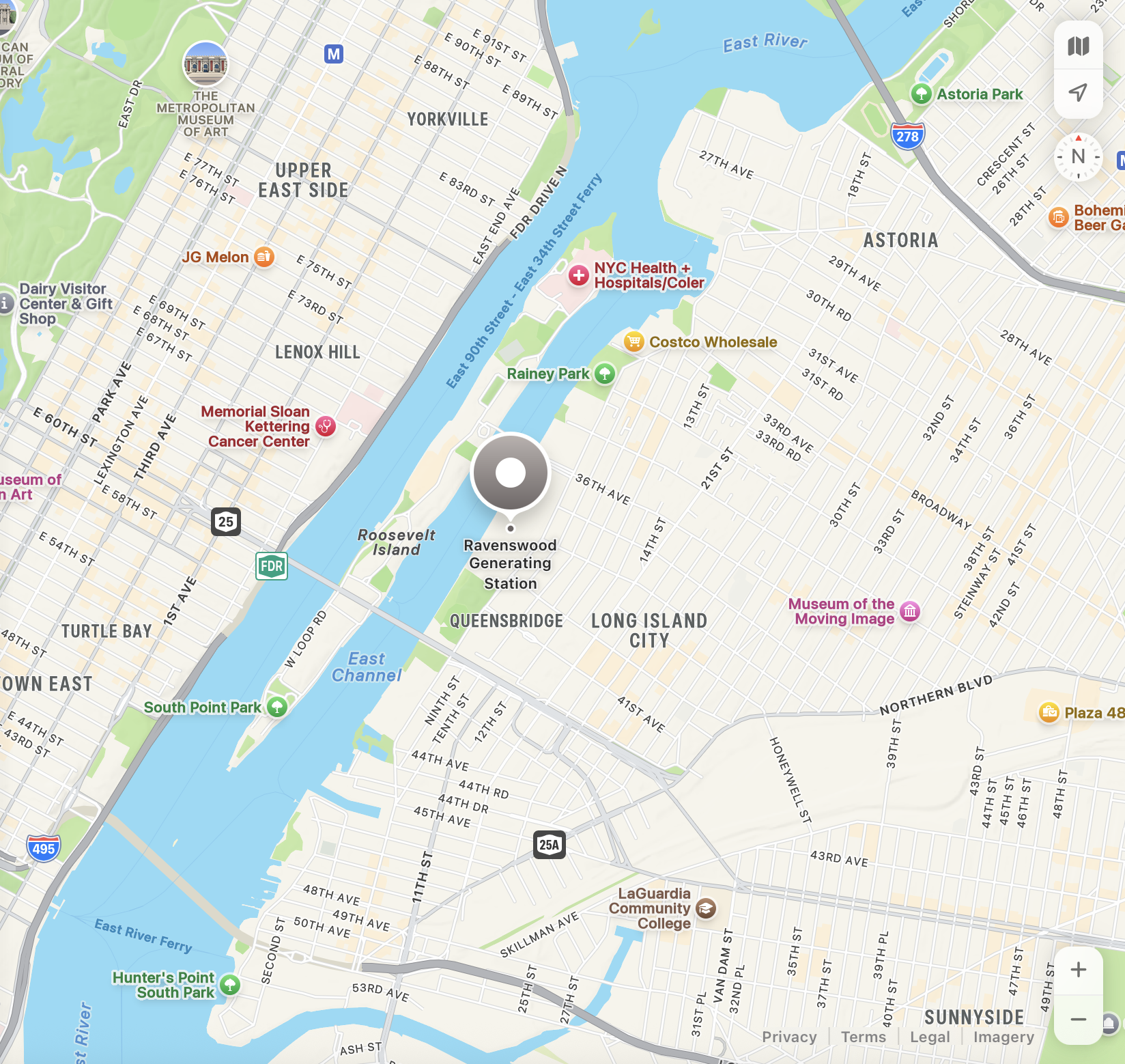
You can see on the map how close much of Manhattan is to this facility. To be fair, the wind usually blows the other way, but the parts of Queens near this facility are also very densely populated. Something called Queensbridge Houses — the largest public housing project in the country — is immediately adjacent.
The planned capacity of the battery storage facility in Ravenswood is 316 MW/2528 MWh — some 25 or more times the size of the facility in Warwick that has now caught fire at least twice.
A New York agency going by the name NYSERDA (New York State Energy Research and Development Authority) is leading the charge to build these energy storage facilities, including in densely populated areas like Queens. On their website, they have a page touting the new battery storage project at the Ravenswood location. Believe it or not, their sales pitch is that the new battery facility is cleaner and greener than the prior natural gas power plants on the site. Here is a quote they take from Queens Borough President Donovan Richards:
“The days of environmental and economic injustice in Western Queens, especially for our historically marginalized public housing families, are coming to an end. As we prepare to transform the Ravenswood Generating Station into a clean energy producer, it’s critical that the surrounding community reaps the benefits of that transition,” said Borough President Richards.
Somehow, both NYSERDA and Donovan omit to mention the issue of the fires.