Doubling Down On The Worst Possible Public Policy ("Affordable Housing" In Manhattan)
/I often write about the folly of attempting, through a myriad of government mandates and subsidies, to compel the replacement of our electricity system with one powered by the wind and sun. You may think it would be impossible to come up with any public policy that is worse than that one of a forced energy system transformation. And yet, the Manhattan Contrarian designee for “worst possible public policy” has gone to something else. That something else is the building of what they call “affordable housing” on some of the world’s most expensive real estate here in Manhattan.
The term “affordable housing” as used by housing advocates is a euphemistic term of art that means something different from what you would think. What it really means is subsidized and income restricted.
The policies of forced energy transition and of building “affordable housing” in Manhattan share some notable characteristics. One is that a few simple observations are sufficient to demonstrate that the policy wastes vasts amounts of taxpayer resources while accomplishing essentially nothing and indeed being destructive. Another is that there is near total consensus among the Manhattan cognoscenti that the policy is a not only good idea but indeed a moral imperative.
If you want to read about the disaster of a government-forced energy transition to generation of power from wind and sun, I can refer you to some hundreds of my prior posts, for example here, here and here. For today, I will discuss the ongoing disaster of pretending to build “affordable housing” in Manhattan.
The occasion for today’s post is the recent announcement of a major new all-”affordable” development to be built in my own neighborhood of Greenwich Village. The address is 388 Hudson Street, where there is currently a large vacant lot of approximately half the block, about 2/3 of an acre in total. This could well be the most valuable vacant site in Manhattan today on a per square foot basis. The proposal is to use about half the site to put up a new building with some 280 apartments, which will be allocated to people of low to middle-income by means of a lottery. The remainder of the site will then become “public open space.” Once selected for an apartment, the beneficiaries will get the right to continue to live in the apartments for the rest of their lives, and even on death to pass the right to occupy the apartments to their heirs under limited circumstances. However, they will have no ability to sell the right to occupy, and if they leave voluntarily they give up all future rights to occupy.
So why has the building of “affordable” housing in Manhattan been designated by this site as "the worst possible public policy”? There are too many reasons to cover fully here, but the main ones are (1) enormous cost per beneficiary if the costs are properly accounted for, (2) many of the beneficiaries are not even poor, (3) the benefit is not counted as income to the beneficiary, and thus the “poor” beneficiaries remain poor even though they get a benefit that could be costing the taxpayers hundreds of thousands of dollars per year each, (4) the beneficiaries become essentially trapped, with a tremendous incentive not to move even if their life circumstances change such that their apartment is no longer appropriate to their circumstances, and (5) the properties inevitably deteriorate and require increasing subsidies and bailouts as the years pass.
The new project is being given the name “Hudson Mosaic.” On December 18, the City announced the “award” of the project to a group of designated developers. On December 22, a piece about the project, along with newly released renderings, appeared on the website New York YIMBY. Here is one of the renderings:
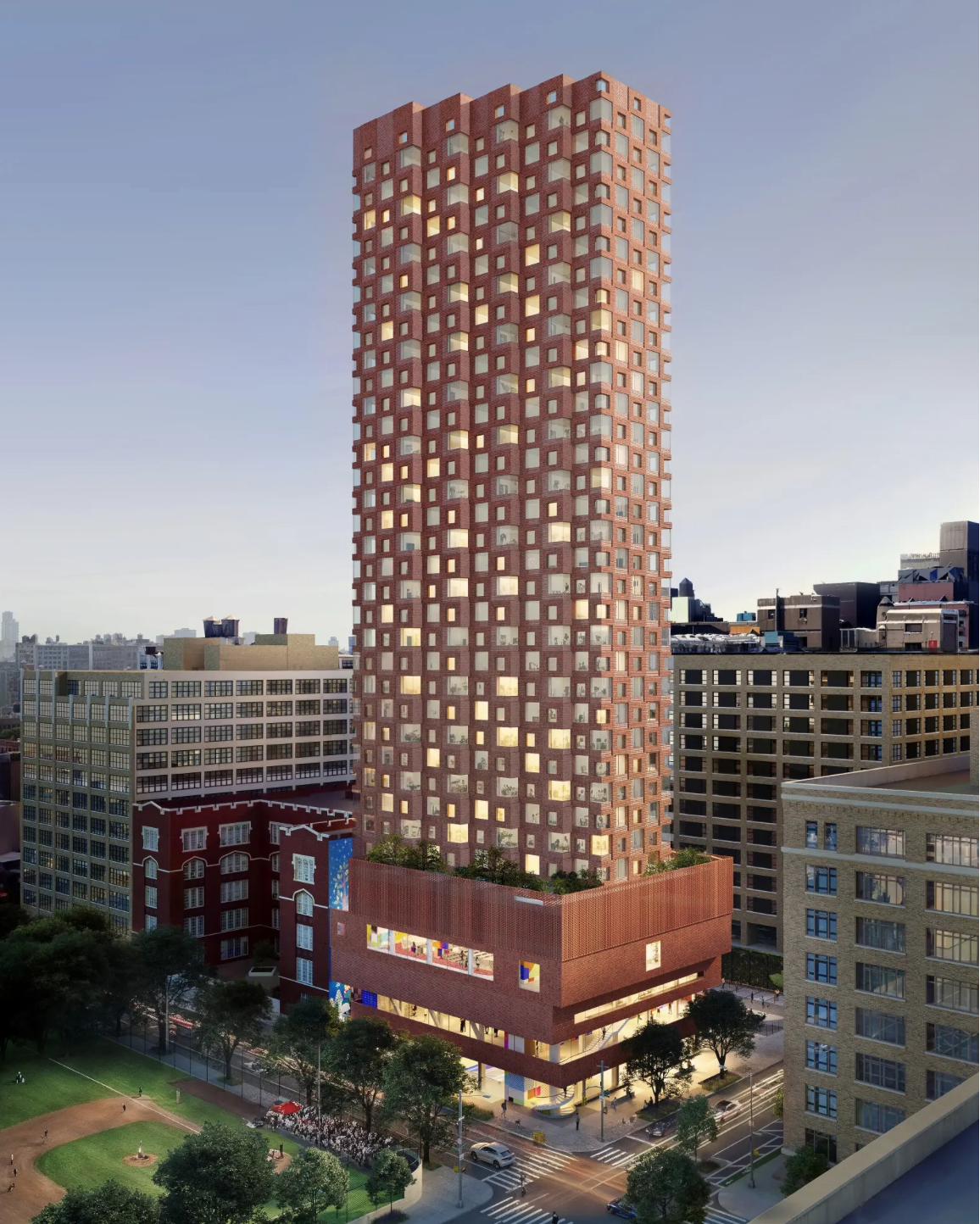
Some history of this area: The site is about 400 feet from the location of a colonial-era mansion that was known as Richmond Hill. Richmond Hill was used as, among other things: (1) one of the buildings that George Washington occupied as a headquarters during his 1776 battles and retreats across Manhattan as the British took over the City; (2) the Vice Presidential residence of Vice President John Adams when the federal government was first established in 1789 and until the capital moved to Philadelphia in late 1790; and (3) as a home of Aaron Burr, including at the time he shot Alexander Hamilton in 1804. Richmond Hill overlooked the Hudson River, but subsequent landfills have moved the waterfront close to 1000 feet to the West. By the mid-twentieth century, this micro-neighborhood had become known as the “printing house” district, mainly occupied by industrial loft buildings that were the home of the financial printers that produced the hard-copy prospectuses and annual reports that Wall Street then required. Those loft buildings today are a combination of offices and residences. Google has recently established a campus of multiple of these buildings just across the street from the site of Hudson Mosaic. The industrial loft building visible on the left side of the rendering above is used today as an office building, one of the tenants being the headquarters of the Squarespace company that is the host of this website. Disney has just built two new headquarters-type buildings a few blocks to the South.
The particular site at 388 Hudson Street was purchased by the City and vacated decades ago to be used for staging of construction of a new water tunnel to augment the City’s supply of drinking water. That endless project is still ongoing (projected to be complete some time in the 2030s), but construction in this area wrapped up in 2013. The City could have sold off this site for big money — multiple hundreds of millions of dollars — but instead chose to keep it vacant until now.
Rather than selling the vacant site to the highest bidder, the City is following a procedure they call “Request for Proposals.” In this procedure the City indicates that it will essentially give the land away to whoever makes the best proposal for the favored use, here “affordable” housing. The consequence is enormous cost to the taxpayers, all of which is opaque. As far as I can tell, the developers are getting the land for free, versus an auction price that the City could have achieved in the range of hundreds of millions of dollars. There is also some sort of City-subsidized financing, although I am unable to find details. The City will also make a grant of tens of millions of dollars to the project, mostly to build a new public athletic facility on the lower floors (but undoubtedly also useful to reduce construction costs for the developer). There will also be a ten year abatement from real estate taxes, with taxes then phasing in gradually thereafter.
Other than the grant for the athletic facility, none of this will appear on the City’s budget. But how much will be the real subsidy to the lucky lottery winners? It could easily be a million dollars or more each. (If the foregone sales price for the land is $300 million, and lost real estate taxes over 20 years are $120 million — which are reasonable if rough estimates — then the subsidy would be in the range of $1.5 million per beneficiary family.). To get an idea how crazy this is, the City could have given $500,000 each to 280 lucky lottery winners — plenty to buy a house outright in a nice middle class area — and have $300 million to spare for other City priorities. If the other priority were “affordable housing,” they could have tripled the number of beneficiaries by auctioning this site and using the money in more modestly priced areas.
Meanwhile, as this new “affordable” project moves forward — along with dozens of others around the City, in areas of all income levels — how are things going with the existing stock of such housing? The answer is, badly. The tightening of rent regulations that took place in 2019, combined with the high inflation of the Biden years, have put much of New York’s rent regulated/income restricted housing into financial distress. In November something called the New York Housing Conference produced a Report titled “Policy Reforms Required to Avoid Defaults in Distressed Affordable Housing.” The Report states that a large percentage of the existing so-called “affordable” (i.e., subsidized and income restricted) developments in the City are in financial distress, failing to cover their costs and debt service. Essentially, the Report then becomes a plea for increased City subsidies to keep the projects from either going broke or deteriorating badly or both:
Recent data shows that a significant number of affordable housing buildings in New York City are experiencing operating deficits, where rents are not covering expenses. Policy interventions to increase revenue and decrease expenses are required to prevent these buildings from defaulting on their loans with private banks and the City of New York. When operating costs and debt service exceeds rental income, building owners don’t have the necessary funds to make repairs but even more consequential is that financial instability threatens the financing making these buildings affordable, putting their tenants at risk.
“Policy interventions” are “required.” In other words, give us more money! But there is never enough money. And yet we continue to double down.
Remarkably, new Mayor Zohran Mamdani and his team will shortly come into office promising to raise taxes on the “rich.” But here are the rich volunteering to pay big money into the City’s coffers without need for additional taxes, but just to buy land to build on, and then pay the property taxes at existing levels. Somehow this form of taking money from the rich doesn’t seem morally acceptable to them. I don’t understand the logic, but maybe they do.