The New Federal Reference Manual On Scientific Evidence: All The Smartest People Get Hoodwinked By The Climate Charlatans
/It is truly remarkable how easy it is to fool the smartest people. And especially when you tell them they are helping to save the world.
So something called the Federal Judicial Center has just come out with a new edition, the 4th, of something called the Reference Manual on Scientific Evidence. The publication date appears to be December 31, 2025.
The idea that the federal government, and in particular the judiciary, needs a reference manual on scientific evidence seems to date from the 1990s. The courts, then as now, were facing an increasing volume of cases involving complex scientific evidence; and meanwhile almost none of the judges are trained in science. Best to provide them with a good grounding in the basics. Fortunately, back in the 60s Congress had established something called the Federal Judicial Center as a “research and education agency” of the judicial branch. Here was the perfect opportunity for that bureaucracy to expand their mission and budget.
In this latest version of the Reference Manual, the FJC has totally lost its way. Somehow, it got captured by a clique of climate charlatans who have inserted a lengthy section that is anti-science and based on logical fallacy. And many dozens of seemingly smart people who were supposedly reviewing this have gotten hoodwinked.
From the outset this Reference Manual thing was not a small project. For the First Edition of the Manual in 1994, the FJC partnered with the Carnegie Corporation, rounded up 19 authors and 98 peer reviewers, and produced a document of some 637 pages. But they were only getting started. For the Second Edition (2000), Supreme Court Justice Stephen Breyer got involved, and the list of contributors had grown substantially. By the Third Edition (2011), the National Research Council (part of the “National Academies”) had joined the project, and the addition of multiple new topics had caused the Manual to expand to 1034 pages.
And now we are up to the Fourth Edition. It runs to 1682 pages. The National Academies have become heavily involved, along with lots of judges. Seven pages preceding the Foreword are taken up listing the dozens of highly distinguished members of various committees and peer review panels who had some role in producing the document. Justice Elena Kagan has written the Foreword.
Many topics have been added. One of those is a section running from page 1561 to 1652 called “Reference Guide on Climate Science.” This is a transparent advocacy piece inserted to further the goals of various “climate” litigations brought in the court system. At the core of this section is a fundamental logical fallacy. How all the distinguished pooh-bahs who signed on to this Manual allowed this chapter to pass through is beyond me.
Now I’m not saying that everything in the Manual is wrong. I guess that a fundamental problem with 1600 page documents is that there is going to be a lot that is wrong and nobody intelligent is ever going to have the time to root all out all the fallacies.
Among sections of the Manual that aren’t too terrible is a section running from pages 47 to 112 titled “How Science Works.” The authors are Michael Weisberg and Anastasia Thanukos. This section contains basic information on the logic of the scientific method, along with many examples of applications. The section is by no means written the way I would have written it (it is way longer than it needs to be, and the most important points are buried), but still I can subscribe to its general approach. At page 62 begins a sub-section titled “Science Investigates Testable Hypotheses.” I think the word “falsifiable” is better than “testable,” but this is close enough. Here is an excerpt from that sub-section:
Communities engaged in scientific endeavors work with testable hypotheses. For a hypothesis to be testable, it must, by itself or in conjunction with other hypotheses, generate specific predictions— a set of observations that one could expect to make if the hypothesis were true and/or a set of observations that would be inconsistent with the idea and lead one to believe that it is not true. If an explanation is equally compatible with all possible observations, then it is not testable and hence, not within the reach of science.
Yes! I would add after Weisberg/Thanukos’s first sentence that if a community refuses to articulate testable hypotheses that can be associated with specific predictions, then that community cannot claim to be scientists. This is precisely the fundamental problem with the community of people who call themselves “climate scientists”: they scrupulously avoid ever articulating any proposition that can be associated with specific quantitative predictions, and which thus can be tested and potentially falsified.
For example, is global warming from human CO2 emissions causing an increase in extreme weather events, like hurricanes and tornadoes? You would think that that proposition could be easily articulated as a testable hypothesis, perhaps associated with some known published index like the ACE (“accumulated cyclone energy”) index. For example: “We predict that for each increase of 50 ppm in the concentration of CO2 in the atmosphere, the ACE index will increase by 20 units.” I’m not saying that that is the only possible testable hypothesis for the association of CO2 emissions with extreme weather, but that is how articulation of a testable hypothesis is done. Under this prediction, if the atmospheric CO2 concentration goes up by 50 units and the ACE index follows by going up 20 units or more, the prediction is looking good. To the contrary, if the atmospheric CO2 concentration goes up 50 ppm and the ACE index follows by going down, the hypothesis has been contradicted.
By the way, here is NOAA’s graph of the ACE index annually since 1851.
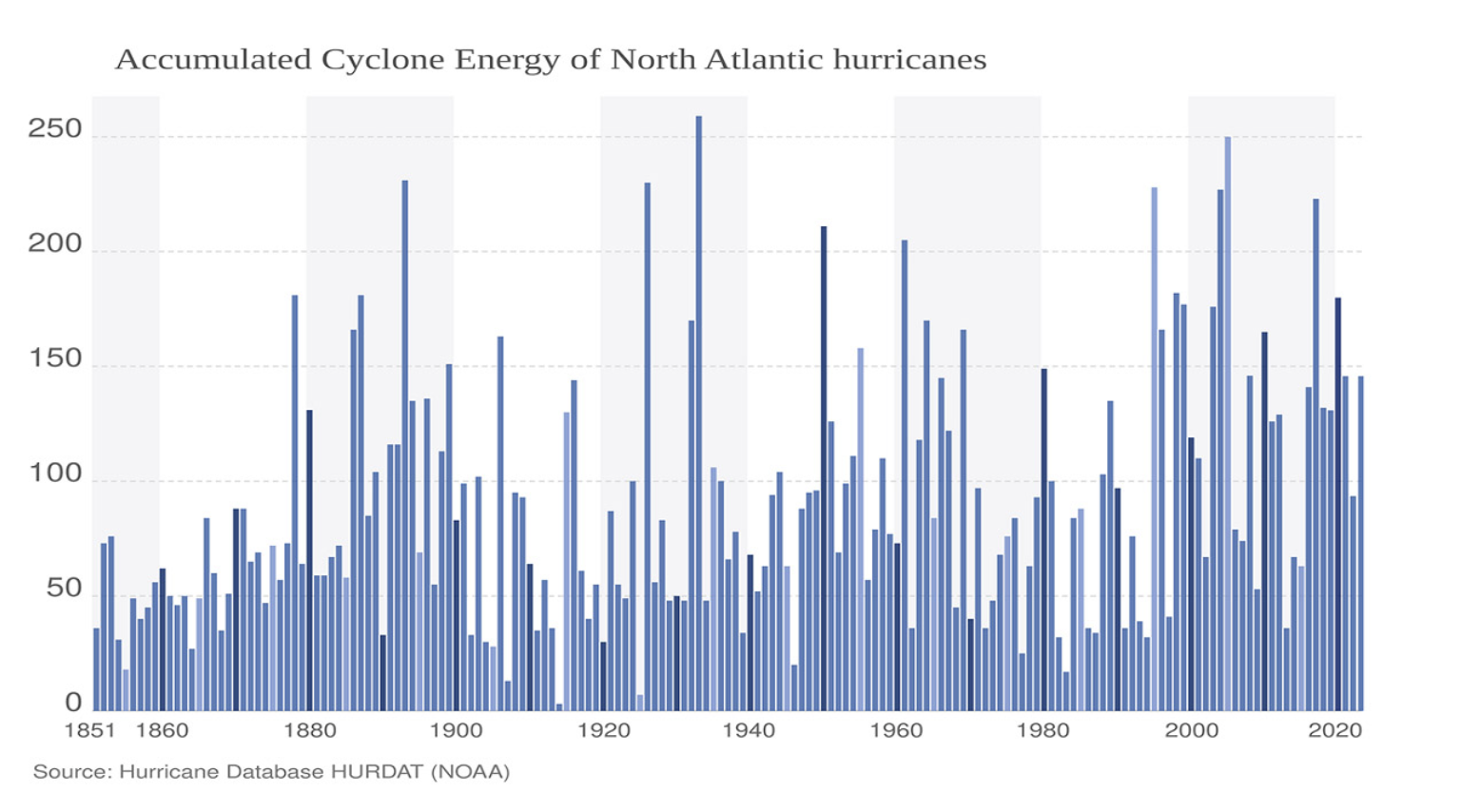
(During the time at least since 1950, the CO2 concentration in the atmosphere has been steadily rising. In other words, you would think from the evidence of this publicly available graph that any association of atmospheric CO2 with the level of hurricane energy has been definitively refuted.)
With that background, take a look at the section in the new Manual titled “Reference Guide on Climate Science,” beginning at page 1561. The lead author is one Jessica Wentz of Columbia Law School. She is a well-known climate alarm advocate, and has served as an expert witness for plaintiffs in litigations seeking to pin climate damage on fossil fuel use.
After lengthy background, we come to the core of this section, beginning at page 1585, with a sub-section titled “Climate Change Detection, Attribution, and Projections.” The very unsubtle idea here is to give support to litigation seeking to blame disasters of various sorts on emitters of CO2 (fossil fuel producers) by “attributing” the disasters to increased CO2 in the atmosphere.
There is a legitimate method to attempt use the scientific method to attribute various events to increased CO2 in the atmosphere. That method is to articulate a testable hypothesis and then subject it to test. That is the last thing that these “climate scientists” would ever allow to be done. Instead, they think they have better ideas. Here is how the authors of this “climate science” section describe how attribution is done in “climate science” (from page 1588-89). Get ready for a torrent of meaningless verbiage:
[A]ttribution involves sifting through a range of possible causative factors to determine the role of one or more drivers with respect to the detected change. This is typically accomplished by using physical understanding, as well as climate models and/or statistical analysis, to compare how the variable responds when certain drivers are changed or eliminated entirely. The goal of such studies is to determine whether, how, and to what extent anthropogenic drivers have contributed to the observed change. Many attribution studies use a probabilistic approach— i.e., researchers will seek to quantify the probability of a particular outcome (e.g., how likely is the occurrence of three inches of rainfall in a day at a given locale) occurring with and without anthropogenic influence on climate. However, researchers can also use a mechanistic approach to attribution, whereby they seek to examine how climate change has influenced one or more physical characteristics of an event or process.86 Mechanistic studies can provide insights on, for example, the change in magnitude or severity of an extreme event that can be attributed to climate change. In the rainfall example above, a mechanistic approach might look at the weather system that produced the heavy rain and describe how one part of climate change that we understand well— e.g., the warming of the atmosphere and its resulting increase in the amount of moisture the atmosphere can hold — contributed to the event. Mechanistic and probabilistic analyses can be combined in order to develop a more complete picture of whether and to what extent climate change is influencing various processes and events.
It goes on and on — and on and on and on — from there, burying you in meaningless doubletalk and bafflegab. How about articulating a testable hypothesis and testing it? They will never, ever, ever do that. It could prove the whole enterprise to be wrong!
Well, the entire NAS (or maybe it’s now the NASEM) has been taken in. (Or maybe they are in on the scam as a way to keep their funds flowing.) Lots of top federal judges are listed on the boards and committees that signed off on this. Once again, all the smartest people prove that they are not very smart.