Yet Another Embarrassment From The National Academy Of Pseudoscience
/In my own professional life, I was not a scientist, and therefore I never much paid attention to the kinds of rewards and honors that practicing scientists pass out to each other. But at some point I became aware that there was something called the National Academy of Sciences, and that among scientists it was considered a big deal to get selected to become a member. This membership is one of those things that you cannot apply for; rather, one day you get “tapped” by some committee of super-elite gurus who invite you to come learn the secret handshake. Here’s what Wikipedia has to say about membership:
Membership of the National Academy of Sciences is an award granted to scientists that the National Academy of Sciences (NAS) of the United States judges to have made “distinguished and continuing achievements in original research”. Membership is a mark of excellence in science and one of the highest honors that a scientist can receive.
(At some point in the 2010s, the NAS got somehow consolidated with comparable “academies” of engineering and medicine, to become a combined organization going by the name of the National Academies of Science, Engineering and Medicine, or NASEM. This post only concerns the Science part of the combined entity, although I have no reason to think that the other parts are any better.)
There are only around 2000+ members of the NAS, out of a universe of some 2 million + people who do some kind of scientifically-related research. So only about one in a thousand gets in. Needless to say, these people must be really, really smart.
Well, as far as I can tell, they are all morons. Also, corrupt morons.
I last wrote about the NAS in February of this year, in a post titled “Would You Trust The National Academies Of Science To Tell You How Science Works?” The occasion for that post was that something called the Federal Judicial Center had just issued a new edition of its Federal Reference Manual on Scientific Evidence. Recognizing that this subject went outside the core of its own expertise, the FJC had called on the NAS to take the main role in the drafting. In the new edition, a chapter from prior editions of the Manual titled “How Science Works” had been taken over by new authors, and substantially re-written and greatly expanded (from 18 to 61 pages). In the process, the new authors had inserted a series of howlers that not only did not fairly describe how science works, but actually got the whole process wrong by 180 degrees. I cited several examples in the February post, but this is the one that goes closest to the heart of the craziness: “While the often-stated maxim that correlation does not imply causation is true, in fact, correlation is the only means that we have of establishing causation in science.” That statement is just flatly wrong. Instead, the process for establishing causation in science operates through the falsification of alternative (“null”) hypotheses of causation. I do not know how anyone could even think to call themselves a “scientist” without basic understanding of that logical process.
And yet here was the NAS, supposedly a collection of the most elite among elite scientists, putting together a chapter of an official court Manual to tell non-scientists (lawyers and judges) “how science works,” and getting it 180 degrees wrong on the single most important point.
Which of course begs for a necessary consideration of the next question: Was this an innocent mistake by ignorant people, or was it an intentional distortion intended to further a political agenda?
Now, just last week, the National Academies have released their latest embarrassment, taking this fundamental fallacy and expanding and running with it. The event at issue was the release of a new Report called “Attribution of Extreme Weather Events and Their Impacts.” Here is the July 15 press release from NASEM, and here is another link to the body of the Report itself. The Report runs to some 175 pages, plus appendices.
The gist of the Report is that now, based on some sort of new research, we suddenly have the tools to “attribute” any extreme weather event of our choosing (hurricane, tornado, drought, flood, whatever) to “human activities.” “Human activities” in this context means the release of “greenhouse gases” into the atmosphere. With that, you can see where they are ultimately going, although this final piece is not mentioned in the Report: the basic idea is that every extreme weather event is the fault of the oil companies.
The very first line of the “Summary”reveals that they knew the conclusion before they started:
“Earth system changes driven by rising greenhouse gas concentrations from human activities are affecting characteristics of extreme weather and climate events, such as frequency and intensity.”
That’s nice. And how exactly do you know it? Here are the two fundamental questions that need to be addressed: (1) What are the alternative hypotheses that you have considered, and how have those been ruled out as the causes of the recent extreme weather events? And (2) what has been your consideration of the evidence, if any, that might contradict or undermine the hypothesis that “human activities” and increased greenhouse gas concentrations are the cause of these extreme weather events?
Get ready: In a Report of 175 pages, they don’t expend even one word to address either of those two questions.
Instead, it’s all about whatever confirming evidence they can find about correlation between extreme weather events and (slightly) increasing global temperatures. They claim to have a “foundational understanding” of the relationship between increasing greenhouse gases and extreme weather events. How they have achieved this “foundational understanding” without ever entertaining any alternative hypothesis is never mentioned. But the “foundational understanding” has supposedly been “strengthened” by the accumulation of evidence consistent with it (while deliberately ignoring all inconsistent evidence). Here is a lengthy quote from the Summary as to how the “foundational understanding” has been strengthened:
Over the past decade, advances in three key scientific pillars have continued to strengthen this foundation. First, physical understanding has matured through accumulation of observational and modeling evidence supporting long-standing theoretical expectations, so that increases in extreme heat and heavy rainfall events across much of the globe can be more confidently and precisely attributed to increasing greenhouse gas concentrations in the atmosphere. Second, the length and quality of observational data have improved in some regions with another decade of data collection . . . , new satellite-based Earth-observing missions, and the development and improvement of homogenized, high-resolution data sets. Third, climate models continue to improve in their representation of critical processes. . . .
Consideration of alternative hypotheses or potentially conflicting evidence? Hey, we don’t do that, we’re scientists!
Readers of this blog and of many skeptic websites know well that the real evidence out there is that extreme weather events are not increasing at all. How dozens of these supposedly top “scientists” from the NAS could write this Report without mentioning or discussing any of this evidence is beyond me. It’s completely humiliating for them.
I won’t try in this post to give any comprehensive set of links here to data sets showing that extreme weather events are not increasing. But, as an example, here is a page at Watts Up With That with data on hurricanes. From that page, here is a chart compiled by Ryan Maue with annual data since the early 1970s on accumulated cyclonic energy:
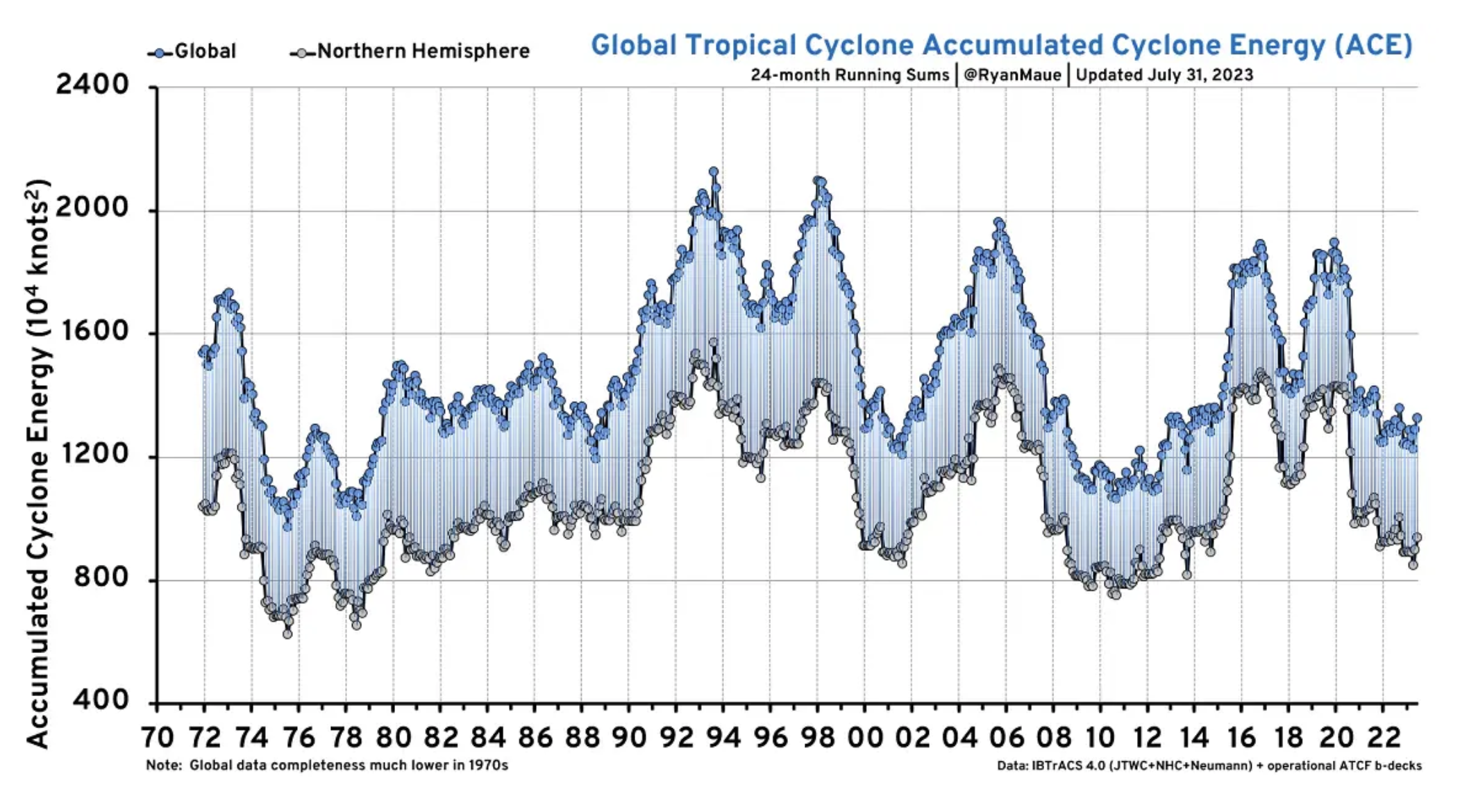
Can you spot the increasing trend? Neither can I. These clowns from the NAS are claiming that even though ACE has not gone up overall, and has gone down in the most recent years, they just know that whatever hurricane comes through next is the fault of Exxon. That’s the level of quality of this work.
On July 14, the day before this Report was released, a guy named Pat Parenteau, gave an interview to Politico’s E&E News on this subject. Parenteau is a long-time advisor to a law firm called Sher Edling, which is known for representing dozens of plaintiffs in lawsuits against fossil fuel producers claiming harm from climate change. The E&E News article is behind paywall, but Energy in Depth here has the key quote from Parenteau:
“A report with the kind of gravitas that the National Academies can bring will be a huge boost to the plantiffs’ cases.”
Further from EID:
The people involved in the report’s development include Michael Burger, an academic and attorney for climate plaintiffs’ firm Sher Edling, as well Delta Merner, who leads the Union of Concerned Scientists’ Climate Accountability Campaign and served on the NAS committee guiding the report’s development until January 2025. Both Burger and Merner have publicly discussed the critical relationship between attribution science and climate litigation.
The federal government needs to completely defund the NAS today, if not sooner. Also, I call on every member of the NAS to resign. If you stay in, you are complicit in this total scam.
UPDATE, July 24: John Christy sends along links to two of his recent papers. The first, published in April 2026, is titled “Declines in hot and cold daily temperature extremes in the conterminous US, 1899–2025.” That’s right, it’s declines rather than increases. The second, from November 2019, co-authored with Ross McKitrick, is titled “Assessing changes in US regional precipitation on multiple time scales.” From the abstract of the second paper: “We show that 2000-year proxy-based reconstructions of the Palmer Modified Drought Index for the US Southeast (SE) and Pacific Coast (PC) regions exhibit LTP and reveal post- 1900 changes to be within the range of longer-term natural fluctuations.” John says that an updated version of the second paper is currently under review pending publication. Needless to say, the NAS Report did not cite and completely ignored both of these two papers (along with all other adverse evidence).