Britain: Time To Go Back To Coal
/Among our “climate leader” jurisdictions, Britain is a serious contender for the top spot. Sure Germany got started earlier than Britain, with the so-called “Energiewende” going back to the 1990s; and upstart American states like California and New York each think that their own hair shirt energy restrictions should qualify them for the number one position.
But Britain’s suite of policies in the aggregate is hard to top: mandatory Net Zero goals set by statute; madcap buildout of wind and solar electricity generation; shuttering of generation from coal and natural gas; refusal to permit drilling in the North Sea; complete ban on fracking. The Energy Minister of the current Labour government — Ed Milliband — is as crazed a climate zealot as you can find anywhere. The British have even dynamited coal-fired power stations to be sure that nobody could ever change their minds about this Net Zero thing and try to re-start the plants.
Here from a post I did back in 2022, is a picture of the former Longannet coal plant in Fife, Scotland, getting dynamited to smithereens in 2021.
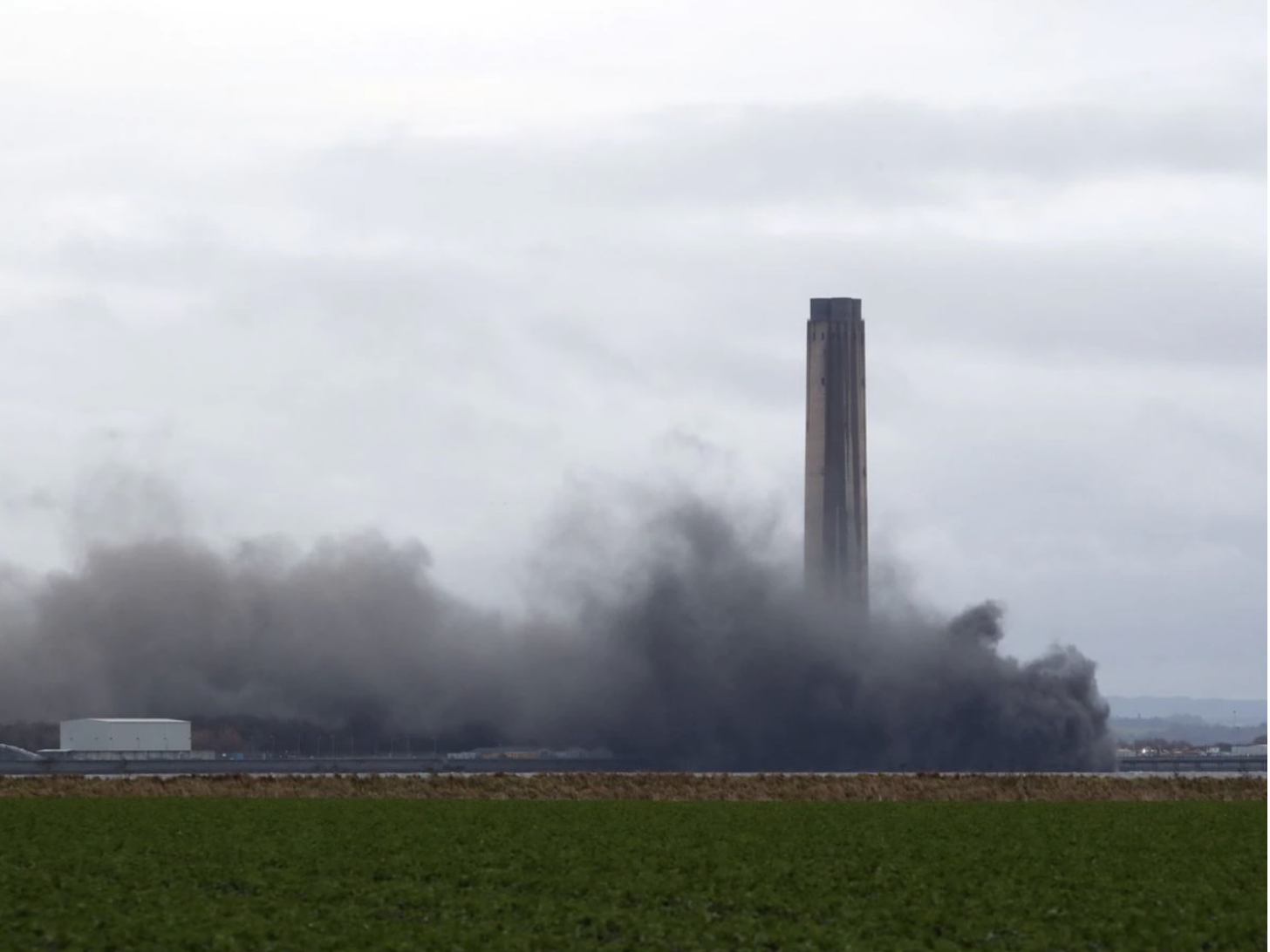
The last coal-fired electricity generation station in the UK closed in 2024. Today, the UK claims to get about 45-47% of its electricity from “renewables,” although that includes about 5-7% “biomass,” plus a small amount of hydro. The wind/solar contribution is around 35-40%. Milliband thinks he can further increase that percentage by just building more and more wind turbines and solar farms.
But unfortunately for the British, their wind and solar generation facilities seem to be subject to all going quiet at the same time, often inconveniently at the very hottest or coldest times of the year. Building more and yet more of them does not solve the problem. Some call this Britain’s “looming firm generation capacity crisis.”
So what’s the answer? How about doing the unthinkable — bring back coal!
On June 9, Andrew Montford, Director of Net Zero Watch, addressed this issue with his new Report “Thinking the Unthinkable: Coal Power and National Security.” (Full disclosure: I serve on the Board of the American affiliate of Net Zero Watch.). Here is the basic assumption underlying Andrew’s paper:
[T]he deteriorating state of the UK economy – unsustainably high electricity prices, low growth, deindustrialisation and a declining tax base – means that Net Zero and, along with it, carbon pricing, will be abandoned, no matter which party is in power.
I think that is clearly right. Reality has caught up with them. It is only a question of time until they are forced to abandon the Net Zero fantasy.
Andrew’s Report also focuses on the national security implications of unreliable electricity, with its inherent need for insecure backup from imports:
[I]mports and offshore production are both vulnerable to the actions of hostile powers, as the sabotage of the Nordstream pipeline in 2022 made clear. In this regard, the UK is horribly exposed. Nearly half of our gas supply comes from Norway. Sabotage of the Langeled pipeline, which alone brings around 20%, would be catastrophic for the UK, and would quickly lead to a civil emergency.
Is it even possible to raise the subject of coal power generation today in the UK, where that fuel has been subject to a decades-long campaign of vilification? Montford:
While such a step [i.e., reviving coal generation] was unthinkable just 12 months ago, the political landscape is moving quickly. Polling by More in Common has found that that ever-rising energy bills are causing political volatility and fragmentation. Italy and Germany have both recently announced the extension of the lives of their coal-fired power stations. As a result, new voices are being listened to. As a hint of just how far the Overton window has already moved, the Reform party’s manifesto for the Scottish elections featured a pledge to allow coal mining once again. It clear that the looming geopolitical threats to the country now mean that the time is ripe to reconsider the consensus against coal that has taken hold in the last two decades.
So all that is needed is a sufficiently imminent crisis to force the issue of coal generation back into the public conversation. The two short weeks since issuance of Andrew’s Report have brought to Britain some indicators of the dire corner it has backed itself into. Readers here probably know about the recent record-setting heat wave that has covered much of Europe, including Britain. Paul Homewood, of the Not a Lot of People Know That website, has a post on June 25, titled “No Wind? No Sun? What Could Possibly Go Wrong?” Homewood’s post includes extensive excerpts from a piece in the Telegraph from June 24 (behind paywall). The gist is that on June 23 the UK’s National Energy System Operator (NESO) had issued an emergency power supply warning, which was then withdrawn after NESO secured emergency supplies from the continent. However, obtaining the emergency imported supplies required getting a special waiver of EU export restrictions. From the Telegraph piece:
The National Energy System Operator (Neso), which manages the grid, issued a rare emergency power supply warning on Tuesday after soaring temperatures triggered a slump in solar energy, with panels struggling to work in the hot conditions. It was subsequently withdrawn after Neso secured emergency supplies from the Continent on Wednesday. Kathryn Porter, an industry consultant, said Neso had “begged the EU” to lift import trading limits which would have capped the amount of energy Britain could import. Ms Porter said the sudden easing of restrictions had allowed the UK to obtain 2.3 gigawatts (GW) of imports versus a 1.5 GW limit introduced in May, helping Britain avoid power shortages.
OK, crisis averted, for now. But Homewood reports on a few other aspects of this solution to Britain’s crunch. First, they had to buy the power from the Netherlands on a day-ahead market that was already at a high level due to the heat wave and lack of dispatchable capacity. Homewood links a Tweet from a firm called Montel Analytics as to the price: “[T]hey are paying up to €1600 per MWh for it.” €1600/MWh is equivalent to more than $2000/MWh, or more than $2.00/kWh. That will translate to a retail price of around $2.50/kWh, compared to average U.S. retail electricity prices of under $0.20/kWh.

Oh, and almost all of the imported power was generated from either natural gas or coal.
In other words, the only effect of the wind/solar generation obsession has been to drive up the cost of electricity to consumers and businesses to ridiculous levels. And, next time around, when the next wind/sun drought comes along on a hot evening, the imported power may not be available at all, and widespread blackouts could follow.
Thank you, Andrew, for getting the subject of coal-fired electricity generation back into the conversation. It’s only a question of time before this will happen.