The Fantasyland Of New York City's Discount Grocery Stores
/If you have paid attention at all to New York’s idiotic new Mayor Zohran Mamdani, you probably know that one of his big promises is to open a chain of City-owned grocery stores. These stores, supposedly, will solve the problem of “affordability” of groceries by offering a basket of standard items at prices some 30% below what the other stores charge.
Now I recognize that there has been some substantial inflation in the food sector of the economy in the past few years. In some cases, and for some families, the price increases have been unpleasant or even difficult. However, I submit that there is no way to look at the American food supply and delivery system without seeing it as something close to a miracle for human flourishing.
According to the Department of Agriculture’s Economic Research Service, the share of disposable personal income spent on food by U.S. consumers in 2025 was 9.7%. And about half of that was spend “away from home,” that is, in restaurants. That leaves less than 5% of disposable personal income as the average cost of feeding a family at home. This has to be an all time record in human history. Also, according to USDA data, the “at home” cost has continued its long term decline as a portion of personal income over the past several decades, going from about 6% in 1997 to under 5% in 2025. Here is USDA’s chart covering the period 1997 - 2025:
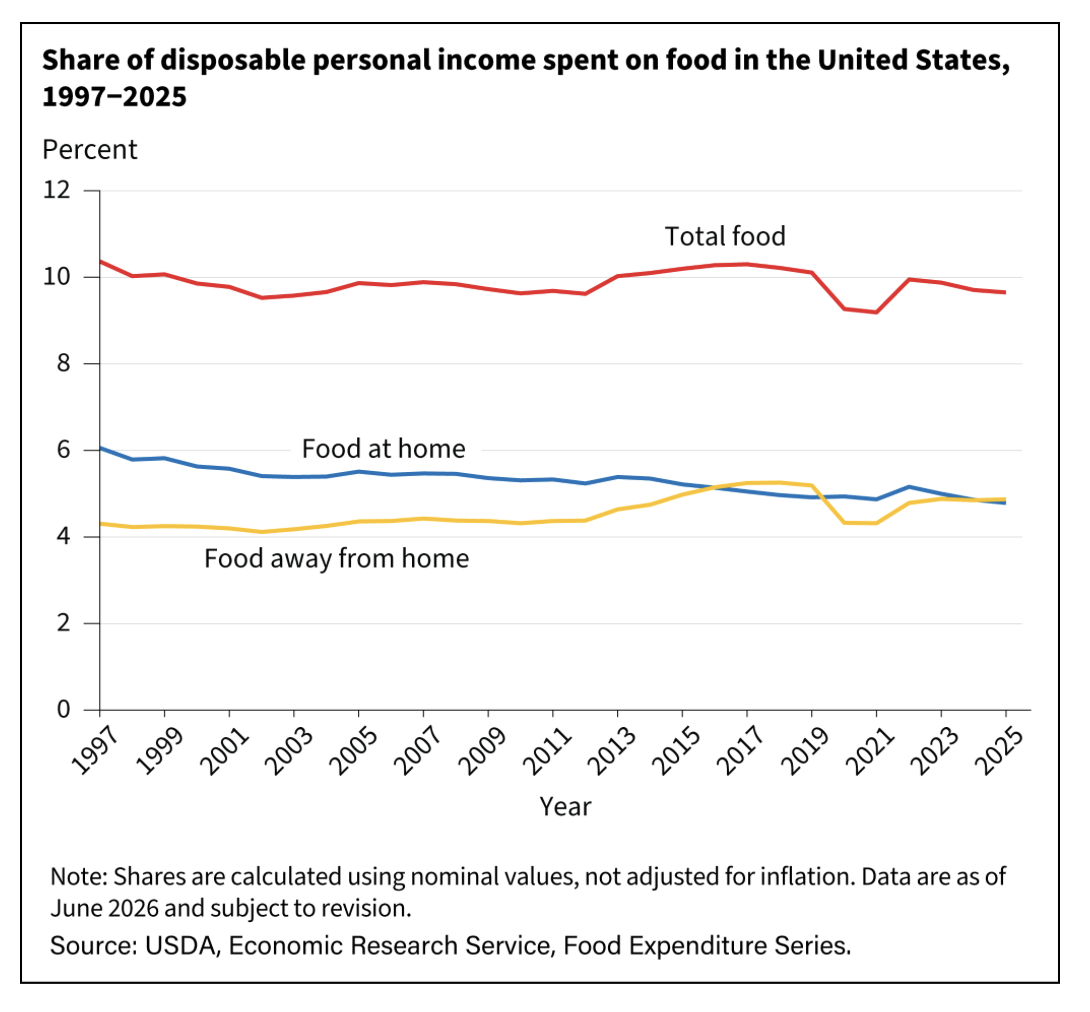
For comparison, in the European Union, average household food expenditure as a percent of disposable income is around 14% (with richer countries like Germany and the Netherlands around 10% and poorer countries like Romania at well over 20%); and in really poor areas like sub-Saharan Africa, average food expenditures can be 40% of income or even more.
But even though our food prices are the lowest (as a proportion of income) anywhere in the world, and the lowest at any time in human history, Mamdani and his crowd have the idea that these prices are unduly high because nefarious capitalist actors somewhere in the supply chains are siphoning off outrageous profits. Therefore, he and his friends — none of whom has ever actually held a job in this industry — can order up new stores to offer the same products at large discounts.
On August 5, New York’s Economic Development Corporation — apparently the agency tasked with conjuring up the discount grocery stores — held an online forum to answer questions on the plan. The New York Post reported on the event in a piece on August 6 with the headline “Mam’s Store Plan Is Bananas.” In the Post’s telling (which is likely correct), the EDC has no idea what it is doing in going into the grocery store business:
An Economic Development Corporation official, during an online info session, was forced to admit to prospective partners that the city had yet to figure out simple logistics, including how to reimburse operators or pay store employees. The EDC official even confessed the city didn’t know how it would calculate the cost of the supermarkets’ signature “core basket” of essential goods, which Mayor Mamdani has said would be sold at 30% “below typical retail prices.” “The city does not have the expertise or experience in running stores, and so we’re looking to start to identify operators to integrate with us,” said Jamie Horton, vice president of strategic initiatives and business operations for EDC, a quasi-public nonprofit funded by the city. Horton fielded questions from about a dozen attendees during the 45-minute Zoom call about the EDC’s 44-page “request for proposals” seeking bids from prospective operators to run the shops, which are estimated to cost $70 million to build out.
It would be a huge understatement to say that these goo-goos haven’t thought their plan through. Of course the biggest question is, what’s to keep the first customer into the store from buying up all the discount merchandise to re-sell for his own profit? That would leave the store empty — the condition of essentially all grocery stores in all socialists systems at all times. On August 6 daughter Jane posted a video asking the question “Can we REALLY expect people to ‘take only what they need’”?
Way back in August 2016 — ten years ago — I had my own post on this subject, titled “Why Capitalism Works And Socialism Doesn’t: Arbitrage.” Excerpt:
If you can buy something cheaply and immediately turn around and sell it for more, chances are you will do it. Why shouldn't you? Is there something wrong with that? This is completely normal and pervasive human behavior. This behavior is also a source of a very large percentage of the wealth in wealthy countries where such behavior is permitted. It is also the reason why, in market economies, comparable things almost always trade for very comparable prices. But of course, in a world of socialism -- that is, where a government attempts to create perfect fairness and justice by means of coercive distribution -- arbitrage poses a mortal threat.
It will be more than a year before any of Mayor Mamdani’s grocery stores actually open. (They are currently projecting the end of 2027, and a good bet is that they will not make that deadline.) But it’s easy to predict that things will not go as they plan. The options are limited: (1) allow anyone to buy as much as they want, in which case enterprising arbitrageurs will quickly buy all the discounted goods and greater and greater subsidies will be needed to keep the stores stocked, with essentially all the subsidies ending up in the pockets of the arbitrageurs and few if any discounted groceries available for the intended beneficiaries; or (2) immediately impose tight rationing (one dozen eggs per customer!), only to watch clever arbitrageurs quickly find ways to get around the rules, or (3) have perpetually empty store shelves, like all other socialist grocery store efforts of the past. I don’t know which it will be (or perhaps some combination), but there aren’t really any other options. Reality is harsh.