Mao Zedong Was A Monster
/The 50th anniversary of the death of Mao Zedong has just passed. (He died on September 9, 1976.). I did not see large amounts of commentary about Mao on the occasion of the anniversary, but everything that I did see was either neutral or positive, with the majority being praise. And as I looked around for any commentary I could find from around the date of the anniversary, most of what I found is again praise.
How could that be? This man was a monster. Certainly, the death toll for which Mao was responsible was a large multiple of anything ever attributed to Hitler, and also a multiple (although a smaller one) of the carnage committed by Stalin. Does any self-respecting person give effusive praise of either of those two? And if not to them, then why to Mao? And it’s not just the death toll. Mao’s frankly ignorant and stupid extreme Marxist economic “theories,” if you want to call them that, caused decades of abject poverty, needless suffering and misery and often starvation for hundreds of millions of Chinese. And then there was the ruthless suppression of dissent (or even the slightest disagreement), which obstructed all efforts to introduce any sanity to counter the economic destruction. I can’t even think of a coherent defense for what Mao did to China and its people.
So let’s see what we can find in the press on the occasion of the anniversary of this man’s death.
The South China Morning Post had a piece on September 9 with the headline “Young Chinese turn to Mao Zedong for life advice, 50 years after his death.” (SCMP, based in Hong Kong, is owned by the Alibaba Group, and has no official relationship with the Chinese Communist Party. However, their independence in today’s Hong Kong is highly dubious.). Excerpts:
When you are denied a pay rise, when you feel anxious about your children’s education, or when you are alienated by colleagues, Chairman Mao can help. At least, that is what China’s online influencers and their hundreds of thousands of followers believe. Wednesday marks the 50th anniversary of the death of Mao Zedong, founding father of the People’s Republic of China.
SCMP notes that there was no official celebration in China of the anniversary of Mao’s death, but that Mao’s popularity is on the rise, with the clear encouragement of the state:
[I]t is hard to ignore the quiet comeback of Mao’s popularity in the country. In recent years, younger generations of Chinese have rediscovered Mao as their life coach. They organise online book clubs devoted to his works, spread the gospel through artificial intelligence-narrated videos, and affectionately refer to him as jiaoyuan, or “teacher”, a title Mao himself once said he preferred. . . . [M]uch of this youthful sentiment aligns with China’s official narrative about Mao as a symbol of national independence.
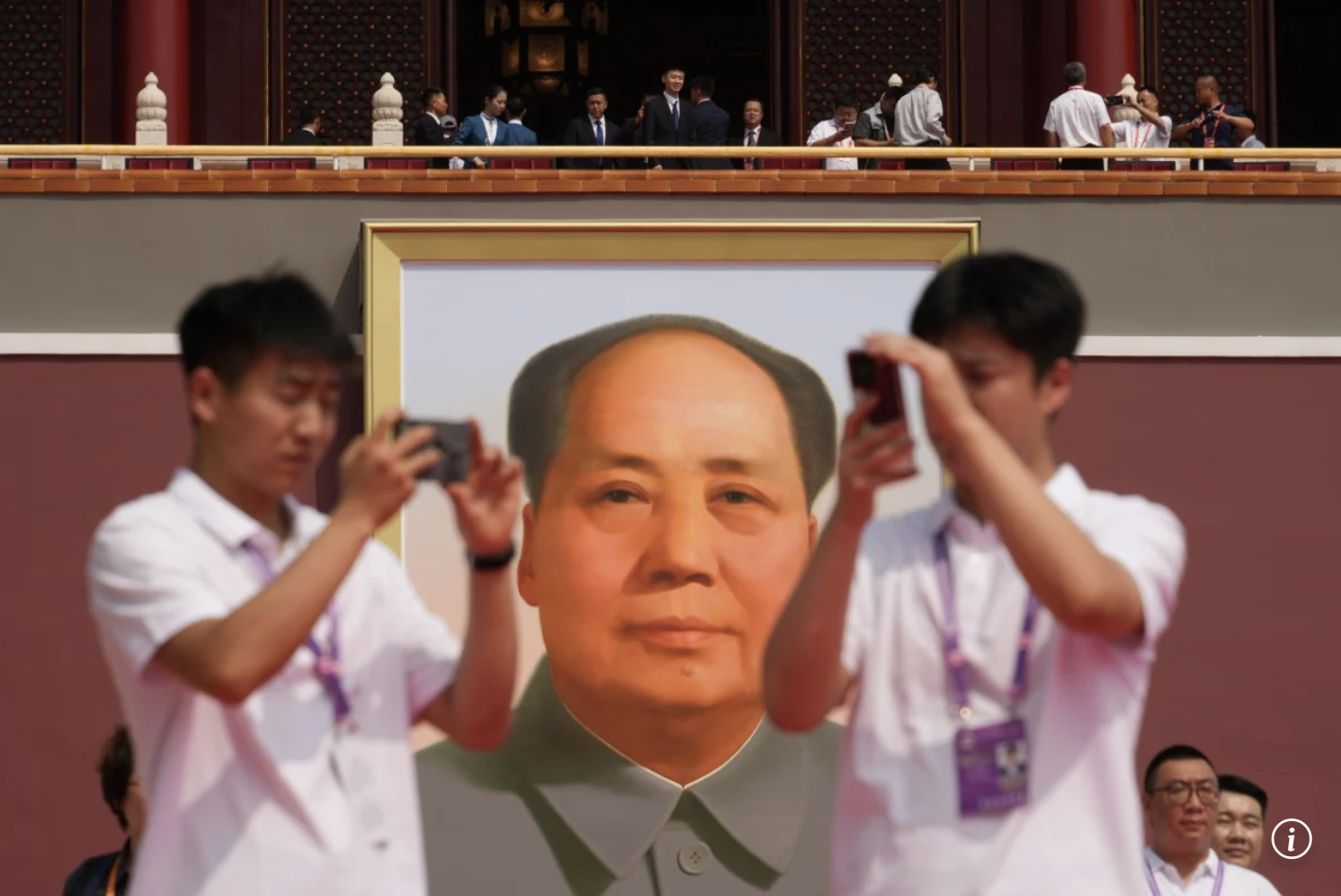
Here from the SCMP is a picture of two young men taking selfies with a large portrait of Mao:
And from the (Hong Kong) Standard on the same date, we have “'Long live Chairman Mao': Supporters pay respects to founder of Communist China.” (Like the SCMP, the Standard is a theoretically-independent Hong Kong based outlet that somehow does not deviate from the CCP line.). Excerpt:
Fifty years after his death, diehard fans of the Chinese Communist leader Mao Zedong lined up Wednesday in his hometown to pay homage, holding portraits, flags and huge floral tributes. Chairman Mao’s . . . life and legacy [were] being commemorated fervently this week by those who still revere him as a visionary leader. . . . The night before, around 1,000 ardent admirers -- some in the short, tunic-style suits famously worn by Mao -- held an emotional ceremony at the statue. . . . "Long live Chairman Mao!" the group roared repeatedly, some pumping their fists in the air and singing revolutionary songs.
Here in the U.S., the press mostly stayed silent on Mao — even as the lesser murderer Hitler is mentioned in the news almost every day. But there is one influencer with a large following who is closely allied with the Democratic Socialists of America and with their current Congressional candidates, and who makes a point of frequently praising Chinese Socialism and by extension Mao. That’s Hasan Piker. Piker has recently made several favorable remarks about Mao (not explicitly tied to the anniversary of his death). The Washington Examiner had a summary on September 18, with the headline “Hasan Piker defends praise of Mao despite millions of deaths under his rule.” Excerpt:
The popular left-wing streamer previously said he would “never criticize” Mao and called him “one of the great leaders of this world,” comments Piker told the outlet were partly made in jest after a brief encounter with police while visiting Tiananmen Square in Beijing. But Piker stood by his broader assessment of Mao’s reign when asked whether he considered the communist revolutionary a great leader. “When I say Mao is a great leader, I mean he’s a great man of history,” Piker said. Piker conceded that there was an “excess” of deaths under Mao, which he attributed to being “born out of mismanagement and famine.”
“Mismanagement and famine.” A few mistakes were made! No Hasan, the famines (multiple over the course of decades), not to mention millions of murders by execution, were not mistakes, but fully intentional.
As I have previously mentioned, I am currently reading Frank Dikötter’s trilogy about Mao’s takeover and rule in China. There are hundreds of excerpts to choose from, but I’ll provide a few.
From The Tragedy of Liberation, pages 58-59, describing what happened in Shanghai and other major cities after the Communist takeover in 1949:
{C]adres vented their hatred in consultation meetings with representatives of trade and industry that degenerated into “struggle sessions” where people were mocked, humiliated and beaten. Soon nobody dared say a word. . . . Within a matter of months, bustling Shanghai was a dying city. Tianjin slipped into slow decay. Guangzhou almost went bankrupt. Factories were idle, trade ceased. Many firms, small and big alike, were driven into the red.
In 1951-52, there was a campaign of terror against the “bourgeoisie.” From page 171:
In the orgy of false accusations and arbitrary denunciations, few escaped with their reputations intact. By February [1952], no more than 10,000 of a total 50,000 “capitalists” in Beijing were considered honest. Similar figures came from other parts of the country. To punish all would wreck the economy. Mao had a solution to this conundrum. He came up with a quota, ordering that a few should be killed to set the tone, while exemplary punishment should focus on 5 per cent of the most “reactionary” suspects. Across most cities, by a rough rule of thumb, about 1 per cent of the accused were shot, a further 1 per cent sent to labour camps for life, and 2 to 5 per cent imprisoned for terms of ten years or more.
The longer things continued, the more the category of “enemies of the Party” expanded. From page 189:
[T]eachers, doctors, engineers and scientists suspected of possessing “counter-revolutionary” links with foreign powers were persecuted. Luo Ruiqing, who now pitched in as head of security, brought the inquisition to bear upon 85,000 teachers in middle schools. One in ten was purged as a deviant element who sabotaged socialism, plotted against the party or encouraged student unrest. In primary schools the number was double. In total, across the country, over a million people were forced to confront accusations of plotting against the state in 1955. . . .
And all this is before we even get to the Great Leap Forward (1958-62) or the Cultural Revolution (1966-76), where Mao and his henchmen cranked up the terror and caused intentional mass famines and racked up really big numbers of starvations and murders in the tens of millions.
The current rulers of China are the successors of Mao, and go around spouting his doctrines as if there is something admirable about them. They seem to have moved on from a mass-murder state to a mass-surveillance state, and at least so far that seems to be working to keep the population suppressed. We’ll see how long that can continue.
Anyway, I didn’t want to let this anniversary of Mao’s death pass without expressing my total revulsion at this man, his successors, and anybody who expresses admiration for them.