Why Ukraine Wants So Badly To Be Independent Of Russia
/When Vladimir Putin has been asked to justify his war for control over Ukraine, his answer is typically that Ukraine and Russia have always been one country. And there is some truth to that. The Russian state traces its roots back to something called the Kievan Rus in the 9th century, with its capital at Kyiv. In the period prior to the 20th century, there were times when parts of today’s Ukraine were controlled by other states (like Poland or Lithuania), but never a time when Ukraine was a fully independent country separate from Russia.
And yet somehow a tremendous desire for independence from Russia seems to have arisen among the Ukrainians. In December 1991, just as the Soviet Union was breaking up, a referendum was conducted throughout Ukraine asking the people whether they wanted to join with Russia or become an independent country. A huge supermajority of Ukrainians — 90.32% overall — voted for independence. When the vote is broken down by province, every single province supported independence, most by well over 90%. The vote was close only in Crimea, but even there 54% supported independence. Other from Crimea, all the provinces gave more than 80% support to independence, with percentages under 85% found found only in the eastern provinces of Donetsk and Luhansk. Here is a map of Ukraine showing the 1991 vote in favor of independence by province:
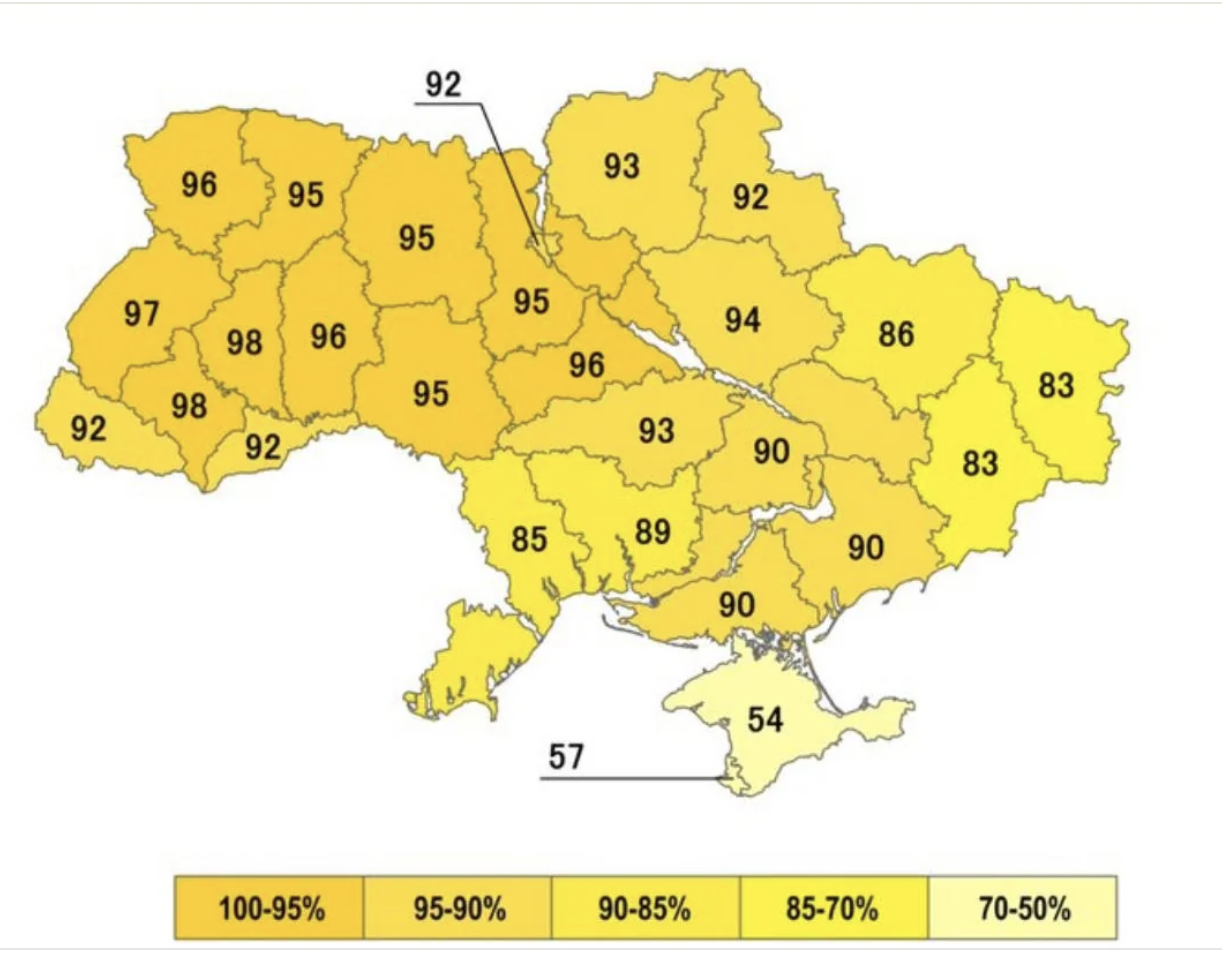
So what had happened to turn the Ukrainians so thoroughly and near-unanimously against Russia? I’ve long had a general sense that Ukraine was treated rather poorly by the Russians during the Communist era, but I only had a vague understanding of any details. Then recently I picked up the book Red Famine, by Anne Applebaum. Applebaum is a historian, perhaps best known for writing for the Atlantic. She is by no means a conservative. The book was published in 2017, which is after Putin had annexed Crimea (2014) but before the current Ukraine war began in 2022.
The heart of the book covers the period of about 1929 to 1933, during which the Soviet state, headed by Stalin, built up to and then conducted an intentionally-imposed famine on the Ukrainian people, killing multiple millions. The background to those events was a Ukrainian independence movement, that had begun growing during czarist times in the 19th century, and then broke out more seriously during the chaos at the end of World War I. In the early 1920s, the bolsheviks crushed the independence movement as part of their consolidation of power throughout the Soviet Union. By the end of that civil war, the Soviet state controlled an unhappy and untrusted Ukraine.
And then came the events of 1929-33. First came “collectivization.” I had long known that the Soviet agricultural system was characterized by large “collective” farms, but I had never given much thought to how they had come into existence. In practice, people who had only recently been independent entrepreneurial farmers were forced to turn over their land and other possessions (animals, buildings, equipment) to the state without compensation. From Red Famine, page 135, describing events of approximately 1929/30:
[Collective farms] would require their members to give up their private property — their land as well as horses, cattle, other livestock, and tools — and to turn all of it over to the collective. Some peasants would remain in their houses, but others would eventually live in houses or barracks owned by the collective, and would eat all of their meals in a common dining room. None of them would own anything of importance, including tractors, which were to be leased from centralized state-owned Machine Tractor Stations. . . .
The process of seizing all the farmland for the state led to mass protests and resistance, which were ruthlessly suppressed. Little information about the process was reported to the outside world. Meanwhile, the loss of their land and independence removed all incentive from the peasants to actually go out and produce a harvest, and the size of the harvest collapsed. From Red Famine page 190, describing events of approximately 1931-32:
Threatened by violence and afraid of hunger, hundreds of thousands of peasants finally relinquished their land, animals and machines to the collective farms. But just because they had been forced to move, they did not become enthusiastic collective farmers overnight. The fruits of their labour no longer belonged to them; the grain they sowed and harvested was now requisitioned by the authorities. . . . As a result, men and women who had so recently been self-reliant farmers now worked as little as possible. Farm machines were not maintained and frequently broke down . . . .
But at the same time the central authorities had imposed the first of their famous “five year plans” (1928-32), supposedly mandating how much would be produced; and then they sent out agents to the countryside to collect food. In effect, the authorities took all the food and left the peasants to starve. As an example, there is this from page 265 of Red Famine, describing events of the winter of 1932-33:
That winter the teams operating in villages all across Ukraine began to search not just for grain but for anything and everything edible. The were specifically equipped to do so with special tools, long metal rods, sometimes topped by hooks, that could be used to prod any surface in search of grain. . . . Thousands of witnesses have described how they were used to search ovens, beds, cradles, walls, trunks, chimneys, attics, trunks, in doghouses, down wells and beneath piles of garbage. The men and women who used them stopped at nothing, even trawling through cemeteries, barns, empty homes and orchards. . . .
This wasn’t a famine that arose as a by-product of drought or bad weather or war or violence. Rather, it was imposed personally and face-to-face in door to door searches and seizures. From page 267:
People who seemed able to eat were searched with special vigor; those who weren’t starving were by definition suspicious. One survivor mentioned that her family had once managed to get hold of some flour and used it to bake bread during the night. Their home was instantly visited by a brigade that had detected the noise and sounds of cooking in the house.
Here is a description of how bad it had gotten by March 1933 (page 305):
In March the OGPU in Kyiv province were receiving ten or more reports of cannibalism every day. In that month their counterparts in Vinnytsia province reported six incidents in the previous month of “cannibalism caused by famine, in which parents killed their children and used the flesh for food.” But these may have been serious underestimates.
And I’m just giving you a tiny sampling.
Anyway, if you wonder why the Ukrainians seem to feel strongly about their independence, this definitely explains it. The Ukrainians have experienced what our new Mayor Zohran Mamdani calls “the warmth of collectivism,” and for some reason they don’t want any more of it.