Today's IQ Test: Which Is Cheaper To Produce Electricity, Wind/Solar Or Fossil Fuels?
/I have been writing here for about a decade that wind and solar would inevitably prove to be far more expensive for producing useful electricity than other methods like fossil fuels, nuclear, or hydro. The reasons are not difficult to understand. Wind and solar, due to intermittency, are not capable of powering a full-time electrical grid on their own. To make the grid capable of fulfilling customer demand 24/7/365, wind and solar require large amounts of additional capital infrastructure — dispatchable back-up generation, energy storage, additional transmission capacity, and more. If wind and solar prove insufficient to eliminate dispatchable back-up generation, then you find yourself running (and paying for) two duplicative systems, when you could have had only one. Energy storage as a potential solution to intermittency turns out to be impossibly expensive. If the only back-up generation you can find that works is powered by fossil fuels, then you haven’t even succeeded in achieving zero carbon emissions in the electricity sector.
And yet we have been, and continue to be, subjected to a constant drumbeat of advocacy claiming that wind and solar are now the cheapest ways to produce electricity. I’ll give you a few examples of that in a moment.
So who is right? We’ve had a long wait here in the U.S. as groups of states have incrementally differentiated their energy systems, and then as data have accumulated as to relative costs between states that have emphasized the “renewables” and those that have stuck with fossil fuels. At this point I think that we can make a definitive call. The answer is that increasing penetration of wind and solar generation on the grid drives electricity costs higher. And not by a little.
Earlier this week a think tank called the Institute for Energy Research came out with a Report titled “BLUE STATES, HIGH RATES ELECTRICITY PRICES: ELECTIONS HAVE CONSEQUENCES.” The Report takes a deep look at five states in particular — California, Florida, Louisiana, Kentucky and New York. Two of those — California and New York — have sought to make themselves the “climate leaders” and have raced to increase use of the renewables and reduce the use of fossil fuels. The other three — Florida, Louisiana and Kentucky — have stuck with fossil fuels. Over time, the prices for electricity as between these two groups of states have diverged dramatically.
But before getting to the details, let’s take a brief look at the party line from those who continue to contend that electricity from wind and sun is cheaper. The unquestioned leader of the advocacy is the International Renewal Energy Agency, or “IRENA,” which is some kind of adjunct of the UN. A good example of their propaganda is their July 22, 2025 Report titled “Renewable Power Generation Costs in 2024.” From the introduction:
Renewables continue to prove themselves as the most cost-competitive source of new electricity generation. On an LCOE basis, 91% of newly commissioned utility-scale renewable capacity delivered power at a lower cost than the cheapest new fossil fuel-based alternative.
“LCOE” is the thoroughly fraudulent “levelized cost of electricity” measure that simply excludes all the ancillary costs of running a grid on renewables (costs like backup, storage, and extra transmission). Unfortunately, when the consumer gets the bill, the ancillary costs get included.
Also in the forefront of the advocacy is the usual gaggle of lavishly-funded environmental groups. From example, consider this from the Environmental Defense Fund on March 21, 2025:
The U.S. is going to need more affordable electric power to supply data centers, manufacturing and homes around the country. . . . Our country’s vast supplies of wind and solar resources are ready to be tapped to support that demand . . . . And these clean energy sources paired with battery storage are cost-effective too. Electricity from wind and solar costs less than electricity from gas and coal.
EDF’s link goes to an IRENA Report. And of course, don’t forget the New York Times. From a piece titled “Want Cheap Power, Fast? Solar and Wind Firms Have a Suggestion,” March 21, 2025:
Wind, solar and battery storage are relatively quick and cheap to construct. That could help avert energy shortages and keep prices low, an argument that renewable energy firms are making to policymakers.
Well, if those claims were true, then California and New York should be beating the pants off Florida, Kentucky and Louisiana on electricity prices. But of course, it is the opposite. Fortunately, we are now far enough into this process to have clear data on the diverging prices among the states. Here is a national map from the IER Report:
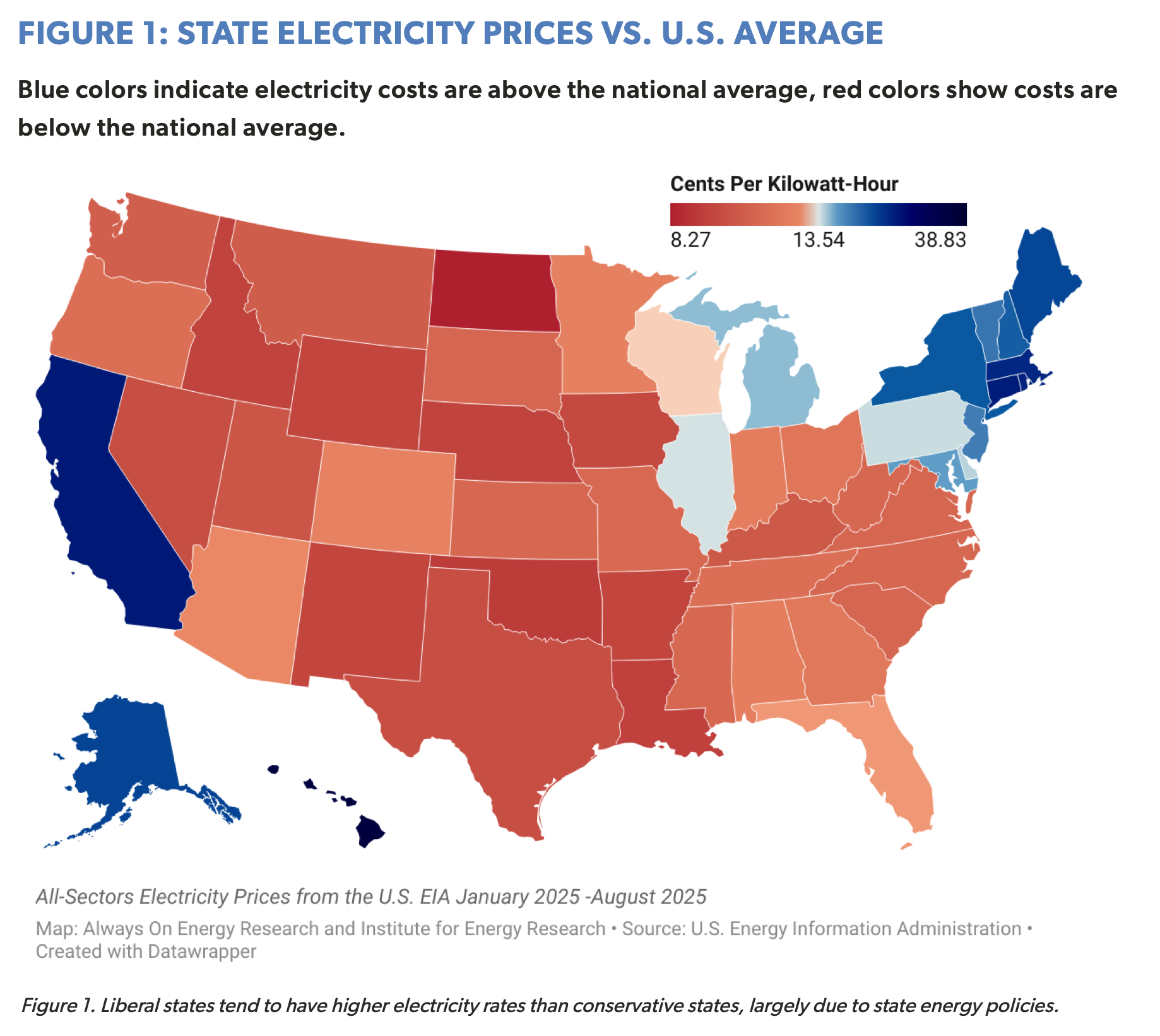
For New York, IER bases much of its discussion on the November 25 Report from the Progressive Policy Institute that I also cited extensively in my post of December 3. For the case of California, here are some details from the IER Report:
California is second in the nation in total electricity generation from renewable resources and leads the country in utility-scale solar generating capacity. California’s generation mix is 42% natural gas, 39% non-hydroelectric renewables, 12% hydroelectric, and 7% nuclear.
And how has that turned out for consumer electricity rates?
California’s electricity rates are the second-highest in the nation. Rates are double the national average. Governor Newsom and California’s state legislature have embraced numerous policies that intentionally increase electricity rates, including a carbon dioxide reduction mandate, renewable mandates, solar cost-shifting (net metering), nuclear reactor closures, and EV charging subsidies, to name a few.
The cases of the three example states that have avoided pursuit of the renewables are equally simple. Louisiana:
In 2025, Louisiana had the third-lowest electricity rates in the United States. The reasons are simple—73% of Louisiana’s electricity is generated by natural gas and unlike California or New York, Louisiana has not attempted to implement carbon dioxide or renewable energy goals through its electricity generation system.
Florida:
Florida delivers electricity at prices 2% below the U.S. average at 13.27 cents per kWh for all sectors. It achieves this mainly by generating 75% of its power from natural gas, even though the state has no significant natural gas production of its own and must import virtually all of it.
And Kentucky:
In 2025, Kentucky had the 13th-lowest electricity rates in the United States and the lowest rates of any state east of the Mississippi River. Kentucky’s rates are 21% lower than the national average. The reasons are straightforward—67% of Kentucky’s electricity is generated by coal and 26% by natural gas. Unlike states such as California or New York, Kentucky has not burdened ratepayers with the carbon dioxide reduction mandates or renewable energy requirements that inflate electricity costs.
To be fair, the IER Report does not cover some states with relatively high penetration of renewables on the grid that nevertheless have below average electricity costs. Prominent examples are Texas and Iowa. Both of those also have full fossil fuel backup capacity, meaning that their electricity costs could be lowered further by eliminating the wind turbines and just paying for one generation system. And, in my view, both Texas and Iowa have reached a practical maximum of wind generation on a grid. My prediction is that attempts in either state to meaningfully increase wind generation from current levels and eliminate fossil fuels will drive electricity costs dramatically higher. But let them go ahead and try. Prove me wrong!
Meanwhile, despite the evidence now available, Mikie Sherrill in New Jersey just won the governorship with a campaign substantially focused on providing more “affordable” electricity through mostly wind and solar generation. Her chances of success are about zero.