President Trump: Don't Pussyfoot Around On Climate Policy!

One of President Trump's unequivocal campaign promises was to pull out of President Obama's Paris Climate Agreement.  Now there is talk that he is going squishy.  Trump going squishy?  And on this issue of all things?

Climate propagandist Coral Davenport has a report in the New York Times on March 2, headline "Trump Advisors Are Split on Paris Agreement on Climate Change."    The advisors advising Trump to stick with the Paris Agreement are said to include Secretary of State Rex Tillerson, First Daughter Ivanka Trump, and of course the Washington Blob of career diplomats.  Tillerson -- wasn't he the very embodiment of evil in his role as CEO of ExxonMobil until just a few weeks ago?  Here's how Davenport articulates the position allegedly now advocated by Tillerson et al.:

[Ivanka] Trump, Mr. Tillerson, and a slew of foreign policy advisers and career diplomats who argue that the fallout of withdrawing from the accord could be severe, undercutting the United States’ credibility on other foreign policy issues and damaging relations with key allies. . . . Foreign policy experts say withdrawing from Paris would have far greater diplomatic consequences than President George W. Bush’s withdrawal from the world’s first global climate-change accord, the 1997 Kyoto Protocol.  “I think it would be a major mistake, even a historic mistake, to disavow the Paris deal,” said R. Nicholas Burns, a retired career diplomat and under secretary of state under Mr. Bush.  "In international politics, trust, reliability and keeping your commitments — that’s a big part of how other countries view our country,” Mr. Burns said.

Really, is this the best they've got?  "Undermining the United States' credibility" and "damaging relations with key allies"?  Under the Paris Agreement, the United States will supposedly cut its "carbon emissions" by 26 to 28% by 2025.  That's only eight years away.  The only mechanism that might actually work that has ever been proposed for achieving such drastic reductions would be to multiply the cost of electricity and gasoline to such a high level that American citizens will become hugely poorer and will be stuck shivering in the dark at home.  China's side of the "agreement" is to continue increasing its carbon emissions by as much as it feels like through 2030, and then (when it thinks it will have fully electrified the countryside and everybody will have cars and its emissions will be about triple ours) maybe leveling off, unless it changes its mind.  (As usual for a Davenport article, she just brazenly lies about China's supposed commitments:  "[T]he Paris agreement includes commitments from every nation, rich and poor, to cut emissions, including China and India, the world’s largest and third-largest polluters."  Fake news, anyone?)  Among all people who are actually awake, this "agreement" makes the United States a laughingstock.  The representatives of the other countries were all giggling behind Obama's back when he signed off on this.  The guys from China and India must have split a gut.  OK, many of the representatives from Europe were likely exceptions.  They are also laughingstocks.

And what exactly is this supposedly "severe fallout"?  That other countries will suddenly realize that we are no longer so stupid that we will cripple our economy for no purpose?  In what way is our failing to decrease carbon emissions drastically over the next eight years even something that other countries care about?  Maybe because they were planning to move in on our export markets as we stupidly priced our exporters out of business?  Why do we owe them that?  I say let's go for the "severe fallout"!

James Delingpole, now working at Breitbart, has a somewhat different take:

Man-made global warming is evidently and demonstrably not a problem.  The people who pretend otherwise are crooks, liars, idiots or shills.  CO2 does far more good than harm.  Fossil fuels aren’t running out – especially not now we’ve discovered the game-changing technology of hydraulic fracturing – and are the ideal solution to our energy needs.  Renewables are a waste of everyone’s time – and always will be.

There is copious evidence to support all these statements and it’s really about time those of us on the winning side of the argument stopped pussyfooting around and apologising for being 100 per cent right. That should include everyone in the Trump administration.  No more cautious speeches equivocating as to whether carbon dioxide is a problem or not, and whether we ought to have more renewables in the mix.  This is a revolution; we’ve got truth and justice on our side. . . .  

I could quibble with a few things there.  For example, renewables are not just a "waste of everyone's time"; instead, they are a tool of impoverishment for the masses and enrichment for a handful of well-connected crony capitalists.  But overall, amen!    


People Don't Pay Any Attention To The Busybodies

On the New York subway these days, they have endless automated announcements about anything you might imagine.  Of course the result is that nobody pays any attention whatsoever.

Riding home last night about 10 PM, an announcement came on that said "Protect your belongings.  Keep your cellphone out of sight."  Here was the scene in my car at the time.

I realized that, in about a third of one car, I was looking at at least half a dozen people doing something or other on their cell phones.  (You may have to enlarge this picture some to spot them all.)  Not one of them paid any attention to the announcement.  They all kept doing exactly what they had been doing.  So I took out my own cell phone and snapped the picture.  Good job busybodies!  

The Airbnb Racial Divide: What's Your Take?

There's a site called "Inside Airbnb" that collects and publicizes data about Airbnb activity and usage in cities around the world.  Its take on Airbnb is generally highly critical.  Founder Murray Cox describes himself as "an independent digital storyteller, community activist and technologist."

A few days ago this site came out with a Report on Airbnb in New York City titled "The Face of Airbnb, New York City."  The subtitle is "Airbnb as a Racial Gentrification Tool."  I am interested on the reaction of readers to the issues raised by this Report.

As background, you undoubtedly know or suspect that there are a large number of predominantly black neighborhoods in New York City.  For this Report, Inside Airbnb counts 72 of them.  While some of those neighborhoods are rather gritty, many of them are quite beautiful.  Examples of the latter include much of Harlem in Manhattan (excluding its public housing projects), and places like Fort Greene, Clinton Hill and Bedford Stuyvesant in Brooklyn.  The website 6sqft, covering the Inside Airbnb Report, includes this picture of a typical block in Bed-Stuy:

Now that these neighborhoods have become quite safe, Airbnb would seem to be a perfect income-making opportunity for the legions of black homeowners.  The houses -- many purchased decades ago for under $100,000 -- now go for $1 million and up; but of course the homeowner can't get the mil without selling and moving.  Airbnb offers the chance to get some considerable income while staying put, and also not having to deal with long-term tenants.

So what is the take of Inside Airbnb?  You can guess it from that subtitle ("racial gentrification tool").  Black residents "suffer the most":

Black neighborhoods with the most Airbnb use are racially gentrifying, and the (often illegal) economic benefits of Airbnb accrue disproportionately to new, white residents and white speculators; while the majority Black residents in those communities suffer the most from the loss of housing, tenant harassment and the disruption of their communities.

Inside Airbnb documents what appears to be a dramatic discrepancy between the rates at which white versus black homeowners make their spaces available via the Airbnb site.  For example:

  • Across all 72 predominantly Black New York City neighborhoods, Airbnb hosts are 5 times more likely to be white
    In those neighborhoods, the Airbnb host population is 74% white, while the white resident population is only 13.9%
  • White Airbnb hosts in Black neighborhoods earned in total an estimated $159.7 million, compared to only $48.3 million for Black hosts
    73.7% of income accumulating to a group representing only 13.9% of the population is a 530% economic disparity
     . . . .  
  • The neighborhood with the highest Airbnb racial disparity was Stuyvesant Heights, in the heart of Black Central Brooklyn, where there was:
    • a 1,012% disparity in the number of Airbnb listings by white hosts
    • an economic disparity of 857% for the total revenue accumulated by white hosts
    • housing and neighborhood disruption due to Airbnb 12 times more likely to affect Black residents than white residents

Funny, but here in Bill de Blasio's New York, I had thought that the single biggest issue, and particularly for African Americans, was "income inequality."  I'm old enough to remember when de Blasio called income inequality the "biggest economic challenge we face."  Actually, that quote is from 2015.  And de Blasio has said plenty of similar things on dozens of occasions both before and after.  

Yet here -- if you believe the Inside Airbnb data (and I have no particular reason to doubt it) -- we have large numbers of African Americans presented with a relatively easy income-generating opportunity, and somehow just not taking advantage of it.  And as far as I can see, in this instance, there is no possibility of asserting some kind of discrimination as the cause for black homeowners not earning the income.  This is not like an employer paying one employee more and another less.  Unless I'm missing something, the black home and apartment owners should have the exact same opportunity as their white peers to list some of their space on Airbnb.  It might take some effort to clean your place up and make it presentable for guests, but doing the actual listing is not very hard at all.

And by the way, I'm not saying that I blame the black residents if they don't want to rent out any of their space on Airbnb.  I don't do that with any of my own space.  But then again, I'm not complaining about any lack of income.  If I was in need of income, I would definitely consider renting out some of my space to generate some.

Anyway, if the big issue really were income inequality, you would think that the progressive response would be to try to help and encourage the black residents to get in on the income opportunities.  If that were your goal, a first step would be to ease up on the restrictive regulations so that more blacks can use Airbnb legally.  (Currently use of Airbnb is generally legal for homeowners, but not for renters.)  Another step might be to offer a seminar on how to use Airbnb.  But instead the push is in exactly the opposite direction.  It seems that we must be horrified at all that despicable income-generation going on all around us.  (According to Inside Airbnb, people trying to make a buck off their properties cause "loss of housing, tenant harassment, and disruption of communities.")

One might get the impression that, to the progressive, the income inequality issue is much more about stoking resentment against the successful, and much less about finding ways for low income people to rise to middle and upper income.  But as I said, I'm interested in the views of readers on this subject.   

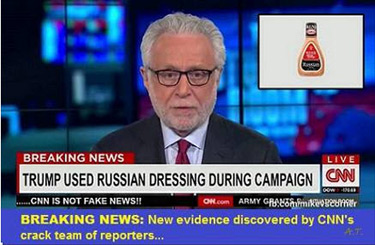
What Is With This Weird Obsession With Russia?

Have you had the sense recently, and particularly so since the inauguration, that the progressive movement has completely lost its mind?  I mean, start with the #Resistance movement and its pointless, often violent demonstrations that couldn't be better designed to alienate everybody who is not already fully committed to radical leftism.  Or consider the climate change cult, desperately committed to keeping the poor poor and driving up everybody's cost of electricity and transportation because they believe that's the way to "save the planet."  But my favorite has to be this weird obsession with Russia.  I can't even begin to figure out what it is about.

The New York Times has easily had several dozen articles since the election about the supposedly nefarious relationship between President Trump and/or his team and Russian officials.  And I don't mean to single Pravda out particularly -- this obsession is all over the mainstream press.  And it goes on day after day with stories of less and less consequence told in breathless tones like they mean something.  Today (just in the last few hours -- presumably for tomorrow's print edition) we have "Kushner and Flynn Met with Russian Envoy in December, White House Says":

Michael Flynn, then Donald J. Trump’s incoming national security adviser, had a previously undisclosed meeting with the Russian ambassador in December to “establish a line of communication” between the new administration and the Russian government, the White House said on Thursday. . . .  [T]he extent and frequency of their contacts remains unclear, and the disclosure of the meeting at Trump Tower adds to the emerging picture of how the relationship between Mr. Trump’s incoming team and Moscow was evolving to include some of the president-elect’s most trusted advisers.  

Scary!  Am I the only one who thinks that it would have been completely incompetent for a president-elect's transition team not to have met at some point before the inauguration with the ambassador from Russia, and for that matter with the ambassadors from 50 or more of the more consequential countries of the world?  

Or consider the immediately prior big story, which was that new Attorney General Jeff Sessions had spoken with the Russian ambassador prior to the election.  Pravda has a brand new editorial up on the subject, again apparently for tomorrow's edition, headline "Jeff Sessions Needs to Go." Excerpt:

In the wake of Wednesday’s revelation that Attorney General Jeff Sessions spoke with Russia’s ambassador to the United States while working with the Trump campaign, despite denying those contacts during his confirmation hearings, key Republican and Democratic lawmakers are calling for him to recuse himself from overseeing any Justice Department investigation into contacts between the campaign and the Russian government. Some are even saying he needs to resign.

It’s a bombshell of a story. 

Look into the "bombshell" story a little, and you find that Sessions, then a senior Senator on the Armed Services Committee, spoke on a panel put on by the Heritage Foundation in Cleveland at the time of the Republican convention.  Some 50 ambassadors from different countries attended. At the end of the panel, several of the ambassadors approached the panel members to shake hands and maybe pose a question or two, in the hearing of dozens of people.  Is this where Sessions somehow agreed with the Russians that they would rig the election on behalf of Trump? It seems that Sessions also had a big one telephone call with the Russian ambassador during the time of the campaign -- as well as other calls with ambassadors from about ten other countries.  Hey, he was a senior member of the Armed Services Committee!  Isn't that part of the job?  Also, we know from the Flynn matter that the NSA recorded all of the Russian ambassador's phone calls, and will gladly leak transcripts to the Times and Washington Post if they are in the least bit embarrassing to any Trump administration official.  So where's this transcript?  

And these are only the latest two out of twenty or more such stories, all alleging some kind of illicit Russian involvement in somehow swinging the election to Trump.  OK, suppose that the Russians wanted Trump to win, and that the Russians are the ones who hacked the Podesta emails, and that the Russians intentionally arranged with Julian Assange to leak the Podesta emails in a way to help Trump and maximize damage to the Hillary campaign.  I don't think it's a given that any of those are true, let alone all of them.  But suppose they are all true.  Why wouldn't the Russians have done it without communicating in any way with the Trump campaign?  Given that the NSA records everything, wouldn't the Russian ambassador be smart enough not to talk about any of these things explicitly on the phone?  And, if there was a transcript out there somewhere where a Trump campaign official promised the Russians something in return for help in the campaign, wouldn't that transcript have been leaked by now? 

And then there is the question of the geopolitical significance of Russia today.  Yes, they do have an outsize military for a country of their population and GDP, and their leader likes to play bigshot.  But really, this intense focus on Russia seems to me to be mostly a vestige of the old Soviet Union days.  Russia does not have nearly the economy it would need to try to rebuild its empire.  It's economy, such as it is, is heavily dependent on selling oil and gas to the West.  Back in the 80s, the Soviet Union had more population than the United States, and pretended to have a GDP of 60% or so of ours and catching up fast.  (And the CIA largely believed it.)  Today:

  • Russia's population is about 143 million and shrinking alarmingly.  Its peak population was over 148 million back in 1995.  The current population is well less than half that of the U.S.  Russia's birthrate is not nearly high enough to sustain the population.  Projections at the link have Russian population going down into the 130 millions by the 2030s, and into the 120 millions by the 2040s.  
  • Russia's GDP for 2016 was under $1.3 trillion, barely 7% of U.S. GDP.  To put that in even more perspective, countries with more GDP than Russia include the likes of Brazil, India, and even South Korea!  For that matter, Mexico is rapidly catching up to Russia in GDP.  (Mexico's GDP for 2016 was almost $1.1 trillion.)

Really, can't the progressives come up with something better to obsess about?

UPDATE, March 5:

Image via NYM and Maggie's Farm.

Meanwhile, over at Fox News, Peter Schwieizer (author of "Clinton Cash") points out that nine shareholders of a Canadian uranium company sold to the Russians donated $145 million to the Clinton Foundation.  The sale required approval from the State Department when Hillary was Secretary of State.  Don't worry, it's no big deal.

Notes From The Front Lines Of Resisting Government Aggrandizement

Among the most famous quotes from Thomas Jefferson is this: "The natural progress of things is for liberty to yield, and government to gain ground."  And he said those words well before there was even a progressive movement, dedicated to the principle that all human problems can be solved by government experts with unlimited power and enough infinite free taxpayer dollars to spend.  Today we have thousands of these progressives strewn throughout the government agencies and the courts, all pushing for expansion of government (i.e., their own) power.  Is it even possible to resist?

One of the front lines in this battle in coming months looks to be over the concept of what is called "Chevron deference."  The name "Chevron" refers to a 1984 U.S. Supreme Court case, Chevron v. Natural Resources Defense Council.  In that case, the Supreme Court held that government agencies should be allowed broad latitude to interpret the statutes and regulations that they then administer.  You may have encountered the term in reading about the nomination of Neil Gorsuch to the Supreme Court.  While Gorsuch's judicial philosophy is thought to be very close to that of Scalia on most issues, he clearly differs dramatically from Scalia on this "Chevron deference" thing.  Here is Jonathan Adler, writing in the Washington Post on February 1:

Scalia feared an overweening judiciary that would use the power of judicial review to direct regulatory policy and supplant the policy judgments of presidential appointees. As a consequence, he was a strong proponent of the Chevron doctrine, under which courts are required to defer to reasonable agency interpretations of ambiguous federal statutes. . . .  Gorsuch, on the other hand, sees in Chevron a potential threat to the fundamental obligation of the judiciary to interpret federal statutes and “say what the law is.”  Writing separately in one recent case, Gorsuch explained that under the Constitution, as written, it is the job of “the people’s representatives” to “adapt the law to changing circumstances. '  . . .  Gorsuch warned that “Chevron seems no less than a judge-made doctrine for the abdication of the judicial duty.”  Allowing agencies to offer authoritative statutory interpretations, Gorsuch warned, threatens to transfer “the job of saying what the law is from the judiciary to the executive,” thereby inviting “the very sort of due process (fair notice) and equal protection concerns the framers knew would arise if the political branches intruded on judicial functions.”

Now, at first blush, it would certainly seem that "Chevron deference" is the ultimate unfettering of the government to enable it to expand as much as it wants, and with nothing to stop it.  Of course every agency interpretation of a statute or regulation will be in a way to give the agency itself more power!  For Exhibit A, look to the EPA under Obama, which has interpreted the term "waters of the United States" to cover every puddle and wet spot (in order to claim jurisdiction over a good half of all private land) and has determined that a colorless, odorless gas (CO2) is a "danger to human health and welfare" (in order to claim jurisdiction over the entire energy sector of the economy).  

But meanwhile, while Chevron deference hands enormous powers to the agencies, it also acts as a constraint upon the courts.  Could it be that the courts are even more dangerous than the executive agencies in expanding their own power?  Before racing too quickly to a conclusion, you might want to consider the Chevron case itself.  The case arose out of an EPA interpretation of the Clean Air Act in a way that actually reduced the number of projects that would be required to obtain an air quality permit from EPA.  Essentially, EPA said that all "sources" of pollutants within any overall project (referred to in the jargon of the time as a "bubble") would be considered as one "source," and there would therefore be no need to obtain a permit to make changes as long as the total emissions within the particular "bubble" did not go up.  This was in the early days of the Reagan administration, and the EPA Administrator was none other than Anne Gorsuch -- Neil Gorsuch's mother.  Meanwhile, the DC Circuit continued to be dominated by appointees of previous Presidents, including Jimmie Carter.  

Needless to say, the Natural Resources Defense Council sued EPA to force it to apply the more intrusive regulatory regime that had preceded.  And the DC Circuit agreed!  This was in the pre-Scalia era of statutory interpretation, when courts often looked to what they thought was the "overall purpose" of a statute in deciding how to interpret it.  Hey, this statute was intended to clean up the air!  (Notice that this method of statutory interpretation does not require any consideration of the actual words of the statute.)  Therefore, there may not be an interpretation that allows projects to proceed while only keeping the level of air pollution the same as before.  Here is how the DC Circuit stated its reasoning:

 [I]n ASARCO, Inc. v. EPA, 578 F.2d 319 (D.C.Cir.1978), the court ruled out application of the ["bubble"] concept to national new source performance standards ("NSPSs") which the Act directs EPA to set with a view to enhancing air quality. In each case the court focused on the purpose Congress envisioned for the particular program at issue. ASARCO declared the bubble concept impermissible when the congressional objective was improvement, rather than simply preservation, of existing air quality. . . .  Congress, EPA does not dispute, intended the new source review requirements to operate not simply as a quality-maintaining scheme but specifically to promote the cleanup of nonattainment areas.  We are therefore impelled by the force of our precedent in Alabama Power and ASARCO to hold that EPA's regulatory change, its employment of the bubble concept to shrink to relatively small size mandatory new source review in nonattainment areas, is impermissible.

So there!  As you may have guessed by now, the Supreme Court reversed, and thus we have the concept of "Chevron deference."  But this was only one of many circumstances of that Reagan era where the courts, particularly the DC Circuit, thought it was their business to direct agencies what to do if the court thought the agency was being insufficiently aggressive in its regulation.  The courts had become a major factor in resisting Reagan's efforts to reduce the size and impact of government.

During the Obama era, it was the opposite -- agencies aggressively seeking to expand their power, and courts often dominated by Bush appointees.  Of course, those judges "deferred" -- and government power expanded.  And now things have reversed yet again: we have new President Trump, but a DC Circuit (and most other Circuits) dominated by the appointees of the President Obama.  Will those courts be resistant to agency efforts to roll back regulation, as Trump has directed the agencies to do?  Without doubt, they will.  As of now they are constrained, at least a little, by Chevron deference.  But do you now see how we seem to have gotten ourselves onto a one-way ratchet of increasing government power (as foreseen by Jefferson)?  So long as the progressives control one or the other of the executive agencies or the courts, they can somehow keep the power of government expanding.

For the long pull, I am not a fan of deference to agencies as interpreters of statutes.  Gorsuch is right that statutory interpretation is at the core of the judicial function.  This is why appointing non-progressive judges, at all levels, is so important.  Meanwhile, maybe the Supreme Court will not get around to undoing deference until Trump gets at least a few appointments to the DC Circuit.      

Today's Entry In The Fight To Preserve All Government Spending Everywhere

As reported here on Friday, the battle is on to protect every last dollar of government spending everywhere.  Tomorrow President Trump will make his first speech to a joint session of Congress.  The buzz is that much of the speech will be about major spending cuts in certain departments.  How to head this off?

At the New York Times, today's contribution is a big unsigned editorial about the travails of Kansas, headline "Kansas' Trickle-Down Flood of Red Ink."  The gist is that the state of Kansas has already tried this ridiculous idea that tax cuts can spur economic growth, and all it has to show for the effort is a big $1.2 billion two-year projected budget deficit -- a "flood of red ink."  Tax cuts are a proven failure!  The editorial reports on the recent noble efforts of some Kansas legislators to close the budget gap by undoing tax cuts dating from 2012-13, an effort just now thwarted by a veto from Governor Sam Brownback.  As usual for a Times editorial, it drips with scorn for the idiots who think that tax cuts might ever be a good idea.  Excerpt:

[Kansas Governor Brownback] made his state an experimental showcase for the driving philosophy of supply-side theorists like Paul Ryan, the House speaker, who served as a staff acolyte when Mr. Brownback was in the Senate. . . .  The result [in the Kansas legislature] was less a victory for Mr. Brownback than a rebuke to his leadership, in particular his near-suicidal clinging to his trickle-down obsession when he should be engineering a compromise with the Legislature. Kansas faces a $1.2 billion budget gap across the next two years that must be dealt with.

Somehow though, in the editorial and elsewhere in this edition of the rag, the Times does not mention anything about our neighboring state of Connecticut, or how it is doing relative to Kansas.  I'm not saying they have to, but then, Connecticut is a state quite similar to Kansas in some respects.  For example, the population of Kansas is just under 3 million, while Connecticut's is just under 3.6 million.  However, Connecticut's state budget, at about $20.5 billion (about $5900 per capita) is noticeably higher than that of Kansas, which is about  $16 billion (about $5300 per capita).  

Kansas and Connecticut in recent years have adopted opposite approaches to dealing with the demands of government constituencies for more spending.  In Kansas, as the Times notes, there have been income tax cuts.  Until 2013, there was a top rate of 6.25%, but the cuts at that time lowered the rate to 4.9%, and also put into effect further scheduled cuts.  The top rate for 2017 is 4.6%.  The Times attributes Kansas' projected deficit of $1.2 billion to those cuts.  In Connecticut, top income tax rates have only gone up.  The Connecticut income tax only began in 1992, at a top rate of 1.5%; the most recent increase was from 6.7% to 6.99% in 2015.

So how have the ever-increasing income tax rates done in ending Connecticut's budget deficits?  According to the Connecticut Mirror from November, "nonpartisan analysts" who had been given a look at Connecticut's numbers were projecting a deficit of $1.5 billion for 2017, and $1.8 billion for 2018 -- a total of $3.3 billion over the two years.  That's close to triple Kansas' projected deficits over the same period.  Funny that Pravda doesn't mention this.  (I'm old enough to remember when in 1991 then Connecticut Governor Lowell Weicker pitched his 1.5% income tax as a temporary measure to deal with a one-time budget "emergency.")

Meanwhile, how is Kansas faring versus Connecticut in the area of economic growth?  I would preface this by pointing out that the effects of either good economic policy or bad take effect slowly and can only be noticed over a number of years.  For an example on the "bad" side, note that Venezuela was reporting an economic "miracle" of spectacular growth as late as 2013, some 15 years after the ascendancy of Chavez, supposedly as a result of blowout government spending of the socialist regime.  Then the bottom fell out.  On the reverse side, Kansas' income tax cut of 1.65% over several years is not nothing, but is relatively small when viewed against a federal top rate of about 39% that applies nationwide.  Gov. Brownback has rather exaggerated his case by calling the cuts "revolutionary" at some times (although perhaps it is the direction of the change, rather than the magnitude, that he is referring to).  Anyway, can we find anything noticeable in the numbers?  In summary, not much.

The unemployment rate from the U.S. Labor Department for Kansas for December 2016 was 4.2%.  For Connecticut it was 4.4%.  (Not a big deal.)  A chart from the federal Bureau of Labor Statistics here shows that Kansas gained about 60,000 jobs from 2012 to 2016 (on a base of about 1.4 million), but then promptly lost about 30,000 of them back in 2016.  That loss of 30,000 jobs came without any noticeable increase in the unemployment rate.  Was it even real, versus a quirk of the statistics?  A chart here from the Connecticut Department of Numbers shows Connecticut employment growing about 40,000 from 2012 to 2016 on the employer survey.  Overall, on these two measures, the results of Kansas and Connecticut over the past few years cannot really be distinguished.

On the other hand, I would point out that the state of Connecticut was booming back in the 70s and 80s, when New York income taxes were higher than they are today and Connecticut had no income tax at all.  Then Connecticut put in the income tax in 1992, and they have had essentially no job growth at all in the 25 years since.  Moreover, in the most recent three years, Connecticut has seen population declines.  There could be other causes for this kind of long-term stagnation, but the ever-increasing income tax stands out as a major one.  The other big ones are aggressive public sector unions and an associated massive pension debt.  Is this what the New York Times would recommend for Kansas?  And how about for the federal government?

UPDATE, March 1:  In the comments, mvs4000 suggests comparing real GDP growth of Kansas versus Connecticut from economic data published by the St. Louis Fed.  For those interested, the answers are:  Connecticut real GDP for 2012 was $228.2 billion, and for 2015 (latest) $225.5 billion, a decline of $2.7 billion, or 1.2% over those three years.  Kansas real GDP went from $131.3 billion in 2012 to $134.3 billion in 2015, growth of 2.2% in three years.  Not great, but hey, way better than Connecticut.  Also, as Michael Moran points out in the comments, two of Kansas' main industries, energy and agriculture, had downturns in the period; Connecticut does not have the same excuse.  Out there in the rest of the states, there is not a perfect correlation between top income tax rates and economic growth, at least in this particular relatively short window, but there definitely is a general trend in favor of the lower-tax states.  Highest-tax California saw respectable growth over the same 2012-15 period of 10.5% ($2,013.6 billion to $2,225.4 billion), while next-highest-tax New York saw not-so-respectable growth of only 1.8% ($1,231.8 billion to $1,254.8 billion).  At the other end of the tax scale, zero income tax Texas had growth of 15.2% ($1,310.5 billion to $1,509.8 billion) -- and that's even with the collapse of oil prices in 2014-15.  Zero income tax Florida had growth of 9.0% ($729.4 billion to $795.0 billion).  If you want to check out any other states, go to fred.stlouisfed.org.