What Is The Difference Between "Flexible Underwriting" and "Predatory Lending"?

Even as Fan and Fred reinflate rapidly out of sight of everyone, there is a new nominee to head their "regulator," now going under the name of the Federal Housing Finance Agency (FHFA).  He is Congressman Mel Watt, Democrat of North Carolina.  Haven't heard of him?  He is the representative from the most preposterously gerrymandered district in the country, NC-12, which snakes in a narrow band across half the state to take in portions of Greensboro, Winston-Salem and Charlotte.  

More on the merits, Paul Sperry at Investors Business Daily in its July 29 edition has a long piece on Mr. Watts and FHFA.  Watts is one of, if not the, leading advocates of "flexible underwriting" as a means of increasing home ownership among low income groups.  IBD gives some of the history:

On the eve of the financial crisis, Watt actually proposed the creation of the regulatory agency he now seeks to run — only, he designed it not to reform Fannie and Freddie but to pressure them to underwrite even more affordable housing, exposing them to even more risk.  The bill he co-sponsored with then-banking panel Chairman Barney Frank — the Federal Housing Finance Reform Act of 2007 — would have forced the federally backed mortgage giants to meet even tougher quotas for affordable lending, while contributing to an "Affordable Housing Fund" to rebuild blighted urban areas.  "The real benefit of this bill is that it will provide a big stimulus for more affordable housing," Watt said at the time, ignoring concerns the agencies already were overexposed to low-income loans.

Shortly after Watt's proposed bill to let Fan and Fred inflate things even further n 2007, the twins collapsed to the tune of a direct $189 billion cost to the taxpayer, not to mention the additional indirect costs of the financial crisis.   A further article from IBD on May 6 lists some of the proposed reforms to Fan and Fred that Watt resisted and voted against over the years:  for example, a proposal to require them to hold more capital, and a proposal to cut off their line of credit from the Treasury.

Of course what occurred in 2008 and after was that Watt's "flexible underwriting" turned overnight into "predatory lending."  Suddenly the banks that had had the chutzpah to follow Fan and Fred's guarantees into making sub-prime loans turned instantly from good guys providing "affordable housing," into bad guys leading the unsuspecting and unsophisticated into underwater mortgages from which there was no escape.

IBD points out that there is no indication that Watt has changed his views, and every reason to believe that he will use his post at FHFA to goad Fan and Fred into inflating the next housing bubble as fast as possible and to make it as big as possible.  Is there any possible good that can come of this?  Does Watt, or his sponsor President Obama, really believe that it helps the intended beneficiaries to use Federal guarantees to get people of low income and iffy credit into large loans that they can barely afford?  Well, we're now getting started on another round of that, with little to no chance that it will come out any better than the last round.


Our "Disinterested, Neutral, Expert" Regulators In Action

The theory under which we have dozens of Federal and state regulatory agencies overseeing our economy is that they are disinterested, neutral experts who can set fair and just rules and oversee a transparent and clean marketplace.  Another theory is that they are venal and self-interested human beings like everyone else, having as their primary goals personal advancement and self-aggrandizement and caring little or not at all about the public interest.

So let's consider an example or two.  Back on July 1 in a post entitled Annals of Government Self-Promotion, Big Bank Edition, I considered the large number of huge recent settlements between government regulators (state and Federal) and big banks, and suggested that it would make sense to look at them as a "very sick game of government aggrandizement" whereby the government passes big profits to the banks by keeping interest rates low, and then "any Federal agency that wants its name in the paper can pick one of the big banks and go out and get at least a few hundred million" by purporting to enforce some incomprehensibly complex regulation. 

Well, the tide continues.  Last week J.P. Morgan put out its latest earnings release for the second quarter of 2013, showing net income of $6.5 billion for the quarter -- a very large number, clearly blown up by the continuing if perhaps slightly diminished efforts of the Fed to keep the banks' cost of funds at or near zero.  And literally days later comes a big front page article in the Wall Street Journal that yet a new Federal agency, this time the Federal Energy Regulatory Commission (FERC) is about to hit up JPM for a few hundred mil.   And yes, there on page 2 in the print edition, there is a photo of FERC Chairman Jon Wellinghoff, formerly obscure energy regulator now launched into greatness by his realization that he just needed to go after the right designated villain for some big money.

What is the alleged wrong?  The WSJ article says "market manipulation," but a July 22 article here at Reuters goes into more detail.  Seems that there are basically two electricity markets in California, one for the next day and the other immediate.  JPM figured out that there were pricing discrepancies between the two markets such that it could bid one price in one and a different price in the other, and almost always make money:

JPMorgan's trading strategy, the ISO said, was to submit bids [in the day-ahead market] with high minimum load costs but exceptionally low - sometimes negative - power prices, making them attractive enough for the grid to schedule the plant to run the next day.  But in the following day's real-time market, JPMorgan would change its prices, submitting very high bids that discouraged the grid from "dispatching," or running, the plants.  That would leave the unit running below its minimum level or not at all, triggering a "minimum load" payment to cover those costs.

Is it just me, or that basically just smart trading?  I thought the whole idea of trading for a financial player was to figure out a strategy to exploit pricing discrepancies between different markets or between similar but not identical products so that you could make money no matter which way the market went.  Go long on the stock and short on the option, or long on the convertible debt and short on the stock, or something like that. 

According to the WSJ, the question of whether to settle has divided executives at the bank.  The head of commodities trading was taking the position that "these employees and the bank did nothing wrong."  Maybe not, but that's not how this game is played.  These Federal regulators must not be embarrassed, and must get their names in the paper, and hey, we just earned $6.5 billion as a back door gift to enable the game to go forward.  So the word is that a settlement of around $400 - 500 million is in the works.

I wonder which agency will get the next one? 

Meanwhile, Fortune Magazine in the June 28 edition carries a big story on the rebirth of Fannie and Freddie.  Remember them?  They are the giant "mortgage twins" who securitized and/or guaranteed most of the housing mortgage market, leading to the housing bubble and the financial crisis.  Oh, and they "stuck the taxpayers with a $189 billion bailout bill after their collapse in 2008."  Did you think that after that debacle they were being wound down or phased out?  Guess again.

It seems that in order to conduct "quantitative easing" I, II, III or whatever we are now up to, the Fed needs to buy some $85 billion of bonds per month.  Where to get them?  Well, they have decided that Fan and Fred debt qualifies.  Thus, buy as much as you can, as fast as you can, with the infinite checkbook.  You probably have already guessed where this is going.  First, Fan and Fred get far more money for housing finance with far lower cost of funds than any other player can even approach.  So nobody else can compete with them in buying up and securitizing mortgages.  So the Fan/Fred market share in buying and/or guaranteeing mortgages soars, now back to about 80%. 

But isn't this exactly what got us into the last mess?  As far as I can tell, yes.  All orchestrated by the disinterested, neutral experts at the Fed, who have just multiplied their own balance sheet by a factor of about 5 in the last few years.  Thankfully, no self interest involved there. 

In other news from the Fed, today's WSJ, page 1, reports that none other than Larry Summers is one of the leading candidates to replace Ben Bernanke as head of the Fed.  Larry Summers, former President of Harvard, is the guy who's so smart that he knows that more spending causes less debt and less spending causes more debt.   At the Manhattan Contrarian, we have dubbed him the man among all men with "more credentials and less actual competence."  But he does know to say the most ridiculous of things that the President wants said.  Make him head of the Fed!  He'll be a good "disinterested, neutral expert."

UPDATE, July 26:  I was thinking more about this last night and I suddenly realized that the alleged wrong of JPM in the California electricity matter is that its trading somehow marginally increased the cost of electricity in California to consumers.  Wait a minute!  California has an entire "cap and trade" carbon restriction scheme, the whole idea of which is to artificially increase the cost of electricity to consumers.  Does FERC not understand that that's how to save the planet?  JPM, I have figured out your defense!   


So, New York Times, What Form Of Energy Generation Is Acceptable?

My eye just happened to catch the editorial in Sunday's New York Times celebrating the impending removal of a large power-generating dam on the Penobscot River in Maine.  To the Times, this is a great thing: 

 [Demolition of the dam is] critical to the entire Penobscot River watershed, which covers nearly a third of the state. Thanks to the work of the Penobscot River Restoration Trust and its partners, the lower river will be free-flowing once again, allowing the revival of a complex migratory ecosystem once teeming with fish working their way up from the sea.

Of course, there is no mention in the editorial of how much power is produced by this dam, or what source Maine is going to use to replace it.  Perhaps the Mainiacs are just supposed to reduce their power usage?

Wouldn't you have thought the New York Times would love hydropower?  It's "renewable," and, unlike wind and solar, it works all the time and doesn't need back-up capacity from the hated fossil fuels.  Sure it has some impact on the environment, but so do wind and solar.   Wind and solar take vast amounts of land to generate small amounts of power, and then they go dead at night for solar and on calm days for wind. 

And how about the thousands of birds killed by wind turbines?  If you haven't seen it, check out this article from Britain's Mail Online from June 27.  The headline is:  

Rare bird last seen in Britain 22 years ago reappears - only to be killed by wind turbine in front of a horrified crowd of birdwatchers

It seems that a group of some 40 bird enthusiasts went out to a remote Scottish island to see a rare "white-throated needletail," a type of bird not observed in the area for decades.  Even as they were observing the bird, it was smacked out of the sky and killed by a wind turbine.  There is a video of the killing at the link.   Is hydro's environmental impact really worse?

Hydro produces meaningful amounts of reliable power -- 7% of total power and 19% of the electricity in the U.S., according to this from the U.S. Geological Survey.  Get rid of that, and where do you go?  Fossil fuels (coal, oil, natural gas) are obviously the dominant option -- filling 82% of U.S. energy demand according to this from the Institute for Energy Research.  The New York Times hates all fossil fuels with a huge passion.  (it thinks that fossil fuels cause "climate change.")

Well, the New York Times likes wind.  According to this from Forbes, with huge government subsidies wind had made it up to 3.5% of U.S. electricity generation by 2012 -- which makes it well less than 2% of total power generation.  (No wind-powered cars!)  The Forbes article notes that the large increase in wind capacity over the last few years was largely driven by Federal tax credits that effectively offset about 30% of the cost of building the turbines.  But the tax credit ended on January 1, 2013.  Without that, wind goes from being somewhat uncompetitive to extremely uncompetitive.  Meanwhile, solar is stuck at less than 1% of capacity and is so expensive that massive government subsidies have not made it go anywhere. 

Is there any option left with the prospect of generating enough power to keep this economy going?  As far as I know, there's exactly one: nuclear.  According to this from the World Nuclear Association, nuclear generates about 19% of U.S. electricity, which would put it at somewhat less than 10% of total power generation.  Oh, but not a single new nuclear plant has been built and opened in the U.S. since the Three Mile Island incident in 1979 emboldened the regulators to make the approvals impossible to get.  The regulatory tourniquet was loosened a bit a few years ago, and according to the the WNA, there are now a total of three nuclear plants under construction in the U.S.  That may or may not be enough to replace the old ones being retired over the next few years.  And then there was the Fukishima incident in 2011.

To its partial credit, the Times has spoken modestly in favor of nuclear power, at least as recently as 2010.   Since Fukishima?  Not that I can find.  Needless to say, its friends from groups like Greenpeace, NRDC, and WWF are passionately against nuclear.

I can say that a few years ago I attended an event at the apartment of the then head of the New York Times editorial board, and she definitely had electricity there.  I seriously doubt that she is ready to give it up.  It's just that, in the New York Times mindset, things like electricity come from the tooth fairy. 


Can New York Learn Any Lessons From Detroit?

The good news about Detroit's bankruptcy filing is that it is causing lots of news coverage of that city and how it got where it is.  While most people may have been vaguely aware that Detroit was not doing too well, not many outside Michigan have known the full magnitude of the disaster:  loss of almost 70% of the population since 1950; going from America's wealthiest large city in 1960 to the poorest today; nearly 70,000 abandoned houses; houses for sale for $1000 or even $1 with no takers; most parks closed and almost half of streetlights out; highest murder rate in the country but police response time almost an hour; etc., etc. 

This is the end game of Progressive government.  Here's the recipe:  be the highest tax jurisdiction in the vicinity; agree to generous pensions and benefits for unionized city workers in return for their working to get you re-elected; get as many people as possible into dependency and handouts; have a business environment hostile to start-ups and entrepreneurship while doing big-time crony-capitalism and show projects to get politicians' names in the papers and generate political contributions (e.g., Renaissance Center, casinos, new stadiums, the GM Poletown plant, the People Mover, etc., etc.).  Of course, the demise of the UAW-ized auto industry didn't help, but that's only a reason why Detroit declined faster than other Progressivized cities, not a reason it was in decline to begin with. 

The lessons appear incredibly obvious, screaming out to anyone who will look.  Is it possible not to see?  Well, yes.  The last few days since Detroit's bankruptcy filing have brought out of the woodwork advocates for a Federal bailout, giving every possible reason why Detroit's situation has nothing to do with failed Progressive policies and instead comes from something else.  Here, for example, is John Nichols today in The Nation, giving his explanation of the sources of Detroit's problems:

But only the most deliberately disengaged commentator would imagine Washington to be blame-free in all this. America’s urban communities—and many not-so-urban communities—have for decades been battered by free-trade policies that foster deindustrialization, by tax policies that encourage offshoring, by all the missteps and misdeeds of Congress and successive presidents.

Funny, John, how those policies of Congress didn't seem to affect Atlanta, or Houston, or Charlotte, or Dallas, or Phoenix, or lots of other growing cities that didn't follow the Progressive prescriptions.  And, of course, the conclusion of Nichols' piece is, since Congress caused the problems, it is up to Congress to solve them, with, of course, a bailout.  Also joining the call for a bailout is Steven Rattner (former "Czar" of the GM bankruptcy) in Saturday's New York Times.

I'm actually somewhat amazed that President Obama and his team haven't been offering up a bailout -- do they actually realize that the Federal government might have some limits?  Well, probably the calculation is far more cynical than that.  They have to realize that all public focus on Detroit can only make people realize that the policies that have brought Detroit to ruin are very much the same policies that Obama is bringing to the whole country.  Let alone that an offer of a bailout to Detroit would have Cleveland and Philadelphia and Baltimore immediately in line, with Chicago next, and the entire state of California following and looking for maybe a trillion.  They still may do it, but I'm betting against it.

And back here in New York, are we capable of learning any lessons from this?  The funny thing is, 40 years ago in the 70s, New York looked very much to be going the way of Detroit, at least in the early stages.  Our taxes got way, way above the neighboring states (19% combined top state/city income tax rate in the 70s vs. 0% for NJ and CT at that time), and we lost about 12% of the population in that decade.  But New York's tax rates were cut dramatically in the late 70s and early 80s.  And now since 1994 we have had almost 20 years of Republican or semi-Republican mayors in the City, during which we have had huge declines in the crime rate (murders dropping from about 2200 to about 500 per year), welfare dependency cut to about one-quarter the previous level, professional management of city services, and, for the most part, a lid on tax rate increases.  And the City has come way, way back.

Yet the Democratic candidates for mayor are competing in offering new Progressive prescriptions, from increased "affordable housing," to easing up on access to cash welfare, to universal pre-K, to, of course, paying for it all by increasing taxes on the high earners.  Can someone please shout the word "DETROIT" at them every time they appear in public?


Does Anybody Actually Think That Obamacare Can Work?

As the implementation deadlines for Obamacare approach, a debate rages as to whether it will prove to be a boon or a train wreck.  If you have actually looked at the text of the law (available here) you will have seen that there are hundreds of provisions that are so complicated that it is just beyond human capability to do this.  But today I want to look at one aspect of the law that in my view shows a complete lack of comprehension of how the world works.

In its quest to achieve perfect social justice, the Affordable Care Act at multiple points defines eligibility for various benefits and subsidies in terms of where a person's household income ranks relative to the "poverty line."  

For example, Section 1331 defines the eligibility for the expansion of Medicaid in the states.  According to Section 1331(e)(1), here's who qualifies:

In this section, the term ‘‘eligible individual" means . . . an individual . . .
(B) whose household income exceeds 133 percent but does not exceed 200 percent of the poverty line for the size of the family involved, or, in the case of an alien lawfully present in the United States, whose income is not greater than 133 percent of the poverty line for the size of the family involved but who is not eligible for the Medicaid program under title XIX of the Social Security Act by reason of such alien status.

And then they're supposed to figure that out by asking the IRS.

Well here's the problem: how is the IRS supposed to know?  The IRS maybe has your tax return as of last December 31.  Of course many people at or near "poverty" didn't file a tax return for last year at all.   But assume you did.  You could have had 8 changes in your life since then that affect your "poverty" status.  You could have gotten a job, or lost one.  You could have gotten married, or divorced.  You could have had a kid, or twins, or had a kid move away.

Consider me back in my law school days.  January to May -- no job, no income, living apart from parents, subsisting off a scholarship (doesn't count for measure of "poverty") and savings from last summer's job (also doesn't count for the measure of "poverty").  Poverty!  I'm eligible!  June to August -- summer job.  Suddenly I'm back in the so-called "second quintile" of the income distribution.  September to December -- back into "poverty"!  The IRS knows nothing about all of this as it is occurring.  Or consider the many, many casual and construction workers in the world, who work for a few days or weeks, then get laid off, then work for another few days or weeks, and so on through the year.  They can go in and out of "poverty," (or 133 to 200 percent of "poverty") by the Census Bureau definition easily ten times in a year.

So is your "poverty" status for this law to be determined from last year's tax return no matter what has happened since?  That's not at all how the Census Bureau determines "poverty" in their surveys -- they look at your (self-reported) status on the date of the survey.  Suppose you lost your high-paying job six months ago and you are now making just enough to get you into that 133 to 200 percent of poverty category.  Does it count or not? And exactly how is the IRS supposed to have any relevant information on this?

The dummies who make these laws have an image of the world where everybody works through the year at a level-salary job that determines their ongoing and unchanging status in life.  The fact is that the world doesn't work that way, and basically that's why we have "poverty" (Census Bureau definition) in the first place.

Needless to say, I'm putting my bets on "train wreck."  But then, what kind of train wreck?   There's the kind where they actually try to do it honestly.  Of course, that kind is impossible, so no, it won't be that.  And then there's the dishonest kind, where you just take people's word on eligibility, and then never check again as they leave poverty status (maybe permanently or maybe to go in and out ten times a year).  Over time the program turns into a massive fraud where maybe a third of the population is getting improper subsidies.  That's certainly the approach being taken with food stamps.  It's also the approach that makes the government grow as fast as possible and add as many dependents as possible right now.    It's not sustainable and will contribute greatly to the huge crash some years out, but why should today's politicians care about that?


What Is The Greatest Scientific Fraud Of All Time?

Being a fan of scientific fraud and of human depravity generally, I can come up with lots of nominations in this category.  If you'd like to be reminded of some of the great ones that you have undoubtedly read about at some time or other,  here is a Top Six list from Cracked, and here is a Top Ten list from Listverse.  They definitely have some memorable ones, from Jan Hendrik Schon, the rising star at Bell Labs who faked results for some twelve papers published in Science and Nature around the year 2000; to the fake "Tasaday" primitive tribe promoted by a Philippine government minister named Elizalde in the 1970s;  to the archeological "discoveries" (planted) of Shinichi Fujimura in Japan in the 1980s; to Ranjit Chandra, who published studies on nutritional allergies of infants, blessing the baby formula products of Nestle and J&J (the studies were never conducted); etc., etc.  One of the greatest frauds, making both lists, is the "Piltdown Man" missing link hoax of Charles Dawson in 1912.

But going through these lists also makes clear that none of these frauds comes close to the big one going on right now, which is the world temperature data tampering fraud.  This is the fraud by which U.S. government agencies "adjust" temperatures of the past downward in order to make it seem like more recent years are warmer, and thus support the global warming narrative.  Now you are going to say, that seems completely ridiculous, they couldn't possibly get away with it, and nobody in their right mind would try such a thing.  Well, I'll just give you some evidence, and you decide. 

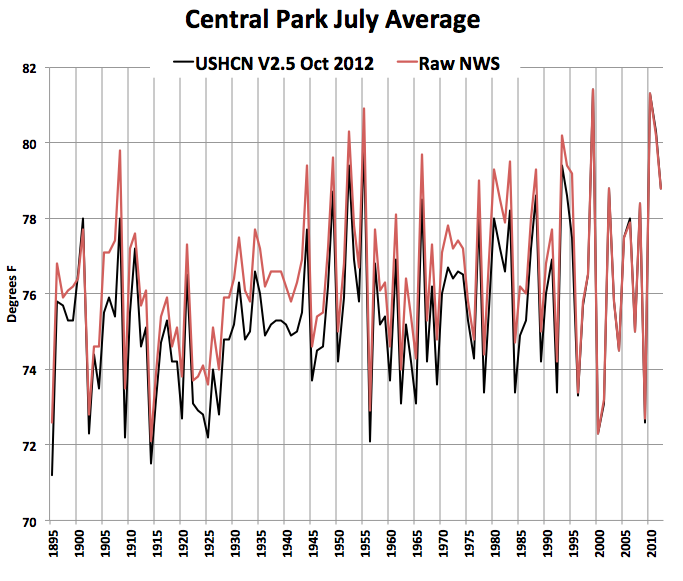
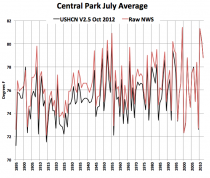
The latest news comes from Joe D'Aleo of the ICECAP website, who reports on a new online tool available from NCDC.  That's the National Climatic Data Center of Asheville, NC -- a Federal agency, part of NOAA, in turn part of the Commerce Department.  NCDC is headed by Tom Karl, a serious global warming zealot.  NOAA has been until recently headed by Jane Lubchenco, another serious global warming zealot.  The new tool enables plotting temperature data for cities, states, or regions.  So D'Aleo tried plotting the data for New York's Central Park for July, going back to 1885.  Meanwhile he happened to know that the National Weather Service (another part of NOAA) had archived data for Central Park for the same time period, so he took the archived NWS data and the new NCDC data and plotted them on the same graph.  Result:

image

Enlarged version.   Hmmmm.  In the new version, the warm years of the 1930s have magically become cooler, thus making the most recent years much warmer by comparison.

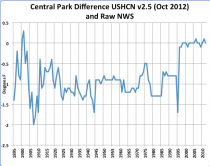
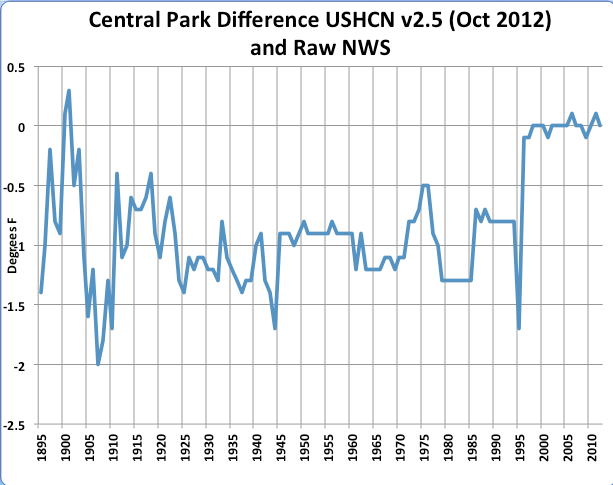
D'Aleo then calculated the differences between the previous raw data and the new adjusted data.  Here is that chart: 

image

Enlarged version.   Hmmmm again.  From 1995 to present, the raw and adjusted temperatures are about the same, but before 1995 the temperatures are "adjusted" downward by between 0.5 and 1.5 deg C all the way back to the beginning of the century.    What's going on here?  And the amazing thing is, they don't say.

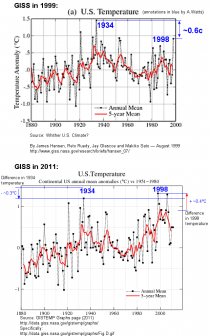
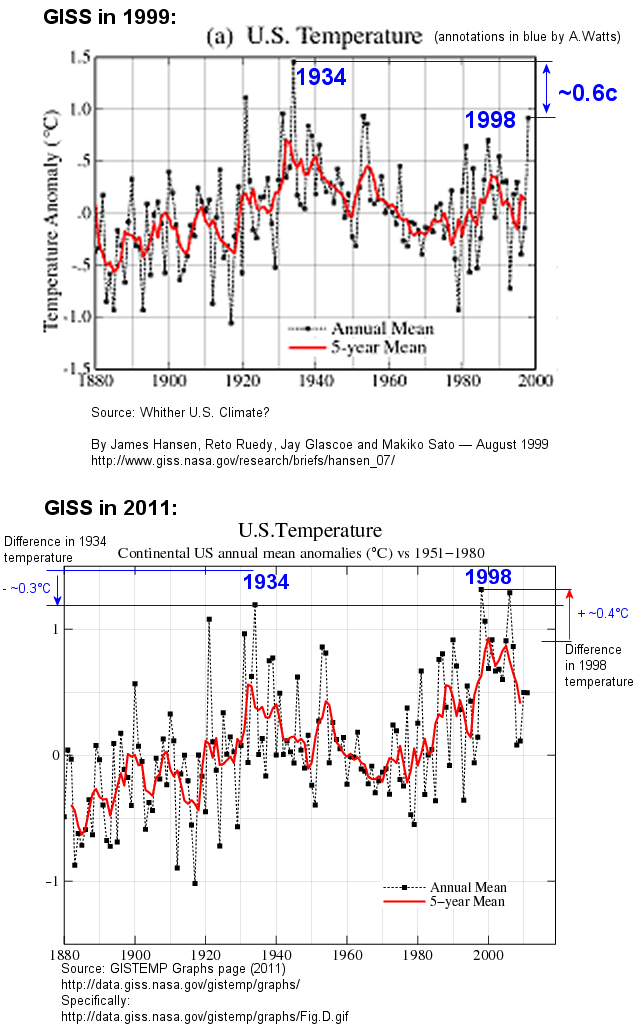
OK, you're thinking, this is some kind of strange anomaly, not a great fraud.  Well, you need to get a little deeper into the subject.  The main keeper of the official temperature records of the U.S. is a part of NASA called GISS (Goddard Institute for Space Studies), headed for decades by the recently (April 2013) retired James Hansen, another serious global warming zealot.  GISS puts out charts of U.S. temperatures plotted on an annual basis.  The funny thing is, those charts have changed over time.  Here we have the 1999 and 2011 GISS versions of U.S. temperatures:

image

Enlarged version.  In 1999 the 1930s were much warmer than 1998, but by 2011, 1998 had become much warmer than the 1930s.  How could that possibly be?  Lots and lots of people have noticed this, and have tried to get an explanation, but none is forthcoming.  

Meanwhile, is there any significance to this?  Well, just to take a small example, in his 2012 State of the Union speech, President Obama, latched on to the recently adjusted NASA data to proclaim:  

For the sake of our children and our future, we must do more to combat climate change.  Now, it’s true that no single event makes a trend. But the fact is, the 12 hottest years on record have all come in the last 15. Heat waves, droughts, wildfires, floods – all are now more frequent and more intense.

In the speech, Obama specifically cited to the recently adjusted NASA data.  You can easily see by looking at the charts that the business of the "12 hottest years on record have all come in the last 15" was completely created by the unexplained NASA adjustments that occurred in 2011.  Before the adjustments, many of the hottest years were in the 1930s. 

Again, is it just an anomaly or quirk, or is there some kind of systematic fraud going on?  A guy named Steven Goddard runs a web site called Real Science.  He makes a cottage industry out of keeping track of archived temperature data and reporting on when the government-paid global warming activists adjust the old data downward.  Input the word "tampering" into his search function, and you come up with literally dozens of examples where Goddard has identified earlier temperatures being adjusted downward to make the present appear warmer by comparison.  The culprits are almost always NCDC and NASA/GISS, although every once in a while the WMO gets in on the act.   

The charts at issue here are the very government charts that are used to support efforts to transform our energy economy and reallocate literally trillions of dollars of wealth and income.  The allegations of data tampering are not frivolous -- they are supported by clear prima facie evidence.  If there were a reasonable explanation, the government should have come out with it a long time ago.  As far as I'm concerned, the case for fraud has been proved.  There isn't any scientific fraud that I know of that comes remotely close.