Not A Good Week For New York -- But It Could Have Been Worse

Sorry to disappear for the past week.  Sometimes they make me work hard around here.

While I've been tied up, new Mayor de Blasio has gotten started on launching his big initiatives.  The two big things last week were the new "housing plan" and the contract with the teachers' union.  The bad news is that this guy does not have a clue what he's doing.  The good news is that he seems to feel at least a little constrained by reality, so it's considerably less bad than it could have been.

"Affordable housing" -- particularly "affordable housing" in Manhattan -- has been nominated for "worst possible public policy" by the Manhattan Contrarian.  Of course, it's a signature initiative from de Blasio.  Here in New York City the politicians have been trying to make housing "affordable" by an endless series of initiatives tying up the housing market since about the time of World War II.  We have rent control, rent stabilization, and a dizzying array of housing subsidy programs -- low income projects, middle income projects, tax exempt bonds to subsidize housing, property tax exemptions of multiple sorts, zoning bonuses, and lots more that I can't even think of right now.  And the result, of course, is the most expensive housing in the country.  Meanwhile, plenty of other growing cities that meddle little or none in their housing markets (think Houston, Dallas, Atlanta, Phoenix) have far lower costs of housing. 

So the big new "plan," Housing New York, was released on May 1.  Of course, this being New York and de Blasio, the "plan" consists of doubling down on decades of failure.   More city-as-developer; more subsidies; more forcing (supposedly) private developers to include "affordable" housing in their developments as a condition for permission to build.  On the other hand, it's almost all platitudes, with very few specifics on how it's going to be implemented.  Go to the section on "implementing the Plan" (page 12) and you will find a lot of airy wishful thinking, such as "Working with financial institutions, pension funds, financial intermediaries and philanthropy, we will also seek to leverage private capital on a greater than 3 to 1 basis," or "We will work in partnership with the State and the Federal government to identify new resources to fund affordable housing in the City and help us meet these critical objectives."  Sure thing, Bill. 

The actual numbers of units to be created are remarkably small.  The headline number is 200,000 units of affordable housing, but that's over 10 years -- so 20,000 per year.  But wait, isn't a mayoral term only four years?  Yes, he's counting most of this from after he's long gone.  And the 20,000 per year is "created or preserved," of which only 8,000 per year created.  That compares to the 80,000 per year created by the private markets in the 1920s -- the last decade when New York had a relatively free housing market and no depression going on.  In a city of 3+ million housing units, this 8000 per year is really a drop in the bucket.  And, given New York's terrible record in actually getting anything built, I would be extremely skeptical that much of this will actually happen.  In the Soviet Union, after seven decades of socialist housing production, they had 25 year waits for tiny shoddy apartments.  We won't have that because we allow a restricted private housing market to continue to operate; it's just that we drive up the cost of the private alternatives by 50% or so.

Also coming out in the last week have been the new teachers' contract, as well as the budget for the coming fiscal year.  Given that de Blasio was essentially put in office by the teachers' union, things could again have been far worse.  The main issue was that the teachers had been working without a contract for several years, and insisted on retroactive pay increases for those years.  Bloomberg refused to agree to that, with the result that he left without doing a new deal.  De Blasio has agreed to the retroactive raises, but with a gimmick:  raises covering 2009 - 2014 will be payable in five payments from 2015 - 2020.  So again, he's putting a big piece of it off until after he's gone.  And then, under any honest accounting, if you committed to that today, wouldn't you have to accrue the whole liability today even though you won't be paying for years?

Go to the budget (follow link here) and you will be hard-pressed to figure out where the increased costs of this contract are hidden.  At page 4 you learn that salaries and wages of city workers are projected to be less in FY 2015 ($23.1B) than FY 2014 ($23.6B).  So where are you hiding these pay increases, including the retroactive ones?  Or is the headcount going down by 10%?  Oh, and the financial plan only goes out to 2018, so the retroactive pay to be doled out in 2019 and 2020 isn't in here anywhere.

And how about pensions?  Supposedly the cost of pensions for city workers is going to go from $8.2B per year in FY 2014 to only $8.7B in four years out in FY 2018.  This is completely fictional.  The section on pension costs tells you nothing about the assumptions.  They're catching a big break this year because the stock market just went up 25% or so last year.  Do they really think that that is going to continue? 

But again there is some relatively good news, which is that they are being quite conservative in their revenue assumptions.  Of course, if you threaten tax increases at every opportunity and have twenty or thirty prosecutions going against your biggest taxpayers (the big banks) at any given time, the idea that your tax revenues might not grow much is probably right.

For now, New York City continues to grow, following 20 years of Republican and semi-Republican governance.  These developments threaten to slow that down some, but not to stop it dead in its tracks.  

How Are Things Going With The Union Movement?

You have probably read about the recent unsuccessful efforts of the UAW to organize fewer than 2000 workers at a VW plant in Tennessee; or maybe you have read about the successful effort of the APA to organize about 2600 pilots at Jetblue.  Meanwhile the big stuff happens where you're not looking.

The U.S. Postal Service not so long ago had almost a million heavily unionized employees.  Here is a chart of how that has gone over the past decade:  from 707,485 "career employees" in 2004 to 489,727 in 2013, the most recent year for which data are given.  That's an average decline of about 22,500 per year, and no sign that it will stop any time soon.  The Postal Service reported a loss of over $15 billion in 2012, and another $5 billion in 2013.  Oh, and they have an obligation of $5+ billion annually to a retiree health care fund, but have defaulted on three recent payments to that fund.  Any business with those problems and without access to the infinite credit card of Uncle Sugar would have pulled the plug a long time ago, or at least have instituted a fundamental restructuring.

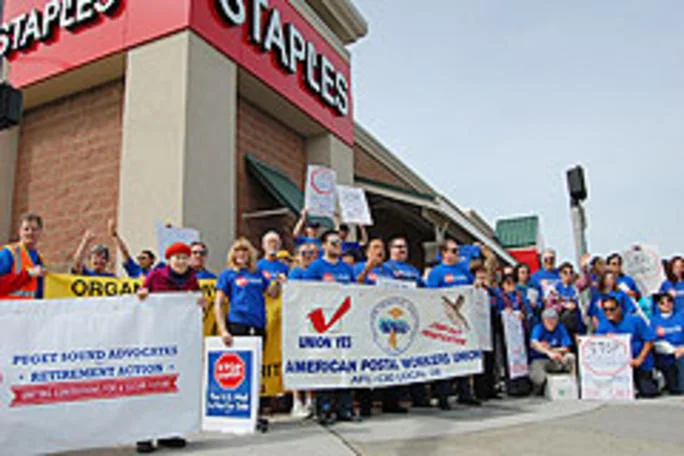
What is the response of the postal union?  You would think that their goal would be to help the employer find a workable business model for the long term, but for some reason that's just not how the incentives of unions operate.  So April 24 was a "day of action" for the postal union to demonstrate against a modest pilot program to outsource some postal retail functions to certain Staples stores.  Here is a picture of one of the demonstrations:

Day-of-Action-Aims-to-Stop-USPS-Staples-Mail-Privatization-Scheme_blog_post_fullWidth.jpg

The head of the postal workers' union, Mark Dimondstein, summarized the strategy:

The union says that the no-bid “sweetheart deal” will compromise the quality, security and reliability that consumers expect and deserve in the handling of their mail. Dimondstein says that an internal USPS document “makes clear that the goal of the program is to replace the good, living-wage jobs held by USPS employees with low-wage jobs in the private sector.”

No word how the strategy of opposing all efforts to reduce costs is going to help slow down the ongoing hemorrhage of revenue and jobs at the USPS.  But maybe the game can last long enough for Dimondstein to get to his own retirement before the Postal Service turns out the lights.

Meanwhile, in the world of state and local government unions, New York's MTA settled this week with its biggest union, the TWU, after going several years without a contract.  The MTA had been saying that it needed major work rule changes and a "net zero" increase in employee cost, but after an intervention by Governor Cuomo (running for re-election) the deal is reported to cost an additional $411 million over the life of the contract.  From whence comes the money?  No indication in the various press releases, but the enterprising Benjamin Kabak of Second Avenue Sagas comes up with the following disclosure in a Supplemental Statement released to bondholders:

MTA anticipates that the onetime payment for retroactive wages in 2014 will be funded from monies derived from released 2013 general reserves budgeted for voluntary deposits to the MTA Long Island Rail Road Plan for Additional Pensions that would have reduced the unfunded liability and future expenses. Increases in current year and annual ongoing costs are anticipated to be paid from funds budgeted for voluntary deposits to the MTA Long Island Rail Road Plan for Additional Pensions, and a portion of monies earmarked for voluntary deposit into the OPEB trust for future retiree healthcare costs.

In other words, they'll borrow it from the future, through the time tested method of underfunding pensions.  Meanwhile this union also continues its ongoing battle to prevent any and all cost reductions.  Retirement age remains an unsustainable 55.  Almost all trains have two people running them, while hundreds and hundreds of clerks do the easily-automatable job of selling fare cards.  The system isn't shrinking, but the problem is, it should be growing, and the ridiculous costs almost completely prevent that.


Fraudulent "Income Inequality" Comes Around To Bite The Left

At this moment, so-called "income inequality" is the favorite theme of those on the Left, from President Obama, to Mayor de Blasio, to the New York Times, to trendy French economist Thomas Piketty.  And this theme at first blush does appear as the perfect approach if your main goal is to see the government expand.  The seemingly independent and neutral Census Bureau puts out lots of "household income" data that show wide and increasing disparities between those at the top and those at the bottom.  And then there is an endless variety of programs -- public housing, Medicaid, food stamps, pre-K education, etc. -- that can be sold to the public as addressing income inequality and yet are counted as zero in the Census Bureau income numbers.  So after spending a trillion or so a year, income inequality doesn't go down and we need another round of the useless programs!  From the perspective of a government growth advocate, what's not to like?

The problem here is that sooner or later someone might look at the data and notice the obvious:  that the government programs actually increase income inequality as measured by the Census Bureau statistics.  In other words, the entire game is a fraud.  I called attention to this issue back in September 2013 in "Do Government Income Support Programs Increase Or Decrease Measured Income Inequality?"  Gradually, a few others are starting to notice.

At Atlantic Cities a couple of weeks ago, Michael Zuckerman went to the Census Bureau data where they publish a number called the Gini index of income inequality for each Congressional district.  (The Gini index is a measure of the degree of income inequality.  Wikipedia has a description of the methodology here.)  He then ranked the Congressional districts by income inequality, from most unequal to least unequal.  The ranking was then picked up by Francis Barry at Bloomberg here, and by Robert Tracinski at The Federalist here.  Barry reorganized Zuckerman's chart to show the ten "most unequal" and ten "least unequal" Congressional districts ranked by Gini index.  Here is that chart:

i_ZFy5XleY60.jpg

In this ranking, of course the first thing one notices is that nine out of ten "most unequal" districts are represented by Democrats, while the majority of the "least unequal" are represented by Republicans.  (The very "least unequal" is Michele Bachman's district, Minnesota 6.)   And wait a minute!  Could it be that the most unequal district of all is none other than my very own district, New York 10?  Yes!  First out of four hundred thirty-five.  It's quite an honor.

But, you are asking, isn't this the very heart of the heart of the home of progressivism?  Here is a link to a map of the district.  It's the Upper West Side of Manhattan.  It's Greenwich Village.  It's Soho and Tribeca.  It's Columbia and New York Universities.  The headquarters of the New York Times is in our district.  We have one of the very most left-wing Congressmen (Nadler).  We gave 74% of our vote to Barack Obama in 2012.  We are the absolute kings of social spending to "benefit" the poor.  Why isn't that spending working?  If the various progressive programs (welfare, public housing, food stamps, vast social services, spending double the national per student average on K-12 education, spending double the national per beneficiary average on Medicaid) worked even a little, shouldn't we be well in the bottom half of income inequality?  Instead, we are literally the worst of the worst.  How could it possibly be that we are number one in income inequality?

Part of the answer, of course, is that we have a large number of high earners here.  (Mean household income is $132,864 according to Census data here.)  But that's not the main thing.  The main thing is that the bottom part of the income distribution is completely fake.  Most importantly, all of the in-kind benefits are counted at zero.  And that's only the start.

The Census Bureau says that 16.7% of the people in this district live in "poverty."  That's by their completely fraudulent measure of "cash income," where in-kind benefits don't count.  But we spend vast sums on the in-kind benefits.  We have large tracts of public housing that would have market rental value of easily $40,000 per apartment per year.  We provide Medicaid to the poor at average cost per beneficiary exceeding $10,000 per year.  Food stamps average about $8000 per year.  Many "poor" families in this district have over $50,000 lavished on them per year in in-kind benefits, and some over $100,000, and none of it counts.

And then, also lurking at the bottom of the Census Bureau income numbers, are a lot of people you probably thought were not poor at all.  You might even have thought they were rich.  They may have a lot of resources available to live on but they don't have any "cash income" at this moment.  I'm talking about those law students at Columbia and NYU and Fordham who will get fancy law firm jobs in a couple of years at $200,000 per year, but this year they are living on family resources and working the summer at an unpaid internship for a Federal judge.  The Census Bureau counts them as "poor" with zero income.  Or there's the new college grad who has just moved to Manhattan to make his fortune but hasn't landed his first job yet.  Or the young heiress with an unpaid job at one of the museums.  With enough of these people you can really run up your Gini index.

And by the way, look at some of the other Congressional districts of the top ten in "income inequality," and you will find a remarkable collection of the homes of the progressive gentry.  New York 12 -- that's our cross-town rivals from the Upper East Side.  Pennsylvania 2 is much of the heart of Philadelphia.  Illinois 7 -- that's downtown Chicago and its super-rich north side.  And California 33 is Henry Waxman's coastal Los Angeles district, including Beverly Hills, Santa Monica, Malibu and Palos Verdes.

None of this is a coincidence.  Income inequality is undoubtedly a consequence of the capitalist system; but the extremes of "income inequality" as presented to us by politicians from intentionally misleading Census Bureau data are something else.  These extremes are substantially the product of fraudulent government numbers that systematically exclude the effects of the government programs sold to the public to cure the inequality.  It all works until the public wakes up and notices that the worst "inequality" is right in the heart of the progressive bastions, in the very places where the progressive programs are most lavishly employed.  

U.K. "Austerity" Update

I haven't been reading too much lately about so-called "austerity" in the New York Times.  Something must be up.  Let's go look for some data.

I last commented on "austerity" in the U.K. about a year ago.  The Conservative/Lib Dem coalition had come to power in 2010 promising to attack "debt" and "deficit," and three years later in early 2013 the economy was still sluggish.  The anti-"austerity" forces were declaring victory.  But a careful analysis by Nicole Gelinas in early 2013 showed that the actual program to that point had been all tax increases and no spending cuts.  The VAT had gone from 17.5% to 20% in December 2010, and the top income tax rate (on income above 150,000 pounds per year) had gone from 40% to 50%, while spending had continued to grow, if more slowly than under the previous regime.

Then in early 2013 the government proposed actual real cuts in spending.  That brought out the anti-"austerity" armies in full force.  As the Guardian reported on April 18, 2013, the execrable Olivier Blanchard, chief economist of the IMF, warned Chancellor of the Exchequer George Osborne that he was "playing with fire" if he proceeded on the "austerity" course.  His boss and head of the IMF, Christine Lagarde, promptly followed with a warning that "poor performance of the British economy had left her with no alternative" but to call on Osborne to rethink his austerity strategy.   There was also the usual pile-on from the ignorant commentariat, such as an article in The New Yorker titled "It's Official:  Austerity Economics Doesn't Work":

Any decent economics textbook will tell you that, other things being equal, cutting government spending causes the economy’s overall output to fall, tax revenues to decrease, and spending on benefits to increase. Almost invariably, the end result is slower growth (or a recession) and high budget deficits.

And then, horror of horrors, Osborne didn't listen to these know-it-alls and went ahead and cut spending.   According to data at ukpublicspending.co.uk, total government spending in the U.K., having leveled off in 2012, actually went down in 2013.  Spending was 694 billion pounds, 46% of GDP, in 2011; 694 billion pounds, 45% of GDP, in 2012, and 675 billion pounds, 43% of GDP, in 2013.  And suddenly, according to the BBC, the U.K. turned in its best year of economic growth since 2007.  OK, it's only a growth of 1.7%.  But compare that, for example, to high-"stimulus" France, where the government spends 55% or more of GDP.  They claim to have had "growth" of 0.1 - 0.2% in 2013.  Pitiful.

Look around for forecasts of economic growth in the U.K. for this year, and you will find that even the IMF is predicting around 3%.   On April 8, the BBC reported that Blanchard had conceded "it was clear that [the IMF's] forecasts had been 'too pessimistic.'"  However, no word that he has changed his views on the horrors of "austerity."  Now, if only the U.K. could get rid of those tax increases, it could see some real growth!  

Update On Official Manhattan Contrarian Predictions

Here at the Manhattan Contrarian, we don't make a lot of predictions.  But we veered from that path with a few Official Manhattan Contrarian Predictions at the end of last year.  This was the first one:

I predict that the number of "uninsured" in the U.S. will increase as Obamacare is fully implemented in 2014.

Now in my humble opinion, this subject is important.  It is important because the whole raison d'etre for Obamacare and the transformation of a sixth of the economy into government vassals, the basis for the endless drumbeat that we listened to thousands of times over the preceding decades, was the so-called "crisis" of the uninsured.  As the supposedly disinterested but actually revolting pro-government-growth-partisan Institute of Medicine put it in their February 2009 study titled "America's Uninsured Crisis: Consequences for Health and Health Care":

The growing number of uninsured Americans--totaling 45.7 million as of 2007--is taking a toll on the nation's health. One in five adults under age 65 and nearly one in ten children are uninsured. Uninsured individuals experience much more risk to their health than insured individuals. In its 2009 report America's Uninsured Crisis: Consequences for Health and Health Care, the Institute of Medicine points to a chasm between the health care needs of people without health insurance and access to effective health care services. This gap results in needless illness, suffering, and even death.

We're now through the initial sign-up period that ended March 31.  We know that at least 4.7 million Americans had their health insurance cancelled due to Obamacare rules.  We know that the President has claimed that some 7 million people have signed up under the Obamacare exchanges.  But of course the 7 million include many who were previously insured and many who had their policies canceled.  So government, has the number of "uninsured" gone up or down?

Well, in the past couple of days we have found out that they are not going to tell us.  And they are not going to tell us because the White House has directed a change in the methodology by which the Census Bureau counts the uninsured so as to make the new data report smaller numbers of uninsured which numbers however are not comparable to the old numbers.

The story was first reported by Robert Pear in the New York Times on April 15.

[T]he new questions are so different that the findings will not be comparable, the officials said.  An internal Census Bureau document said that the new questionnaire included a “total revision to health insurance questions” and, in a test last year, produced lower estimates of the uninsured. Thus, officials said, it will be difficult to say how much of any change is attributable to the Affordable Care Act and how much to the use of a new survey instrument.

The Pear article makes it clear that many of the changes in methodology came at the request of, and subject to the approval of, the White House.

The White House is always looking for evidence to show the benefits of the health law, which is an issue in many of this year’s midterm elections. The Department of Health and Human Services and the White House Council of Economic Advisers requested several of the new questions, and the White House Office of Management and Budget approved the new questionnaire. But the decision to make fundamental changes in the survey was driven by technical experts at the Census Bureau, and members of Congress have not focused on it or suggested political motives.

I like that last line.  The so-called "technical experts" at the Census Bureau are exactly the people who put out the ridiculously fraudulent "poverty" and "income inequality" numbers that are hugely designed to drive further growth of the government.  This is a Washington bureaucracy, where everybody votes Democrat and shares an interest in government expansion.  How naive can we be?

In his Best of the Web column yesterday, James Taranto reminds us of the story of the initial nomination by Obama of Judd Gregg (Republican Senator from New Hampshire) as Commerce Secretary, and subsequent withdrawal of that nomination by Gregg.  Taranto quotes a report from the time as to Gregg's reason for withdrawing:

Sen. Judd Gregg said today [Feb. 12, 2009] that his decision to withdraw from consideration for commerce secretary was due in part to his concern with the Obama administration's decision to have the next Census director report to senior White House staffers as well as the commerce secretary.

Obama and his team knew exactly what they were doing taking control of the Census Bureau into the White House. 

Bloomberg View blogger Megan McArdle -- who often gives the government much more benefit of the doubt than I ever would -- reacts as follows:

I’m speechless. Shocked. Stunned. Horrified. Befuddled. Aghast, appalled, thunderstruck, perplexed, baffled, bewildered and dumbfounded. It’s not that I am opposed to the changes . . . .  But why, dear God, oh, why, would you change it in the one year in the entire history of the republic that it is most important for policy makers, researchers and voters to be able to compare the number of uninsured to those in prior years?

Well, there is nothing remotely honest about what is going on.  Who could possibly be so naive as to think that the interest of the "policy makers, researchers and voters" in honest data to make their decisions trumps the interest of the administration in preserving Obamacare and the interest of the bureaucracy in getting more Democrats elected to Congress in 2014?

Now, it is actually possible that the number of so-called "insured" is going to increase slightly this year, entirely due to a substantial expansion of Medicaid, otherwise known as bribing people to accept free "insurance" so that the numbers can be improved.  The number of new Medicaid sign-ups is said to be around 3 million.  It is a very safe bet that absent that free giveaway the numbers of uninsured would be up.  But no way is the government ever going to let the people see honest numbers.