More Insights Into Our Ruling Class's Thinking From The Latest Government Amicus Brief In The Argentina Case

As the battle between Argentina and its hold-out creditors continues to play out in the U.S. courts, currently in the Second Circuit Court of Appeals here in New York, the government gives more insights into the thinking of the people in charge by filing increasingly preposterous amicus briefs.  The latest turned up on December 28.  It is available on the Shearman & Sterling website here.

The problem starts from the fact that Argentina agreed on these bonds to be sued in New York and to be bound by the law of New York, which on the relevant points is no more complicated than "we will enforce your agreement to repay the loan."  Perhaps you might think that the government of the United States would stand up for New York law on that point, but instead it has decided to stand up for the ability of deadbeats to find some way, any way to avoid payment.  I previously commented here on this very odd choice of sides.  But what possible thinking could get you to the idea that Argentina has the right side here?  The amicus brief has the answers.

Here is the articulation of the main point:

[V]oluntary sovereign debt restructuring will become far more difficult if holdout creditors can use novel interpretations of boilerplate bond provisions to interfere with the performance of a restructuring plan accepted by most creditors, and to greatly tilt incentives away from voluntary debt exchanges and negotiated restructuring in the first place.
A sovereign’s potential resistance to paying non-exchanged debt is a critical tool in its efforts to negotiate broad creditor support for restructuring. This leverage will be lost if creditors believe that a holdout strategy will eventually result in substantial or full payment. If enough creditors adopt this strategy, foreign sovereign debt restructuring will become impossible.

Or to put it in simpler terms, if we want them to be able to stiff the creditors, we have to give them the right to stiff the creditors.  I love the use of the Orwellian term "voluntary" restructurings.  This was a take-it-or-leave-it offer of about 25 cents on the dollar; if you don't take it we will fight to the death to be sure you get nothing.  The 25 cents was not picked out of the blue, but was carefully selected against the backdrop of the perceived difficulty of collecting from the defaulters.   Does the U.S. government not understand that if its position is accepted, the next "voluntary" exchange offer will be at 10 cents, or maybe 1 cent?

Well, if the government's first point didn't make any sense, there's an even dumber one on the next page:

In addition, the decision could harm U.S. interests in promoting issuers’ use of New York law and preserving New York as a global financial jurisdiction. See Allied Bank v. Banco Credi- to Agricola, 757 F.2d 516, 521 (2d Cir. 1985) (“The United States has an interest in maintaining New York’s status as one of the foremost commercial centers in the world.”). The decision could encourage issuers to issue debt in non-U.S. currencies in order to avoid the U.S. payments system, causing a detrimental effect on the systemic role of the U.S. dollar.

They have no comprehension that the entire lending business only exists because the rule of law enforces repayment.  Of course Argentina would prefer to borrow money in Argentina (or maybe Cuba?), where what passes for the rule of law is "we will stiff you if we feel like it"; but, oddly enough, no one will lend them the billions of dollars they want on those terms.  The lending market is in New York, and governed by New York law, precisely because New York law enforces repayment.  The way to keep the lending market in New York is to enhance the ability of lenders to get repaid, not to undermine it.  Is it really possible that our top State and Justice Department officials and United States Attorneys are too dumb to know that?  Yes, it is.

By the way, the top guys signing onto this are Harold Koh, Legal Advisor to the State Department (and former Dean of the Yale Law School, and committed orthodox thinker of the Manhattan variety on all essential points) and Preet Bharara, United States Attorney, otherwise known for wasting the vast resources of his office largely on the futile jihads against drugs and insider trading.

Where does this all lead?  Argentina's current jefe, Christina Kirchner, gets to maintain her populist bona fides by playing tough with the American creditors, while her country continues its long, slow decline into poverty.   What is worst about this is that the United States is helping the rulers of Argentina maintain power, while they slowly destroy the country. 
More (State) Government Wealth Destruction: The LIPA Follies, Continued

From today in Crain’s New York Business, (may be behind a pay wall)  the headline “LIPA to require state bailout.”  LIPA would be the Long Island Power Authority, purveyor of the highest-priced electricity in the lower 48.  I like the term “require,” like there’s nothing we can do about it.  It’s just a law of nature!

In fact what we have going on is serious wealth destruction, $7 billion or so, by a succession of New York governors, Democrats Cuomo pere et fils, as well as the intervening Republican Pataki.  (What, we can’t blame this one on Spitzer?  Surprisingly, no; although if he had gotten a chance to weigh in on it he clearly would have gotten it wrong.)

It seems that Gov. Andrew Cuomo, in his recent State of the State address, proposed to “abolish” LIPA. 

“It has never worked,” he said. “It never will.” But analysts believe that persuading a private company to buy the much-maligned utility would require the state to assume at least $4 billion of LIPA's $7 billion in debt. A sale would then trigger nearly $1billion in additional costs: early-termination fees paid to bondholders, as well as penalties for the derivatives contracts that would suddenly become void, according to people who have studied a privatization.

Who could have seen it coming that LIPA would never work?  Just a brief review of the history (more detail in my previous post here and at Wikipedia here):  From about 1973 to 1985, Long Island’s then-private utility LILCO built a nuclear power plant at Shoreham at a cost of about $6 billion.  When it was fully built and ready to operate, then new Governor Mario Cuomo, bowing to strongly expressed nuclear fears of the Long Islanders, decided to block the opening by refusing to cooperate in the development of an emergency evacuation plan.  The opening was blocked, and now Long Island had spent $6 billion with no electricity to show for it.  That $6 billion (plus some accumulated interest) is the hole we are still trying to deal with.  Cuomo pere came up with the idea of transferring much of the cost of the plant to other New York taxpayers, and to Federal taxpayers, by creating a “public” utility for Long Island that could issue tax exempt bonds.  That would be LIPA.  Of course, they didn’t have the people actually to run a complex utility, so LIPA was set up as the thinnest of possible shams to claim the tax exemption – nothing but a board of directors with all the real work subcontracted to private utility operators.  It took until 1998, in the administration of Pataki, to finally get LIPA up and running and all the debt refinanced into tax exempt bonds.

But even though the interest rates were somewhat lowered, Long Island still had the now $7 billion of debt and also had to buy its electricity elsewhere.  Not hard to see why it has the highest electric rates in the country.  It also had a utility consisting of nothing but a political board with no idea how to produce or deliver electricity, and a mission to come up with electricity free both from all risks and all costs.  Not possible. They pretended to solve that by skimping on maintenance.  Then came Hurricane Sandy.  The next-to-no maintenance thing didn’t work out so well.

Meanwhile, how dangerous is nuclear power really?  The worst recent nuclear accident is the one at Fukushima, Japan in 2011.  How many people died from radiation as a result of that?  Believe it or not, not a single death there has been definitively attributed to radiation so far, although an unknown number of cases of cancer could develop in the future.  Here is the Wikipedia entry:

A few of the plant's workers were severely injured or killed by the disaster conditions (drowning, falling equipment damage etc.) resulting from the earthquake. There were no immediate deaths due to direct radiation exposures, but at least six workers have exceeded lifetime legal limits for radiation and more than 300 have received significant radiation doses. Predicted future cancer deaths due to accumulated radiation exposures in the population living near Fukushima have ranged from none to 100.

Meanwhile we accept tens of thousands of deaths per year from automobile accidents without complaint and, indeed, barely noticing it.  Also, the people of Westchester accept (reluctantly) the risk of the Indian Point nuclear plant, that supplies about 25% of the electricity for New York City.  Our current Governor also is trying to close that one down.  Oh, and he continues a hold on drilling for natural gas within the state by the “fracking” method.  So what exactly is the method of producing electricity that he and his supporters will allow?

You will not be surprised that I do not have a lot of sympathy for the Long Islanders here (who let their way overblown fears get the better of them and now would like others to pay the cost), nor for the Governors who go along with and indeed lead this vast wealth destruction.  Sorry, but this is not the problem of the rest of the New York taxpayers, let alone the Federal ones.

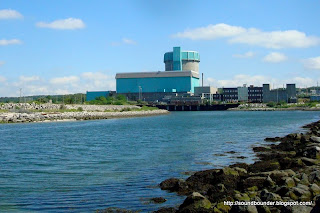
Here’s a picture (from 2010) of the Shoreham power plant, still sitting there idle after all these years.

The Bronx Water Treatment Plant -- Unbelievable Bumbling At All Levels

Here is a story that you have not been following, but you should be.  The main villain in the story is the Federal EPA.  The City administration (current and prior) and contractors do not come out well, although perhaps not villains.  The Manhattan DA looks like a complete fool.  The New York Times comes off as clueless, accepting whatever they are told by people in authority without ever asking even a semi-intelligent question.

We begin with an article from the NYT of Monday, January 13:  "Inquiry Is Said to Find Fraud at Bronx Water Plant."   It seems that the Manhattan DA has been conducting an investigation of financial problems at the Bronx water treatment plant under construction, and has uncovered (drum roll) fraud!  The main accused perpetrator is Schlesinger-Siemens Electrical, an affiliate of the German engineering giant Siemens AG.  A so-called "deferred prosecution agreement" with Siemens is in the works.

Well, this is the NYT parroting some kind of publicity out of the DA's office.  Can they tell us some of the background?  Basically no, other than that it is a "troubled $3.2 billion"  project, and then this line:  "The federal Environmental Protection Agency has fined the city $5 million for delays on the project, which was mandated by a 1998 consent decree."

We can learn some more by turning to Bronx Week of August 16, 2012.  Turns out that although the City signed a consent decree agreeing to build the plant in 1998, the original EPA order was in 1993.  Also, according to a quote from former City Comptroller (and current candidate for mayor) William Thompson, "The DEP told the public that this project could only cost $992 million,"  So the cost has well more than tripled. 

Bronx Week also tells us that the alleged purpose of the plant was that the federal EPA "fear[ed] water from the Croton water shed. . .  was in danger of contamination."  It is a filtration plant, designed to remove harmful bacteria -- $3.2 billion to remove bacteria.  OK, here we are in 2013, 20 years after the original EPA order, and the plant still isn't done and hasn't filtered a single drop of water yet, and we've been drinking away at the Croton water for all these 20 years.  Are the bacteria levels elevated in the slightest?  Of course they are not -- if they were, it would be big news.  Has even one single person ever gotten sick?  Not that I've ever heard of, and again, if it happened it would be big news, and I've been following this one closely. 

Here is the statement from the NYC Department of Environmental Protection as to why they are engaging in this gigantic project.  Lots of gobbledygook, but this looks to me like the key quote:

The Croton System has provided high quality water to consumers for many years. Although Croton water currently meets all existing health-based water quality regulations, it frequently violates the aesthetic standard for color. Water quality problems have resulted in the Croton System being removed from service on numerous occasions, typically during the summer and fall months (in four of the last several years – 1992, 1993, 1994 and 1998). The entire system was shut down for most of 2000-2001 because of contaminants that leaked into the [aqueduct].

Hmmmm.  $3.2 billion because of non-health-related "color" problems, most recently 12 years ago?  If the color level gets a little high in the Croton water, why isn't it a far better solution to switch over for a while to water from the other systems, as they did in prior years, instead of blowing $3.2 billion on a filtration plant?  Oh well, but if the cost went from under $1 billion to over $3 billion, it's not so surprising that there could be some fraud involved.  Or is there?  Back to the New York Times to learn what the "fraud" is supposed to be:

In one, the company essentially used smaller minority-owned subcontractors as fronts to make it look as if they had provided roughly $10 million in labor and equipment, when it was really provided by Schlesinger-Siemens or other companies, the people said. By doing so, the company evaded city contract requirements that it hire a certain percentage of contractors owned by minorities or women, or certified by the government as disadvantaged.
The second arrangement, the people said, involved fraudulent filings with city agencies that made it look as if the company, as required for bidding and the contract, had a licensed master electrician on site overseeing the work: installing the systems that will run the huge plant.

That's right, in a plant where they are blowing $3.2 billion to achieve no meaningful result, the only alleged "fraud" the prosecutors can come up with consists of failing to hire enough of the mandated politically connected cronies for the job.  Shouldn't we be happy that they are at least using some competent German engineers?

Meanwhile, is it anybody's job to ask whether this plant is delivering any value and whether there are cheaper ways to assure the quality of the drinking water -- namely, the ways that the quality has in fact been assured for the past 20 years with no plant?

Hurricane Sandy Relief Bill Passes The House

Despite my best efforts to point out the reasons why it was a bad idea, the House went right ahead and passed the ridiculously over-priced $50.7 billion Hurricane Sandy relief bill.  Don't count on the Senate to stop it at this point.

Thanks to the 179 Republicans and one Democrat (Rep. Andrew Harris of Maryland) who voted against this monstrosity.  Of course, even the nays were not really standing up for the proposition that the Federal government shouldn't be involved in disaster relief at all.  Instead, for the most part they were trying to establish only either (a) that massive disaster relief expenditures should be offset by cuts somewhere else, or (b) that they shouldn't just vote the maximum amount of every wish list that the governors could come up with, and instead should at most only vote piece by piece for expenditures that could be justified.  

Basically, this bill has a little to do with Hurricane Sandy relief, and a lot to do with bailing out the even bigger disaster of the budgets of New York, New Jersey, and to some degree Connecticut.  There's so much money in this bill that I'll bet it will make the budgets look good for the whole remaining terms of Governors Cuomo and Christie.  As for the 20 or 30 hurricanes in the Gulf that we will have to pay for as our quid pro quo for this one, well that's not Cuomo's or Christie's problem. 

Somewhere out there there must be someone other than myself who has figured out what a terrible idea this Federal disaster relief thing is for New York and New Jersey, but I haven't been able to find it. 

Fake Keynesianism On Full Display On The WSJ Op-Ed Page

Does any reader out there think that people in the government actually know what they are talking about?  If so, you can just disabuse yourself of that idea by reading the op-ed by Alan Blinder in today's Wall Street Journal.  Sorry it's behind the pay wall, but the link will take you to where you can get in if you are a subscriber.

Who is Blinder?  Currently a professor of economics at Princeton, but just recently Vice Chairman of the Federal Reserve.  Shouldn't somebody with those kinds of titles know at least a little something about basic public policy?  OK, here are a few key quotes:

At current rates of spending and taxation, federal receipts cover less than 74% of federal outlays.  So if the government hits the debt ceiling at full speed, total outlays . . . will have to be trimmed by more than 26% immediately.  That amounts to more than 6% of GDP, far more than the fiscal cliff we just avoided. . . .
Bad things will surely happen, one of which will be a swift descent into recession.

Blinder is completely ignorant of economic history, which shows that sharp cuts in government spending and in the size of the government are the cause of economic booms, not recessions.  Read my previous post here and the linked article by David Henderson for more detail.

It is beyond breathtaking that our top government officials operate at this level of ignorance.  And if you think that anyone at the Fed in Washington, or in the Treasury Department, or in the White House (including the top guy) knows any better, you are wrong.  (A few people in some of the regional Feds do know better.  They are a small minority and their voices are at present barely being heard.)

Greece, Latvia, And "Austerity" As An Economic Policy

The incompetent conventional wisdom sees the two poles of economic policy as "austerity" and "stimulus."  Exemplifying the incompetence is the IMF, which put out a report back in October comparing countries engaging in "austerity" to those following programs of "stimulus."  The conclusion (no surprise here from these fools) :  "stimulus" is better!  Summary of the IMF report and link here.

What's amazing to me is how many news organizations and bloggers buy into this terrible terminology, which seems specifically designed to obfuscate the only important issue, namely the relative size and growth of the state sector versus the private sector.  Here is really everything you need to know about economic policy:  large private sector, small state sector, successful economy;  small private sector, large state sector, unsuccessful economy.

The term "austerity" just completely confuses the issue.  "Austerity" means some combination of government spending decreases (usually not very much) and tax increases (generally onerous) -- a totally muddled mess.  So the state shrinks maybe a little for a while, but gets more revenue to keep the private sector from growing and let the government grow more as soon as the heat is off.  The chance that will work is about zero.  The thing that will work is massive spending cuts and no tax increases.  But the dopes like the IMF, New York Times, Krugman, et al. will cite the poor results of "austerity" in support of their preferred program of a blowout of government spending.

Consider Greece.  You would have to be in a cave for the past couple of years not to know that government of Greece is undertaking a program of "austerity" in order to earn bailouts from the various European bailout providers.  Greece's economic performance is, of course, terrible.  Do you have the impression that Greece has been engaging in big cuts in government spending?  The answer is that there have been some cuts, but not enough to actually shrink the state sector meaningfully as a percentage of the economy.  From Anders Aslund writing at Bloomberg News on January 7, 2013: 

Greece . . . maintained high public expenditures of 50 percent of gross domestic product in both 2010 and 2011, when it was supposed to be pursuing austerity.

According to the New York Times here, in the current budget passed in November, Greece has promised government spending cuts of about $10 billion, which would be about 3% of gdp.  That's maybe something, although in my view not nearly enough from a start of 50%.  Also, I don't believe that they will actually follow through and do it.  But meanwhile, how about taxes?  Oh, those are going up, and a lot. The Telegraph reports that on Friday the Greek parliament voted for tax increases to raise revenues by 2.5 billion euros -- that's also about 3% of gdp.   The corporate income tax rate is going from 20% to 26%, a sure economic killer.  The top personal income tax rate is going from 40% to 42%.  Well, that's what it means to do "austerity."  I think we can count on continuing economic failure in Greece.

It's actually hard to find a clean example of a country that has cut government spending massively without also engaging in destructive tax increases, but probably the best recent example is Latvia.   Again from Aslund's article at Bloomberg:

In 2009, Latvia carried out an arduous fiscal adjustment of 9.5 percent of GDP. . . .  Cuts in public spending accounted for two-thirds of the Latvian fiscal adjustment. It decreased government expenditures from a high of 44 percent of GDP in the midst of the crisis to a moderate level of 36 percent of GDP this year. Latvia has kept a flat personal income tax now at 21 percent and a low corporate profit tax of 15 percent.

Latvia did raise their VAT somewhat, so they are not as clean a case as one would like.  According to Anne Applebaum in the Washington Post here, Latvia's economy shrank 24% in 2008-09, but has been growing at a rate of about 5% since.  To the extent that some of that 24% shrinkage reflects the cuts in government spending, keep in mind that gdp accounting records a dollar of government spending as equivalent to a dollar of private spending, which it is not.