Hurricane Sandy Relief Bill In Congress Proves Yet Again That I Am A Contrarian

At the last moments of the 112th Congress just after New Year's, John Boehner pulled from the agenda the $60.4 billion Hurricane Sandy Relief Bill that had already passed the Senate.  As a result, the bill died, and will have to be re-introduced in the new Congress.

All of New York and New Jersey are officially outraged that Congress did not pass this bill.  This proves once again that I am just a contrarian.   The Congress should definitely not pass this bill or anything like it.  My view is based not only on the fact that this bill is ridiculously overpriced and larded with pork, but more importantly on the fact that such spending by Congress is a bad idea in general and a huge disadvantage to New York and New Jersey in particular.  Am I the only one who can see why this is so?

First, let's have a review of official establishment New York/New Jersey opinion on the bill.  We'll start with the New York Times on December 28: 

[T]he Northeast [must] get the $60.4 billion in aid it needs to recover from Hurricane Sandy. . . .   Responding to and preparing for natural disasters is one of government’s most important functions. Each time a huge storm hits, lawmakers should provide immediate relief without having to worry about . . . House members putting ideology before common-sense preparation.

That's actually temperate compared to this from the Daily News on January 3:

House Speaker John Boehner will evermore bear the degrading stain of a dishonorable man unless on Friday, Jan. 4, 2013, Congress passes the full $60 billion superstorm Sandy relief bill. . . .  No one so small, so petty, so duplicitous and, worst of all, so callously and cavalierly ready to tell Americans in dire need to go to hell has a rightful place at the highest reaches of the government.

Whew!  Even to suggest that the $60 billion amount should be examined is to brand yourself as "small," "petty," "duplicitous," and "callous"!  Governor Christie of New Jersey on January 2 tried to top even that one (via ABC News):

New Jersey Gov. Chris Christie said today that it was "disgusting" that the House adjourned without voting on a $60 billion relief package for the victims of superstorm Sandy and put the blame squarely on a fellow Republican -- House Speaker John Boehner. . . .   Christie in an angry news conference decried the "selfishness and duplicity," the "palace intrigue," "the callous indifference to the people of our state."

And maybe the angriest of all was Republican Congressman Peter King of Long Island (via NewsMax):

“They raised millions of dollars in New York City and New Jersey, they sent Governor Christie around the country raising millions of dollars for them.  I’m saying, anyone from New York and New Jersey who gives one penny to the Republican Congressional Campaign Committee should have their head examined.”

Well, the New York Times may think that disaster relief is "one of government's most important functions," but for the first 150 or so years of the Republic the Feds didn't do it at all, and even when I was a kid they barely got involved in it.  There was a gradual change, and only with Hurricane Katrina in 2005 had the idea completely taken hold that it's the Federal government's job to pay off one hundred percent of all losses and restore everything back to perfection with the infinite credit card.

And of course the result of this foolish policy is unbelievable overbuilding on barrier islands and other exposed places, just to get ready for the next storm and the next Federal bailout.  During a visit to New Orleans in 2011 we visited sites in the below-sea-level Lower Ninth Ward where deluded celebrities were hard at work building new homes to "help the disadvantaged."  What are they thinking?  People should not live there other than at risk purely of their own money.  Poor people should just not live there at all.

And if Federal government open-check-book disaster relief is a bad idea for the country as a whole, it is a particularly terrible idea for New York and New Jersey, because these areas, thankfully, are not very subject to natural disasters.  We almost never get a serious tornado or earthquake, and hurricanes, while they do occur, are quite rare here compared to other areas like the Gulf Coast and Florida.  According to data from NOAA here, in the 50 years from 1961 to 2010 some 27 "major" hurricanes (categories 3, 4 and 5) made landfall in the United States.  Of those, 23 hit the Gulf Coast or Florida; 3 hit the Carolinas; and just one (Gloria in 1985) hit in the mid-Atlantic.  While we may be looking to get a big handout at this moment, over time the disaster relief game is a massive transfer away from New York and New Jersey and to other areas far more susceptible to hurricanes, tornadoes and earthquakes.  By demanding this relief now, we are encouraging more building in those areas and setting ourselves up to pay 10 or 20 or more times any amount we can hope to get in today's handout.

In any sustainable model, government disaster relief needs to be brought closer to home where it won't be treated like free money to be wasted at will.  Governor Christie, and for that matter Cuomo, should take the occasion to divert money from the many bloated portions of their own budgets, like school spending (where in New York we spend about double the national average per student) and pensions, and when the special interests seek to defend their own perks in the face of the hurricane victims, they should be called "disgusting," which they are.  But Christie and Cuomo recognize the Federal government as a much softer touch than the home town government employee labor unions.

So it's not hard to understand why a big Federal handout looks like a good idea to a Chris Christie or a Peter King.  For Christie, he can exploit the hurricane victims to get himself bailed out of a bad budget situation and avoid a big fight with the local unions.  King, like all the Congressmen (and Schumer is far worse), loves the people to believe in a world where the Federal government is the infinite candy man and the adoring public must come kiss the feet of those dispensing the Federal money.  Both Christie and King (and Cuomo and Schumer) will be long gone when their erstwhile constituents get done paying for the next 20 hurricanes in Florida and the Gulf.

Far less comprehensible is how seemingly intelligent people in the press fall for this game.  Yes, I mean you New York Times and Daily News.  The Post also has not been blameless, but far less so than the other two; at least it admits the legitimacy of examining the $60 billion to see how much of it is actual disaster relief and how much is pork and political payoffs.

And finally, a word on the $60 billion.  I don't have the resources to check every item in the bill, but I know enough about several of the items to know that this number is wildly, ridiculously padded.  See here.  Has anyone but me noticed that the $60 billion happens to be just about exactly the same amount that the newly increased taxes are supposed to raise in the entire coming year?  That's right, every penny of it in the first year is planned to go for just one disaster relief bill.  And now that our modus operandi is that the Feds must pay every penny of loss from every disaster, what is the chance that there won't be at least one of these, or maybe two, pretty much every year?  In other words, the entire tax increase is spent before getting to the first dollar for reducing the deficits.  This is not a sustainable model, people.

Totally, Completely, Utterly Incompetent

At this late hour on New Year's night, the word is that the House is likely to pass without change the Senate bill to, as they say, "avert the fiscal cliff."  There are two pieces to the "fiscal cliff" -- tax increases and spending cuts.  One is significant; the other is not.  It appears that the bill that will be passed addresses only the part that is not significant, and totally fails to address the part that is significant.

The part that is not significant is tax increases.  Tax increases are not significant because the cost of government spending will come out of the rest of the economy no matter what.  Today's spending can be paid for in only three ways:  today's taxes, tomorrow's taxes (i.e., the children will pay it), or inflating the currency.  Nobody's ever thought up a fourth option.  If you have one, write your congressman.   I'm 62, so whatever they don't get out of me in the next couple of years is going to the children.  Should I feel good that the tax increases on me for a couple of years aren't quite as bad as they might have been?   Without spending cuts, it only means that my kids are going to get the bill, or the even worse alternative, that a massive inflation will destroy both my retirement and their ability to make their way in life for decades.  My older daughter asks, given that they think they can spend without regard to the level of revenue, why do they bother to tax at all?  It's a very good question.

So the only important part of the deal is the spending cuts.  Well, it seems that they have skipped that part.  CBO appears to be touting numbers of $10 billion or so (over 10 years!) of spending cuts, but no amount of searching by me seems to be able to turn up any actual example of what's getting cut.  Well, assume that there actually will be $1 billion or so per year of cuts on $3.7 trillion of spending, or maybe .03%.  Is this a joke?

The CBO's numbers project $600 billion or so of revenue (over ten years) from the tax increases, or $60 billion +/- per year.  I don't believe these numbers, since the revenue supposedly comes from a handful of people from whom evasive action can be expected.  But assume that the figure is right.  Then it is about 6% of the projected cash-basis deficits.  Starting, say, tomorrow, January 2, it is going to be immediately obvious that they have not even started to address the bulk of the problem.  Are we going to do anything about the other 94%, or just ignore it?

A president who had even the tiniest element of competence would see it as the core of his job to put forth specific proposals to get the spending under control.  I do not believe that Obama is going to do it. I think that he is fully in the thrall of Fake Keynesianism, that he believes firmly that all government spending is good, no matter how wasteful, that more is better, and that the government creates the wealth by printing and passing out the fiat currency.   In other words, he is totally, completely, utterly incompetent.  I want to be proven wrong, but I don't think I will be.   

Finally, just a small word on the so-called projected revenue from the deal.  Taxes on capital gains are going up to the extent that income including the gains exceeds $450,000 for a couple.  Do they understand that the realization of capital gains is hugely discretionary, and you can manage them to take them when it is most advantageous?  If your income is going to be above $450,000 this year, then borrow against the asset this year (not taxable) and sell it next year or the year after when your other income is lower.  A few people (e.g., divorces) will not be able to manage things perfectly, but almost every dollar of so-called projected revenue from this capital gains tax increase is illusory.  Sorry.  And that's just one example.

Are We All Fake Keynesians Now?

The latest word from the "fiscal cliff" negotiations is that we will get about the worst of all possible results:  tax increases but few or no spending cuts.  The forces defending every last dollar of the unsustainable spending seem to have two main arguments, one being the "Washington Monument" strategy (see yesterday's post) and the other being Fake Keynesianism.  

Fake Keynesianism is the prescription that all government spending is good and government spending must always remain high and increasing because it keeps people employed and enables them to spend money -- or something like that.   If you believe in Fake Keynesianism then by its logic you would also believe that the two most successful economies in the world are North Korea and Cuba and that the government could improve our economy by paying everyone to dig holes and then fill them back in.      

Here's a little round-up of recent statements in the Fake Keynesianism category:

From Nelson Schwartz in today's New York Times:  

Another big question mark is whether unemployment benefits for more than two million jobless Americans will be extended beyond Jan. 1. . . .  [F]ailure to extend them would deliver another sizable blow to a still-fragile economy, experts said.

Love those unnamed "experts," all of whom seem to have fallen for Fake Keynesianism.

From economist Menzie Chinn of the University of Wisconsin (via Media Matters): 

[W]e too can make the current US recovery worse than that of the Great Depression; just implement a front loaded fiscal contraction, heavy on spending cuts.

From economist Alan Blinder (former Vice Chairman of the Fed) (via NPR):

Blinder says the looming sequester cuts will slow the economy at a time when it's already weak. 

Similar quotes can be found everywhere from the likes of Paul Krugman and Robert Reich.  How about this one from Paul Samuelson:

[W]ere we again planning . . . to shift from astronomical deficits to even the large deficits of the thirties then there would be ushered in the greatest period of unemployment and industrial dislocation which any economy has ever faced.

Samuelson is dead you say?  The quote is from 1943, where Samuelson warns against cutting spending when World War II is over.  The spending was cut.  Result:  boom.  Oh, even though some 10 million people were redeployed from government to private employment within about a year and a half, the government statistics measured a 12% drop in gdp.  Unfortunately, the government doesn't have appropriate tools to measure these things.  This article by David Henderson needs to be read by everyone.  Key quote:

Most of the policies that Samuelson had feared actually happened, and in spades. Price controls were eliminated. Not only was the federal budget deficit decreased, but also, in 1947, the budget surplus was over 5 percent of GNP. Demobilization happened big-time. Between 1945 and 1947, when the postwar transition was complete, the number of people in the armed forces fell by 10.5 million. Civilian employment by the armed forces fell by 1.8 million, and military-related employment in industry fell off the cliff from 11.0 million to 0.8 million. As demobilization proceeded, optimistic employers in the private sector scooped up millions of the soldiers, sailors, and others who had been displaced from the armed forces and from military industries.

There are also numerous voices today pointing out the necessity of cutting spending.  But few are pointing out that Fake Keynesianism is just a fallacy, adopted by far too many seemingly bright people.  The government cannot spend our way to prosperity.

The Government Goes Full "Washington Monument" To Avoid Any Spending Cuts

CBO figures for the 2012 fiscal year just ended show cash basis spending of $3.54 trillion, revenues of $2.45 trillion, and a one-year cash deficit of $1.09 trillion.   Proposed tax increases on high earners promise to bring in maybe a tenth of that, less than $100 billion per year, at some potential loss to future growth.   Other pre-scheduled tax increases in the fiscal cliff (i.e., restoring 1990s tax rates on the middle class and letting the AMT hit several million more people) are things no one believes will actually happen.  Just perhaps, it is time to consider cutting spending.  Say, by around $1 trillion per year. 

The so-called "fiscal cliff" comes with about $100 billion of pre-arranged spending cuts.  That's less than 3% of annual Federal spending, and only about a tenth of what it would take to approach cash basis budget balance, even while continuing to ignore the ongoing problem of entitlement acceleration.  But $100 billion in cuts would be a start.  In my opinion any large organization that tries can cut 3% of its spending in a way that nobody will really notice.  Needless to say, the prospect of these minimal cuts is throwing the Federal bureaucracy and its allies in the press into spasms in their efforts to defend every last dollar of spending.  

To the defenders of spending, the main question is whether these insignificant 3% cuts should be characterized as "devastating," "drastic," or "draconian."  A google search of "fiscal cliff devastating cuts" returns 30 million hits, an example being this from the White House (via CNN Money) in September:  "The White House budget office, in a report mandated by Congress, said the cuts "would have a devastating impact on important defense and nondefense programs."  A similar search for "fiscal cliff drastic cuts" returns 1.45 million hits.  Example (from the Council on Foreign Relations):  "Democrats [are] pushing for more revenue as part of any deal to avert the drastic mandatory cuts."   Draconian is running a distant third, with only 223,000 hits in response to "fiscal cliff draconian cuts"; but you have to save a word like "draconian" for special situations, as in this from the mayor of Providence, Rhode Island at the Huffington Post:  "The fiscal cliff would have profound and draconian consequences for the City of Providence."

How to turn 3% cuts into "devastating," "drastic," and "draconian"?  The answer is the "Washington Monument strategy," by which the bureaucracy, instead of doing its job and finding ways to minimize the impact of the cuts, instead maneuvers to maximize the impact and visibility of the cuts ("We'll have to close the Washington Monument!"), in order to build up public pressure to avoid them.  For example, this from Mayor Taveras of Providence:  "Here in Providence, these cuts would hit hardest our most vulnerable citizens: children in low-income households, senior citizens, individuals in need of substance abuse counseling."  Actually the cuts wouldn't hit any of these things at all if Providence stopped wasting its money on outrageous pensions for its public workers and instead used its own money to provide the services to "our most vulnerable citizens."  Or here we have USA Today reporting on threats from FAA and TSA of cutbacks in air travel if the cuts are allowed to proceed.  "FAA could be forced to close more than 100 smaller airports. . . .  TSA could lay off thousands of baggage screeners. . . ."  Those services were provided privately until just a few years ago.  Now that they are Federally provided, they are the perfect way to threaten to inconvenience the public to get support for other spending the public doesn't even know about.

Readers of this blog do not need to be reminded that the Federal government cut its level of spending by 50% twice in the twentieth century -- first in 1921, and then in 1946-47 (in the demobilization from World War II).  Both times the economy took off into a prolonged boom.  Time to do it again.


Which Is Better, Responsible Behavior or Irresponsible Behavior?

My daughters separately refer me to this article from last Sunday's New York Times Magazine:  God Save The British Economy, by Adam Davidson.  

This is the story of an American economist, one Adam Posen, who finds himself appointed as a member of the Monetary Policy Committee of the Bank of England in an era of Tory government.  It seems that the Cameron government has come to office committed to a program of "austerity."  Great word, "austerity."  As in, "The economy's only chance to return to long-term growth, Cameron argued, would be a painful, but brief period of austerity."  As soon as they use that word (it appears upwards of 30 times in the story) you know where this is coming out.  "Austerity" -- how cruel! how heartless!

Posen figures out that there is an alternative to "austerity," known here as "stimulus."  Seems to be working in Japan.  (I can't believe that Japan is the best example they could find of the benefits of "stimulus."  Isn't that a clear indication that there is no actual success?)   The MPC starts taking votes on monetary policy, and before you know it it's going 8 to 1 against Posen every time.  But he's a principled chap, and sticks to his guns.   There isn't a real end to the story.  But, according to the author, the tide of proper world thinking is now turning against "austerity" and toward "stimulus."

In the 2010 mid-term elections, U.S. voters flooded Congress with Tea Party-friendly candidates.  Many carried the mandate to halt further government stimulus.  Since then, though, an increasing number of global economic policy leaders have turned on austerity.  Earlier this year, in a remarkable joint statement, the I.M.F., along with the World bank, World Trade Organization and eight other major economic institutions, warned that austerity was hurting global growth and raising unemployment.  They asked the world's major economies to embrace stimulus.

Whatever you think of the loaded terms "austerity" and "stimulus" (I would prefer "responsible behavior" and "irresponsible behavior"), you can't get away from the fact that these policies are the opposite of each other.  They cannot both be right.  If one of them is right, then the other is a fallacy.  

Which one is the fallacy?  It's not too hard to figure out.  "Stimulus" as an ongoing economic policy implies an ever-increasing occupation of the economy by the state.  If that worked, North Korea and Cuba would be great economic successes.  Look around and figure out which are the most dynamic and successful economies:  the United States for 200 years after its founding (with the exception of the depression), Britain (before the socialists took over after World War II, and again for a period after the Thatcher reforms), Hong Kong, Singapore, post-war Germany, Australia, Canada (under current Conservative government).  What is the key thing they have in common?  Low occupation of the economy by the government.  What happens when there is high occupation of the economy by the state?  Even putting aside the disaster of communism, consider the likes of Greece, Spain, Argentina, Venezuela.  

Yes, when the state cuts back its spending, the first thing that occurs is that some people get laid off.  If you measure gdp by counting a dollar of government spending as equal to a dollar of private spending (which is how all gdp accounting is done) then when the state cuts spending you will measure an immediate drop in the economy.  The accounting is fallacious.  A dollar of government spending is not equal to a dollar of private spending, but nobody knows any other way to measure it.  To restore a dynamic economy, resources must  be redeployed from the inefficient uses to which government spending has put them, and into the private economy.  Call it "austerity" if you want.  I call it responsible behavior. 

So then, who has been duped by the conventions of gdp accounting (or by general predilection for big government) into falling for the fallacy that endlessly increasing government spending is a positive for an economy.  Well, according to Davidson, the I.M.F., the World Bank, the World Trade Organization, and "eight other major economic institutions," -- not to mention, of course, Davidson himself, the New York Times and essentially all other major media.  Oh, and don't forget President Obama and his administration.  Yikes!  It's no wonder there's not much constituency for a big shrinkage of the government.  We'll just have to wait until the Ponzi scheme starts to crash.  Meanwhile, if you are getting the idea that almost all of our highly credentialed intellectuals are just plain wrong about just about everything important, you are right!

Global Warming Mini Round-up

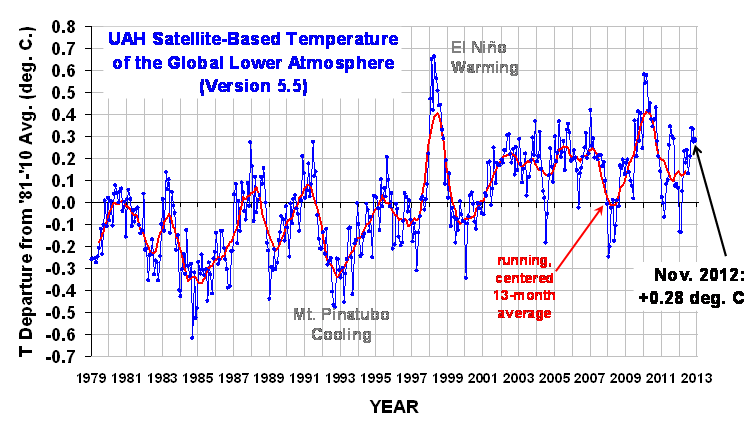
The survival of the world through the Mayan apocalypse reminds us to check back in on the mother of all end-of-days prophesies, global warming.   Global warming promoters have put out models projecting warming of 2 deg to 5 deg C by the end of the century.  That would be .2 to .5 deg C per decade.  How's that going?

Here and below is the latest graph from UAH, one of the organizations that processes and publishes the most accurate data on world air temperatures, derived from "microwave sounding units" on satellites.  

Looks like the latest temperature is actually down about .4 deg C from the peak reached fifteen years ago in early 1998.  If the world were warming at the rate of 2 deg C per century, we should be up .3 deg C since early 1998; if it were warming at 5 deg C per century, we should be up by .75 deg C since then.   So the predictions of doom are off by anywhere from .7 deg C to 1.15 deg C in fifteen short years.  When can we declare the hypothesis falsified?

Christopher Monckton of Benchley, writing at Watts Up With That, uses the occasion to mock those who continue to believe the prophesies in the face of mounting contrary evidence.  What we need to do, he says, is to provide a "diplomatic rat hole," that is, a way for the true believers and promoters to climb down gracefully now that they have been proven wrong.

Maybe so, but the promoters don't seem ready to go quietly just yet.  Looking at the Cabinet of the United States of America, we have Energy Secretary Steven Chu, who now wants to talk about anything but temperatures.   Here is a report from the Hill about Chu speaking at an "energy forum" back in April 2012:

Energy Secretary Steven Chu said . . . that scientific evidence of climate change is getting more and more powerful. . . .  "Over the last couple of years, the dispassionate, hard science evidence has been mounting, increasing," said Chu. . . .  "[Sea level] is rising even faster than we thought.  The number of violent rainstorms have increased faster than we thought," he said at the event in New York, adding that though there are "bumps and wiggles" that are not understood, trends are clear in the long term.

Got that?  Fifteen years of declining temperatures are mere "bumps and wiggles" that are not understood, but we know that warming is occurring by looking at sea level and counting the "number of violent rainstorms."  Given that the forum was hosted by the New York Times, apparently no one was so impolite as say out loud that the right way to determine whether the atmosphere is warming is to measure the temperature.

And now we have John Kerry nominated for Secretary of State.  If possible, John Kerry is even more of a true believer in global warming than Chu.  But, you say, why does that matter, given that Kerry's job as Secretary of State will have little or nothing to do with climate change?  Well, Kerry certainly doesn't see it that way.   Among many of Kerry's over-the-top pronouncements, check out this one from the Huffington Post in 2009:

Make no mistake: catastrophic climate change represents a threat to human security, global stability, and -- yes -- even to American national security.
Climate change injects a major new source of chaos, tension, and human insecurity into an already volatile world. It threatens to bring more famine and drought, worse pandemics, more natural disasters, more resource scarcity, and human displacement on a staggering scale. We risk fanning the flames of failed-statism, and offering glaring opportunities to the worst actors in our international system. In an interconnected world, that endangers all of us.

Get ready for climate change to become the number one issue at State.  And don't worry:  you can be sure that Kerry will be one hundred percent impervious to the evidence that the global warming is not actually occurring.

Closer to home, we have our very own Assemblywoman from Greenwich Village, Deborah Glick, devoting the better part of her current newsletter to her opposition to "fracking" for natural gas based on the supposed threat of greenhouse warming:

Methane is the most destructive of the greenhouse gases.  Not only is methane released through melting of polar ice caps, it is also released through the use and extraction of natural gas. . . .   An ancillary result of the use of natural gas is the release of methane into the atmosphere when it is burned. The release of methane is only exacerbated if the gas is obtained through hydrofracking. 

Do you get the strong impression from that, as I do, that poor Ms. Glick does not know that "natural gas" and "methane" are the same thing, and that burning natural gas/methane creates CO2 and water, not methane?  Well, which is worse, that, or not knowing that the increase in global temperatures ceased 15 years ago?  You decide!

And finally, from the letters to the editor page of the New York Times today, we have more opposition to fracking from none other than Yoko Ono, identified only as "a co-founder of Artists Against Fracking."  The New York Times is way, way too cool to admit that they know that Yoko Ono is some kind of celebrity.  

Industry documents show that 6 percent of the wells leak immediately and that 60 percent leak over time, poisoning drinking water and putting the powerful greenhouse gas methane into our atmosphere.  We need to develop truly clean energy, not dirty water created by fracking.

Thanks Yoko.  And by the way, would you be kind enough to identify which kind of "truly clean energy" would be acceptable to you and your gigantic carbon footprint?  Much appreciated.
UAH_LT_1979_thru_Nov_2012_v5.5.png