Can New York Learn Any Lessons From Detroit?

The good news about Detroit's bankruptcy filing is that it is causing lots of news coverage of that city and how it got where it is.  While most people may have been vaguely aware that Detroit was not doing too well, not many outside Michigan have known the full magnitude of the disaster:  loss of almost 70% of the population since 1950; going from America's wealthiest large city in 1960 to the poorest today; nearly 70,000 abandoned houses; houses for sale for $1000 or even $1 with no takers; most parks closed and almost half of streetlights out; highest murder rate in the country but police response time almost an hour; etc., etc. 

This is the end game of Progressive government.  Here's the recipe:  be the highest tax jurisdiction in the vicinity; agree to generous pensions and benefits for unionized city workers in return for their working to get you re-elected; get as many people as possible into dependency and handouts; have a business environment hostile to start-ups and entrepreneurship while doing big-time crony-capitalism and show projects to get politicians' names in the papers and generate political contributions (e.g., Renaissance Center, casinos, new stadiums, the GM Poletown plant, the People Mover, etc., etc.).  Of course, the demise of the UAW-ized auto industry didn't help, but that's only a reason why Detroit declined faster than other Progressivized cities, not a reason it was in decline to begin with. 

The lessons appear incredibly obvious, screaming out to anyone who will look.  Is it possible not to see?  Well, yes.  The last few days since Detroit's bankruptcy filing have brought out of the woodwork advocates for a Federal bailout, giving every possible reason why Detroit's situation has nothing to do with failed Progressive policies and instead comes from something else.  Here, for example, is John Nichols today in The Nation, giving his explanation of the sources of Detroit's problems:

But only the most deliberately disengaged commentator would imagine Washington to be blame-free in all this. America’s urban communities—and many not-so-urban communities—have for decades been battered by free-trade policies that foster deindustrialization, by tax policies that encourage offshoring, by all the missteps and misdeeds of Congress and successive presidents.

Funny, John, how those policies of Congress didn't seem to affect Atlanta, or Houston, or Charlotte, or Dallas, or Phoenix, or lots of other growing cities that didn't follow the Progressive prescriptions.  And, of course, the conclusion of Nichols' piece is, since Congress caused the problems, it is up to Congress to solve them, with, of course, a bailout.  Also joining the call for a bailout is Steven Rattner (former "Czar" of the GM bankruptcy) in Saturday's New York Times.

I'm actually somewhat amazed that President Obama and his team haven't been offering up a bailout -- do they actually realize that the Federal government might have some limits?  Well, probably the calculation is far more cynical than that.  They have to realize that all public focus on Detroit can only make people realize that the policies that have brought Detroit to ruin are very much the same policies that Obama is bringing to the whole country.  Let alone that an offer of a bailout to Detroit would have Cleveland and Philadelphia and Baltimore immediately in line, with Chicago next, and the entire state of California following and looking for maybe a trillion.  They still may do it, but I'm betting against it.

And back here in New York, are we capable of learning any lessons from this?  The funny thing is, 40 years ago in the 70s, New York looked very much to be going the way of Detroit, at least in the early stages.  Our taxes got way, way above the neighboring states (19% combined top state/city income tax rate in the 70s vs. 0% for NJ and CT at that time), and we lost about 12% of the population in that decade.  But New York's tax rates were cut dramatically in the late 70s and early 80s.  And now since 1994 we have had almost 20 years of Republican or semi-Republican mayors in the City, during which we have had huge declines in the crime rate (murders dropping from about 2200 to about 500 per year), welfare dependency cut to about one-quarter the previous level, professional management of city services, and, for the most part, a lid on tax rate increases.  And the City has come way, way back.

Yet the Democratic candidates for mayor are competing in offering new Progressive prescriptions, from increased "affordable housing," to easing up on access to cash welfare, to universal pre-K, to, of course, paying for it all by increasing taxes on the high earners.  Can someone please shout the word "DETROIT" at them every time they appear in public?


Does Anybody Actually Think That Obamacare Can Work?

As the implementation deadlines for Obamacare approach, a debate rages as to whether it will prove to be a boon or a train wreck.  If you have actually looked at the text of the law (available here) you will have seen that there are hundreds of provisions that are so complicated that it is just beyond human capability to do this.  But today I want to look at one aspect of the law that in my view shows a complete lack of comprehension of how the world works.

In its quest to achieve perfect social justice, the Affordable Care Act at multiple points defines eligibility for various benefits and subsidies in terms of where a person's household income ranks relative to the "poverty line."  

For example, Section 1331 defines the eligibility for the expansion of Medicaid in the states.  According to Section 1331(e)(1), here's who qualifies:

In this section, the term ‘‘eligible individual" means . . . an individual . . .
(B) whose household income exceeds 133 percent but does not exceed 200 percent of the poverty line for the size of the family involved, or, in the case of an alien lawfully present in the United States, whose income is not greater than 133 percent of the poverty line for the size of the family involved but who is not eligible for the Medicaid program under title XIX of the Social Security Act by reason of such alien status.

And then they're supposed to figure that out by asking the IRS.

Well here's the problem: how is the IRS supposed to know?  The IRS maybe has your tax return as of last December 31.  Of course many people at or near "poverty" didn't file a tax return for last year at all.   But assume you did.  You could have had 8 changes in your life since then that affect your "poverty" status.  You could have gotten a job, or lost one.  You could have gotten married, or divorced.  You could have had a kid, or twins, or had a kid move away.

Consider me back in my law school days.  January to May -- no job, no income, living apart from parents, subsisting off a scholarship (doesn't count for measure of "poverty") and savings from last summer's job (also doesn't count for the measure of "poverty").  Poverty!  I'm eligible!  June to August -- summer job.  Suddenly I'm back in the so-called "second quintile" of the income distribution.  September to December -- back into "poverty"!  The IRS knows nothing about all of this as it is occurring.  Or consider the many, many casual and construction workers in the world, who work for a few days or weeks, then get laid off, then work for another few days or weeks, and so on through the year.  They can go in and out of "poverty," (or 133 to 200 percent of "poverty") by the Census Bureau definition easily ten times in a year.

So is your "poverty" status for this law to be determined from last year's tax return no matter what has happened since?  That's not at all how the Census Bureau determines "poverty" in their surveys -- they look at your (self-reported) status on the date of the survey.  Suppose you lost your high-paying job six months ago and you are now making just enough to get you into that 133 to 200 percent of poverty category.  Does it count or not? And exactly how is the IRS supposed to have any relevant information on this?

The dummies who make these laws have an image of the world where everybody works through the year at a level-salary job that determines their ongoing and unchanging status in life.  The fact is that the world doesn't work that way, and basically that's why we have "poverty" (Census Bureau definition) in the first place.

Needless to say, I'm putting my bets on "train wreck."  But then, what kind of train wreck?   There's the kind where they actually try to do it honestly.  Of course, that kind is impossible, so no, it won't be that.  And then there's the dishonest kind, where you just take people's word on eligibility, and then never check again as they leave poverty status (maybe permanently or maybe to go in and out ten times a year).  Over time the program turns into a massive fraud where maybe a third of the population is getting improper subsidies.  That's certainly the approach being taken with food stamps.  It's also the approach that makes the government grow as fast as possible and add as many dependents as possible right now.    It's not sustainable and will contribute greatly to the huge crash some years out, but why should today's politicians care about that?


What Is The Greatest Scientific Fraud Of All Time?

Being a fan of scientific fraud and of human depravity generally, I can come up with lots of nominations in this category.  If you'd like to be reminded of some of the great ones that you have undoubtedly read about at some time or other,  here is a Top Six list from Cracked, and here is a Top Ten list from Listverse.  They definitely have some memorable ones, from Jan Hendrik Schon, the rising star at Bell Labs who faked results for some twelve papers published in Science and Nature around the year 2000; to the fake "Tasaday" primitive tribe promoted by a Philippine government minister named Elizalde in the 1970s;  to the archeological "discoveries" (planted) of Shinichi Fujimura in Japan in the 1980s; to Ranjit Chandra, who published studies on nutritional allergies of infants, blessing the baby formula products of Nestle and J&J (the studies were never conducted); etc., etc.  One of the greatest frauds, making both lists, is the "Piltdown Man" missing link hoax of Charles Dawson in 1912.

But going through these lists also makes clear that none of these frauds comes close to the big one going on right now, which is the world temperature data tampering fraud.  This is the fraud by which U.S. government agencies "adjust" temperatures of the past downward in order to make it seem like more recent years are warmer, and thus support the global warming narrative.  Now you are going to say, that seems completely ridiculous, they couldn't possibly get away with it, and nobody in their right mind would try such a thing.  Well, I'll just give you some evidence, and you decide. 

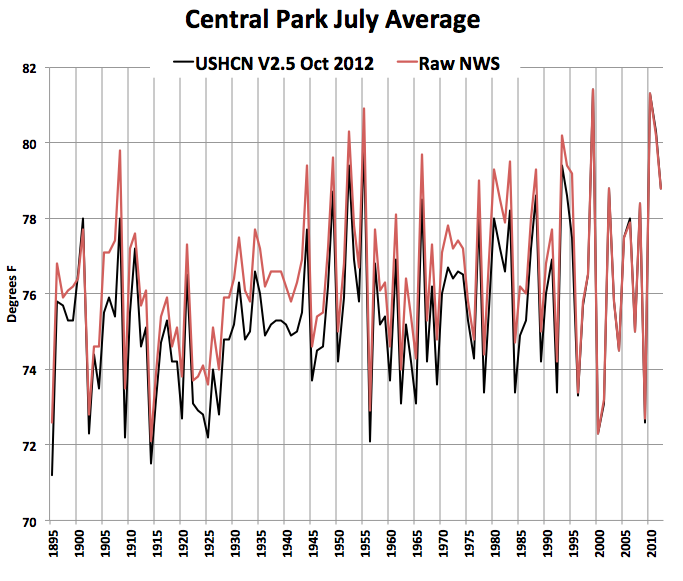
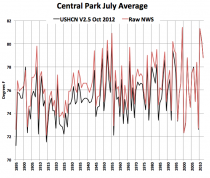
The latest news comes from Joe D'Aleo of the ICECAP website, who reports on a new online tool available from NCDC.  That's the National Climatic Data Center of Asheville, NC -- a Federal agency, part of NOAA, in turn part of the Commerce Department.  NCDC is headed by Tom Karl, a serious global warming zealot.  NOAA has been until recently headed by Jane Lubchenco, another serious global warming zealot.  The new tool enables plotting temperature data for cities, states, or regions.  So D'Aleo tried plotting the data for New York's Central Park for July, going back to 1885.  Meanwhile he happened to know that the National Weather Service (another part of NOAA) had archived data for Central Park for the same time period, so he took the archived NWS data and the new NCDC data and plotted them on the same graph.  Result:

image

Enlarged version.   Hmmmm.  In the new version, the warm years of the 1930s have magically become cooler, thus making the most recent years much warmer by comparison.

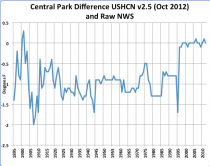
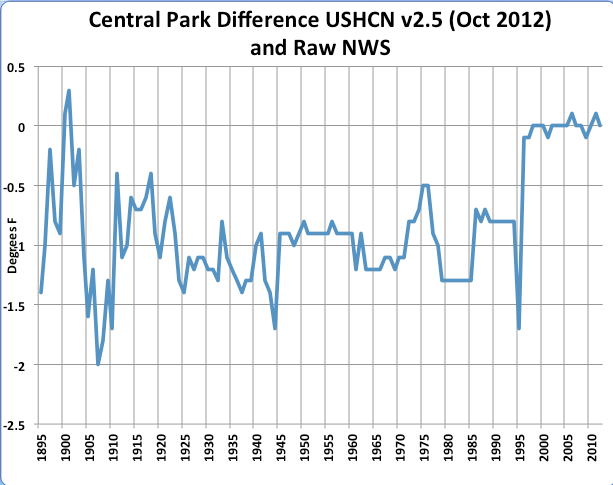
D'Aleo then calculated the differences between the previous raw data and the new adjusted data.  Here is that chart: 

image

Enlarged version.   Hmmmm again.  From 1995 to present, the raw and adjusted temperatures are about the same, but before 1995 the temperatures are "adjusted" downward by between 0.5 and 1.5 deg C all the way back to the beginning of the century.    What's going on here?  And the amazing thing is, they don't say.

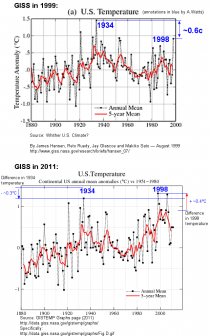
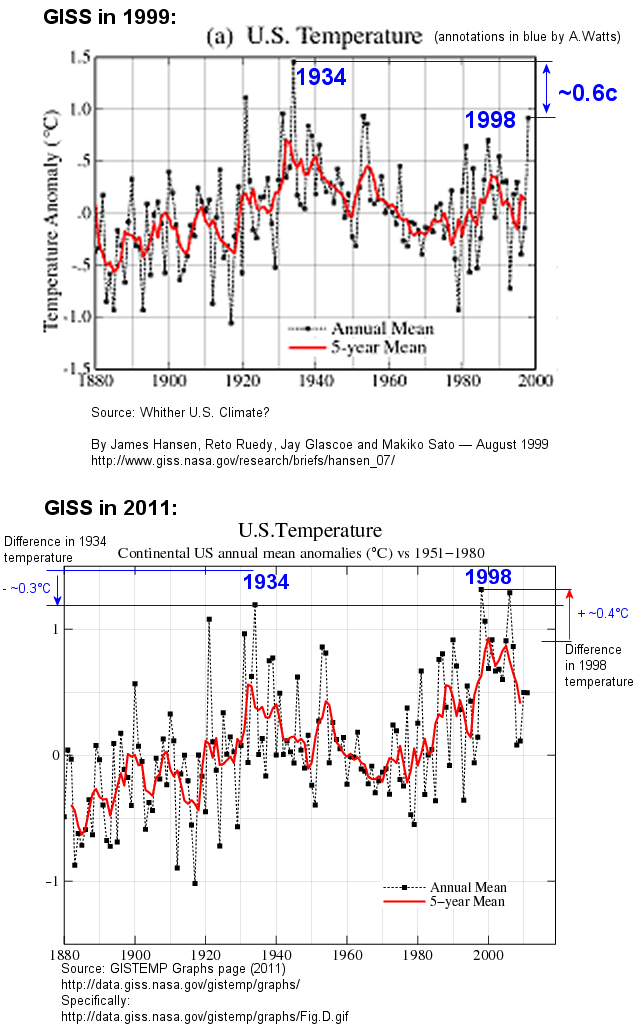
OK, you're thinking, this is some kind of strange anomaly, not a great fraud.  Well, you need to get a little deeper into the subject.  The main keeper of the official temperature records of the U.S. is a part of NASA called GISS (Goddard Institute for Space Studies), headed for decades by the recently (April 2013) retired James Hansen, another serious global warming zealot.  GISS puts out charts of U.S. temperatures plotted on an annual basis.  The funny thing is, those charts have changed over time.  Here we have the 1999 and 2011 GISS versions of U.S. temperatures:

image

Enlarged version.  In 1999 the 1930s were much warmer than 1998, but by 2011, 1998 had become much warmer than the 1930s.  How could that possibly be?  Lots and lots of people have noticed this, and have tried to get an explanation, but none is forthcoming.  

Meanwhile, is there any significance to this?  Well, just to take a small example, in his 2012 State of the Union speech, President Obama, latched on to the recently adjusted NASA data to proclaim:  

For the sake of our children and our future, we must do more to combat climate change.  Now, it’s true that no single event makes a trend. But the fact is, the 12 hottest years on record have all come in the last 15. Heat waves, droughts, wildfires, floods – all are now more frequent and more intense.

In the speech, Obama specifically cited to the recently adjusted NASA data.  You can easily see by looking at the charts that the business of the "12 hottest years on record have all come in the last 15" was completely created by the unexplained NASA adjustments that occurred in 2011.  Before the adjustments, many of the hottest years were in the 1930s. 

Again, is it just an anomaly or quirk, or is there some kind of systematic fraud going on?  A guy named Steven Goddard runs a web site called Real Science.  He makes a cottage industry out of keeping track of archived temperature data and reporting on when the government-paid global warming activists adjust the old data downward.  Input the word "tampering" into his search function, and you come up with literally dozens of examples where Goddard has identified earlier temperatures being adjusted downward to make the present appear warmer by comparison.  The culprits are almost always NCDC and NASA/GISS, although every once in a while the WMO gets in on the act.   

The charts at issue here are the very government charts that are used to support efforts to transform our energy economy and reallocate literally trillions of dollars of wealth and income.  The allegations of data tampering are not frivolous -- they are supported by clear prima facie evidence.  If there were a reasonable explanation, the government should have come out with it a long time ago.  As far as I'm concerned, the case for fraud has been proved.  There isn't any scientific fraud that I know of that comes remotely close. 

The Endless Supply Of Fake Scares And Statistical Scams

Back in May I wrote about the mortal blow suffered by the anti-salt campaign when the Institute of Medicine decided to do a real study and apply some actual statistical analysis to the results.    Turns out that there is no evidence at all that a low salt diet is good for you, and some that it might even be bad.  Meanwhile, a long list of power hungry busy-bodies -- the Federal Departments of Agriculture and HHS, the WHO, the American Heart Association, Mayor Bloomberg -- got exposed for trying to use a plausible hypothesis and some fake math to seize a little more control over your life.  I'm still waiting for any of them to apologize.

Well, salt is of course just one example.  If you start looking around, there is an endless supply of these fake scares and statistical scams.  And the essential ingredients are always the same:  a plausible hypothesis, little or no evidence, fake math, and power-hungry busy-bodies looking to get more control over your life.   In looking at these things, it doesn't matter if you don't know much math and never took statistics, because there is only one thing that you need to know to tell the real from the fake:  Relative Risk of less than 3 is meaningless.  If the Relative Risk is more than 3, they will tell you, because this will universally and immediately be recognized as a significant result.  If they aren't trumpeting a Relative Risk of over 3, then they don't have it and the whole thing is a scam.  It's easy!

Let's take a couple of examples for today.  First, the low fat diet.  The idea that we need to reduce fat in the diet is by this point so completely ingrained in our culture that it is second nature.  You can't go to the supermarket without seeing dozens of low fat and reduced fat items, all playing off the multi-decade browbeating of the consumer into believing that lowering fat will improve heart health and help keep weight under control.  The anti-dietary fat campaign is everywhere!  And certainly, it starts from a seemingly plausible hypothesis -- "fat" makes you "fat"!  Get it?  Now go to the Dietary Guidelines for Americans put out by the Center for Nutrition Policy and Promotion of the Department of Agriculture.   This is the Official Word of the Federal Government -- surely they know what they are talking about!  Click the link for Chapter 3 - Foods and Food Components to Reduce.  You will find that the first four pages of that chapter are about the need to reduce salt in your diet (uh-oh!), immediately followed by the next three pages on the need to reduce fats.  The section on fats is filled with seemingly authoritative statements like this one:

A strong body of evidence indicates that higher intake of most dietary saturated fatty acids is associated with higher levels of blood total cholesterol and low-density lipoprotein (LDL) cholesterol. Higher total and LDL cholesterol levels are risk factors for cardiovascular disease.

A "strong body of evidence" you say?  Can you please tell us the Relative Risk?  Of course not.  Actually, I have read three full-length books on this subject, and if there's one thing that's clear it's that the attempt to demonstrate a link between dietary fat and cardiovascular disease has yielded zero, zilch and nothing.  They're making it up.

Actually it's worse than that.   Starting in 1993 the government actually commissioned and paid for one of those massive studies specifically intended to gather evidence on whether there were any health benefits to a low fat diet.  It was called the Women's Health Initiative Dietary Modification Trial, and it enlisted almost 50,000 women between the ages of 50 and 79.  This was one of those randomized studies -- 19,541 assigned to follow a low fat diet, and 29,294 assigned to continue the usual diet.  The results were reported in the Journal of the American Medical Association in 2006.  Here is a summary report on the study from the Harvard School of Public Health.  And the results?

The results . . . showed no benefits for a low-fat diet. Women assigned to this eating strategy did not appear to gain protection against breast cancer, colorectal cancer, or cardiovascular disease. And after eight years, their weights were generally the same as those of women following their usual diets.

So, kindly explain why the Dietary Guidelines, most recently issued in 2010, continue to contain the advice to reduce fats?  The answer is that these people do not give up power willingly, and do not apologize for being wrong, even spectacularly wrong.  All I can say is, I hope you aren't wasting your time trying to reduce the fat in your diet.  Let's have a steak for dinner! 

Now how about example 2 for today -- "environmental tobacco smoke," aka ETS, aka second-hand smoke.  Surely we all know that that stuff is dangerous.  The EPA has told us so!

I should start by mentioning that I am no fan of tobacco smoke, and I found the days of thick tobacco smoke in bars, restaurants, airplanes, and offices quite unpleasant.  The evidence that smoking is harmful to health of the smoker is strong.  That of course gives the zealots their plausible hypothesis that second-hand smoke must also be harmful to health.  But is there real evidence that ETS is harmful to health?   

The answer is, not that I can find.    Go to the basic EPA page for the public on this subject, and what you get is mumbo jumbo authoritative statements just like in the Dietary Guidelines.  "Exposure to secondhand smoke can cause asthma in children who have not previously exhibited symptoms."  "Infants and children younger than 6 who are regularly exposed to secondhand smoke are at increased risk of lower respiratory track [sic!] infections."  But no evidence.  There is a link to a 2006 Surgeon General report.  That report, it turns out, does contain long lists dozens of studies of subjects exposed to ETS and their development of certain medical conditions.  And they do have a column in their charts to report Relative Risk.  And for the large, large majority of the studies the result in that column is "NR" - no result.   And for the rest of the dozens of studies, the results are almost universally a RR of well under 2.  I managed to find one such study with a RR of just over 3 and a total of 29 subjects.

Frankly, this is insulting to our intelligence.  

Unfortunately, an awful lot of what you think you know is one sort or another of fake scare or statistical scam. 


The Smartest Government Is Not Very Smart

On Monday President Obama made a speech about "smart government," saying he was going to make the government "smarter, quicker and more responsive" by urging the cabinet to adopt all the latest new technology, or something like that.  The speech has rightly come in for a lot of ridicule.   See, for example, Jonah Goldberg at Town Hall here, or an IBD editorial here, or William McGurn in the New York Post here.

The fact is that it is not within the possibilities of government to be smart the way that markets are smart.   McGurn has it pretty close: 

[T]he problem with government is not that it lacks smart people. The problem with government is that it doesn’t have the incentives to get the best out of smart people — and never will.

Good point, but actually it's a lot worse than that.  On this subject, if you have never read the classic essay I, Pencil by the economist Leonard Read, you really should.  It's not long.  

Read's thesis is often stated as "nobody knows how to make a pencil."  And if you think about it, you will realize that, as seemingly simple as is a pencil, you have no idea how to make one from scratch, and neither does anybody else - even the people in the pencil business.  Imagine yourself in a hunter-gatherer society, and someone hands you a basic number 2 pencil and asks you to make another one.  If you are the smartest person in the world, and have your whole lifetime to try, you will barely have begun what you need to accomplish.  For starters, you need to learn how to make iron, and then axes and saws, to chop down and carve up trees.  (Try chopping down a tree some time with a stone ax.  After about a week of backbreaking work, with luck you have one large log.  Now, how are you going to cut it up into lots of little cylindrical pre-pencils using your stone tools?)  The fact is, the smartest person in the world will die a long, long time before figuring out how to make a pencil.  And what incentive is going to cause a next generation to continue the work?

Now, please, consider the problem of making a computer.  The fact is that no amount of mere "smartness" can accomplish the job.  Even collaboration among hundreds or thousands of "smart" people won't get anywhere.  The only way that these jobs get done is through thousands upon thousands of sequential inventions incentivized through the miracle of market exchange.

But our President thinks he can successfully reconfigure the use of energy, and the entire healthcare industry, because he is "smart" and he has a bunch of "smart" people working for him.   Well, the job of producing the best energy or the best healthcare for a $15 trillion economy is a lot harder than making a pencil.  What I can't get over is the hubris of their thinking that they can outdo in a short period of time what millions of people sharing information through markets have been able to do.

So how's the "smart" government doing?  It's just a question of which ridiculous illustration you want to pick.  Jonah Goldberg picks this one: 

Marvin Horne [is]a farmer who owes the federal government $650,000 in fines. Why?  He failed to comply with the Department of Agriculture's national raisin reserve program, created by the Truman administration, which even liberal Supreme Court Justice Elena Kagan dubbed "just the world's most outdated law." The program stockpiles raisins in case of an emergency. Such emergencies -- if they ever existed -- ceased being a problem after World War II. It's no surprise, alas, that government programs are as hard to fire as the employees working for them.

Well, that's a pretty good example, but really not hard to top.  One of my favorites is the so-called "Strategic Petroleum Reserve."  Here's the idea:  pump lots of oil out of the ground at great expense, ship it a long way at great expense, and then pump it back into the ground at great expense.  And presto, you have a "Strategic Petroleum Reserve."  Now, why would it not have sufficed to just buy the rights to an undeveloped oil field and leave the oil in place?  Because, dear man, we are way, way too "smart" for that!  

But of course I'm talking about small, small beer.  The current big money is in Obamacare.  Hubris on steroids!  At her new website, Megan McArdle has three posts on the ongoing unraveling of Obamacare, here, here and here.  I just can't get over the idea that "smart" people believe that all imperfections in an area covering some 18% of the economy, over $2.5 trillion per year, can be fixed a some "smart" people coming up with a 1000 page law and some other "smart" people coming up with many more thousands of pages of regulations, that no one can really ever read or understand, trying to micro-manage everyone's behavior.         


Yes, It Does Matter If The New York City Comptroller Is An Odious Human Being

So serial sexter Anthony Weiner is in the race for mayor of New York, and it gradually develops that, despite past conduct that would seemingly be completely disqualifying,  he is actually a credible candidate against a field of people who seem to have no idea what the job of mayor is about.  If Weiner's conduct is not disqualifying, then I guess nothing is.  On Sunday, Eliot Spitzer joined the race for New York City Comptroller.

The problem with Spitzer is that his sexual escapades are far and away the least significant instances of his disqualifying conduct.  The New York Times and the Wall Street Journal both ran editorials on Monday reviewing some of the Spitzer history, and John Podhoretz weighed in today in the New York Post.  It's good to be reminded of this stuff. 

The Times editorial at first seems scathing, until you read the others and realize that as usual the Times has missed most everything important.  Here is the key section of the Times editorial:

Desperately needed reforms were thwarted, opportunities lost — and it was more than a sexual scandal that made Mr. Spitzer’s truncated governorship an exceptional debacle in a capital city that is debacle central. It was that he saw himself as a “steamroller” instead of a leader, that he stoked alienation and resentment in his allies as well as his adversaries, the opposite of what a competent politician should do.

And then there's this howler: 

This was the man who built a solid record and shiny reputation as a hard-charging attorney general.

So you need to turn to the Journal to be reminded of how truly awful this man was, and it didn't begin when he became governor.  Starting with his time as AG, the Journal reminds us that Spitzer:

  • Held a press conference announcing that he was going to indict AIG and its CEO Maurice Greenberg, then never did it but used the threat to force Greenberg out of the company.  After Greenberg's departure AIG risk management went off the rails, leading to massive losses in the mortgage derivative markets, a government bailout, and loss of more than $100 billion of shareholder value.  In my view, there is nothing unfair in blaming Spitzer for that debacle.
  • When John Whitehead (former Goldman Sachs CEO and senior State Department official) published an op-ed standing up for Greenberg, Spitzer called Whitehead and said "I will be coming after you.  You will pay the price.  This is only the beginning and you will pay dearly for what you have done."
  • Spitzer brought a case against former NYSE head Dick Grasso seeking return of Grasso's lump sum pension payout of $138 million.  The case ended in complete victory for Grasso in the courts and a debacle for the NYAG.
  • Spitzer forced a management decapitation at Marsh & McLennan that again led to massive loss of shareholder value.  He also began a criminal prosecution against senior insurance brokerage executives at Marsh.  After a 10 month trial, the executives were acquitted on all but one charge.  Then, well after sentencing, it came to light that the NY AG's office had withheld some 700,000 documents from production, which the judge found would have been "invaluable" to the defense.  These disclosures led to vacation of all the convictions.

I guess that's what the New York Times refers to as a "solid record and shiny reputation as a hard-charging attorney general."  And even the Journal leaves out Spitzer's shake-downs of the investment banking industry for the supposed sin of having securities analysis and investment banking under one roof.  And then we get to the worst one of all, when Spitzer was governor, using the state police to gather dirt on political opponents.  Really, this guy could not be topped. 

But, you ask, the office Spitzer is now running for is New York City Comptroller.  This is not a prosecutorial position, nor an executive position.  Maybe it doesn't matter if Spitzer is an odious human being? 

It does matter.  The main jobs of the Comptroller are two: (1) sole trustee of the five pension funds for City workers, and (2) conducting audits of the City's mayoral agencies.  Here are a couple of examples of what an ambitious, self-aggrandizing bad guy with those responsibilities can do.

The five City pension funds have assets in the range of $100+ billion.   They are very large shareholders in many publicly traded companies.  Now let's say that the stock of some publicly traded company drops suddenly.  Many plaintiffs' law firms will promptly bring complaints alleging that there has been a fraud.  Under the securities laws, the right to be the "lead plaintiff" in these cases goes to the shareholder who owns the largest number of shares bought during the class period.  The "lead plaintiff" then picks a law firm to be "lead counsel" and that firm gets the lion's share of the legal fees.  Some of these cases generate legal fees in the tens of millions of dollars, sometimes even over $100 million. 

The New York State pension funds are known for regularly claiming their position as "lead plaintiff," and the City pension funds have also played in this sandbox to some degree.  Why do they do it?  Because the plaintiffs' law firms make huge amounts of money off these cases, are deeply indebted to the government functionaries who can cause big pension funds to select them, and are thus fantastic sources of political contributions.  Alan Hevesi (former New York State Comptroller recently released from jail) perfected this game (although Hevesi went to jail for yet something else).  Also, great opportunity for headlines when a big case settles.  "SPITZER WINS $100 MILLION SETTLEMENT FOR PENSION FUNDS!!!!!!"

Well, you say, they are just vindicating their rights as shareholders and getting payments to which they are entitled.  What's wrong with that?  The answer is that nobody pays attention to the fact that the same pension funds are almost inevitably also on the paying ends of these settlements.   Here's how it works.  Suppose a class action alleges that because of wrongful disclosures all shareholders of Citigroup who bought stock during 2012 have been defrauded.  The NYC pension funds turn out to be the entity that bought the most Citigroup shares during 2012, and they become lead plaintiff.  But they also bought lots of shares in 2011, 2010, 2009, 2008 and on back.  They are entirely likely to own many more shares of Citigroup bought outside the class period than in it.  Now Citigroup settles the case by putting up some hundreds of millions of dollars.  As shareholders who bought outside the class period and still own that stock, the pension funds are on the paying end of this.

Do the NYC pension funds receive more than they pay in such a settlement?  To figure that out, you need all the dates and amounts of stock that they bought and sold and what they still own.  Of course they don't disclose that information to the public, so nobody but them can tell.  Given that legal fees and expenses take at least around 25% of the settlements, and that the dates of stock purchases are substantially random, I find it hard to believe that the funds can be net gainers in most of these settlements.  I have never seen anyone make an actual calculation, and the information to do so is hidden.  This is a great area for big corruption.  No one is on to it.  Yes, this is a huge reason why a self-aggrandizing guy who recognizes no personal limits should not be New York City Comptroller.

And how about the audit function?  That gives a self-aggrandizing guy endless opportunities to get in the news and upstage the mayor.  Sometimes it's justified.  Would Comptroller Spitzer confine himself to issues of actual merit?  No chance.