Fallacy Of The Day

I often say to my kids that almost everything in life is some sort of scam or fallacy.  OK, it's an exaggeration, but not that much of one. 

Here's something you probably would never have thought of as a major fallacy, but it is.  How many headlines have you seen about increasing risks of cancer, with the general implication being that more cancers must be caused by a deteriorating environment?  Or is it just a fallacy?

An excellent blog called Numberwatch, by British mathematician John Brignell, has a short write-up in November 2012 on the "independence fallacy."  This fallacy is particularly relevant when discussing the causes of death:

[T]he probabilities of cause of death are not independent. Because we all die of something, they are constrained to add up to 100%.

In other words, our very success in curing other causes of death leads of necessity to our living longer and eventually ending up with cancer.

This is not a trivial point. Much of the bureaucratic interference in our lives has been justified by the putative increase in cancer rates. The main reason that they are increasing is that we are not dying of the other diseases that have inflicted man throughout his existence.

Keep this in mind next time you see some study using an increase in cancer rates as the justification for increasing government involvement in some aspect of your life.

The Next Four Years -- Looks Like The War On The Economy Will Continue

Four years into a pitiful economic recovery, what are the prospects for the next four?  In the last four years, the government footprint in the economy has gone up by 4 - 5% of gdp -- no sign that that is going to go down any time soon.  Social Security, Medicare, and Medicaid continue to increase at rates far in excess of overall economic growth, with no good prospect of reform.  Taxes on the top producers have just gone up.  But the U.S. economy is a huge and remarkably resilient engine.  Can't it get going and outrace these things?  

If you were thinking of getting your hopes up, consider this from Obama's second inaugural address:

We will respond to the threat of climate change, knowing that the failure to do so would betray our children and future generations. Some may still deny the overwhelming judgment of science, but none can avoid the devastating impact of raging fires, and crippling drought, and more powerful storms. The path towards sustainable energy sources will be long and sometimes difficult. But America cannot resist this transition; we must lead it. We cannot cede to other nations the technology that will power new jobs and new industries — we must claim its promise. That is how we will maintain our economic vitality and our national treasure — our forests and waterways; our croplands and snowcapped peaks. That is how we will preserve our planet, commanded to our care by God. That's what will lend meaning to the creed our fathers once declared.

And this wasn't just buried somewhere.  From all indications, it appears that he intends to make it the signature initiative of his second term.

There were no policy specifics mentioned.  However, every policy idea that has ever been on the table as to "climate change" has two essential features:  (1) it attempts to decrease the use of carbon-based energy either by direct prohibition or by raising the price, and (2) its effect on total world use of carbon energy, given rapid increases in third world use, cannot have any but completely negligible effect on world temperature, even if you believe that more atmospheric CO2 will increase temperatures.

Over at the Washington Post's wonkblog, Steve Plumer has a list of policies that Obama might try:  have EPA force the closing of coal-fired power plants (sure to raise the price of electricity); force the use of more "renewable" energy (costing a multiple of carbon-based energy); back to cap and trade (specifically intended to raise the price of energy to force the people to use less, aka intentional impoverishment of the people).  Or how about a really high, really regressive "carbon tax"?  Maybe that will "save the planet" by forcing the low income people to stay home and keep their homes heated to only 50 degrees.  Or how about a few more billions -- make it trillions! -- for renewable energy subsidies?  Of course, the renewables can't possibly compete with fossil fuels on equal terms, so when the subsidies end, all of the wind and solar producers go out of business the next day.

Meanwhile, it's been fifteen years since world temperatures have increased -- fifteen years in which carbon emissions from the third world and former third world (China, India) have soared.  One would think that the climate campaigners by this time would be looking for a way to climb down inconspicuously and slink away before they make themselves look even more ridiculous.  Nope, they're doubling down.

In the old days the government thought it was its business to make electricity available and inexpensive.  From the 1930s to 1990s we had the Rural Electrification Administration, that handed out big grants to bring carbon-based electricity to every farm in America.  What happened to that?  Well, no Federal bureaucracy ever goes away.  In 1994 they turned it into the Rural Utilities Service.  According to allgov.com, that agency dispensed some $9 billion from 2002 - 2012.  And one of the key missions?  Making electricity less expensive in rural areas!  Here's a press release from December 19, 2012: 

USDA ANNOUNCES FUNDING TO HELP REDUCE ENERGY COSTS IN REMOTE, RURAL AREAS

Well, nobody ever said the government had to be consistent.  The point is to pass out money and to make yourself look like the sugar daddy.

Anyway, everything about "climate change" policy is a war on the efforts of entrepreneurs to make the economy more productive and efficient, and the people wealthier.  So what is the chance of the economy improving any time soon?

A Good High Level Summary Of Manhattan Conventional Ignorance

The term "conventional wisdom" is often applied to describe a widely-held point of view with which the writer disagrees.  But I can't bring myself to apply that term to the Manhattan orthodoxy, because "wisdom" implies that there was at least some grasp of the facts and some application of thought to arrive at the conventional position.  A better term for the Manhattan orthodoxy is "conventional ignorance." 

The funny thing about Manhattan conventional ignorance is that its purveyors are often very smart people.  They make successful careers dealing with complex concepts and solving difficult problems.  That leaves little time for studying history or thinking about public policy, but others in the elite crowd are already doing that, and they all agree on all essential points.  So it's really easy just to conform. 

Yesterday one of my partners, whose field is tax, invited me to the annual lunch of the Tax Section of the New York State Bar Association.  This was a very large affair, perhaps 3,000 attendees, held in the large Grand Ballroom of the New York Hilton.  It would be fair to say that all the top tax lawyers in New York were there. 

The draw was a speech by a guy named Edward Kleinbard.  Perhaps you haven't heard of him, but he's a bona fide big name in the field of tax law.  After many years as a top partner at the Cleary Gottleib firm, he went off to become Chief of Staff of the Joint Committee on Taxation of the Congress (OK, my radar should have been alerted by that one), and then left there to become a professor at USC Gould School of Law.  My colleague personally knew Kleinbard and described him as a "really smart guy."  The advertised topic was "budget and tax policy."

Well, this guy may know more than anybody about reverse K squared tax shelters or the language of the new ObamaCare tax provisions, but this speech had nothing to do with his actual expertise.  He had decided to branch out into being a public policy guru, with the compass of the New York Times editorial page and Obama campaign talking points to guide him.  This speech was to be a high level summary of Manhattan conventional ignorance.

Title of the speech:  Why Tax Revenues Must Rise.  Already I knew I was in trouble.  Well, why can't spending be cut instead?  In summary the answer was that spending is just a law of nature and there's nothing that can be done about it.  I made notes of a few of the key quotes:

Spending cuts just aren't going to happen.
You can't suck too many dollars out of the economy too quickly.
Spending just cannot be cut more.
The sharp austerity path is not a great idea.  Most of us thought that was resolved in the Great Depression.

There you have the instinctive and ignorant acceptance of the official narrative that the Great Depression was cured by government spending.  He is blissfully unaware that it was in fact spending cuts well in excess of 50% of the total that set off the postwar boom.  Here is a link to one of my prior posts on this, with further links to the important David Henderson article about the postwar spending cuts and subsequent boom.

Cut discretionary spending?  That's already been "cut to the bone."  There was no specific mention of why the hundreds of billions of dollars of annual spending for things from agriculture subsidies, to education, to green energy boondoggles, to the Commerce Department, to the Labor Department, to the TSA, to disaster relief, to the drug war, etc., etc., cannot be cut or, in fact, eliminated.

Cut entitlements?  That will take decades.  We can't have "medical costs visited cruelly out of the direct pockets of Americans."  Did he actually say that?  Yes.

I won't go on.  It's too painful.  Three thousand people or so - the best and brightest in New York tax law - sat there nodding their heads.  At the end of the speech, there was a little polite applause.  I booed, but I was off in a corner in a room way too big for many people to hear me. 

Of course, the speech actually demonstrated the fundamental argument for refusing to raise any taxes in any respect, because providing any additional revenue just gives added credence to the ridiculous argument that spending cannot be cut.  Kleinbard cannot justify that, and neither can anyone else.  As soon as someone actually challenges the "it's just a law of nature" argument, the whole structure crumbles.
How Many Times Must The Taxpayers Pay To Rebuild Sea Bright, New Jersey?

At this writing the Senate still hasn't approved the second-round $50+ billion Hurricane Sandy relief bill, but I'm not holding out much hope that it will go down to defeat, or for that matter be trimmed even a little.  So it's time to further examine the infinite credit card mindset behind these things.

Yesterday the AP had a story raising the legitimate question of whether it's the right thing to rebuild yet again in some of those communities destroyed time and again by ocean storms.  The story was picked up by numerous outlets.  Here is the version at Newsday.  But like almost everything from the press, the story is so totally infected by the infinite credit card mentality and ignorance of history as to be next to useless.

The headline is:  Should worst-flooded areas be left after Sandy?  Here's the response of Dina Long, mayor of Sea Bright, NJ:  

"We're not retreating," said Dina Long, the mayor of Sea Bright, N.J., a chronically flooded spit of sand between the Atlantic Ocean and the Shrewsbury River only slightly wider than the length of a football field in some spots. Three-quarters of its 1,400 residents are still homeless and the entire business district was wiped out; only four shops have managed to reopen. . . .  But as in many other storm-damaged communities, there is a fierce will to survive, to rebuild and to restore.  "Nobody has come to us and said we shouldn't exist," she said. "It is antithetical to the Jersey mindset, and particularly to the Sea Bright mindset. We're known for being strong, for being resilient, for not backing down."

Sounds like the voice of a brave fighter.  Or is she a contemptible moocher?  To me the answer entirely depends on whether the residents of Sea Bright are prepared to rebuild with their own money, or private insurance, or whether their so-called "strength" and "resiliency" is just a function of the hand-outs they can suck off the Federal credit card.  Incredibly, the AP reporter is not curious enough to understand that this is the fundamental question.  It is not asked.  But we know the answer, since the $60 billion Federal hand-out is enough to pay for all legitimate losses from Sandy at least three times.

Well let's take a little look at the history of Sea Bright.  When was the last time it was flooded by some combination of its ocean and river?  That would be 2010.  Here's a story about the 2010 storm and its aftermath:

“Sea Bright families are still recovering from the effects of the snowstorm that hit the area and destroyed local families’ homes back in 2010.  This funding will help fully repair the damage caused; it will also bolster the relevant public infrastructure to prevent future damage from the regular storms and floods that affect area,”  said New Jersey U.S. Senator Bob Menendez. 

The Federal funding in question would be $1.4 million to build and repair bulkheads "to minimize [future] flood damage."  Looks like that money went straight down the rat hole.

And the next previous flood at Sea Bright?  Why, that would be September 2009!  Here is a youtube story with a video of the ocean flowing up onto the streets.

Before that, it seems you have to go all the way back to 1992.  Lou Lumenick of the New York Post lived there at the time, and wrote a recent story for the Post describing his experience in the horrific 1992 destruction.  Oh, but here in a blog post from 2005 called "The Jersey Shore Real Estate Bubble" we have a description of houses for sale "north of $3 million" on the very site of properties destroyed in the 1992 storm.  Those would be the houses just now destroyed and that the taxpayers must pay for.

Next, a policy paper from Rutgers University (for those who don't know, it's the state university of New Jersey) listing other major storms that destroyed Sea Bright, going back into the 19th century:

1962 The Great Ash Wednesday Northeaster
1944 - Great Atlantic Storm

Christmas Storm and Jan. 1914 Storm - caused massive destruction

1890s - storms repeatedly destroyed wooden bulkheads and battered many of the cottages in Sea Bright

And here is NJ Governor Christie calling the House of Representatives "disgusting" for postponing a vote on Federal relief to bail out these people for the umpteenth time.  Really, Governor Christie?  Perhaps I am the only person in the United States who finds it disgusting that the Congress votes $60 billion of Federal taxpayer money to bail out everyone who built anything on the coast that got destroyed.  But it is disgusting, and it's time for a few other people to join me.

Back to the AP story.  They have the idea that the only possible alternative to Federal hand-outs to rebuild again and again is "buyouts" of the affected property owners.

If buyouts did occur, [Prof. Jon Miller of Stevens Institute of Technology] predicted they would happen in areas with lower property values because of the high cost of buying up prime coastal real estate. That could have the unintended consequence of placing the shore off-limits to all but the wealthy, he said.

It's like the idea of letting people suffer their own losses, or buy their own insurance, doesn't even occur to them.  It's beyond the pale!  The mindset is:  of course it's obvious that the taxpayers must either bail out or buy out the people who just bought newly built $3 million homes in a community that has been destroyed by the ocean seven times in the last 130 years.   Am I the only person who is willing to say no to this insanity?

More Insights Into Our Ruling Class's Thinking From The Latest Government Amicus Brief In The Argentina Case

As the battle between Argentina and its hold-out creditors continues to play out in the U.S. courts, currently in the Second Circuit Court of Appeals here in New York, the government gives more insights into the thinking of the people in charge by filing increasingly preposterous amicus briefs.  The latest turned up on December 28.  It is available on the Shearman & Sterling website here.

The problem starts from the fact that Argentina agreed on these bonds to be sued in New York and to be bound by the law of New York, which on the relevant points is no more complicated than "we will enforce your agreement to repay the loan."  Perhaps you might think that the government of the United States would stand up for New York law on that point, but instead it has decided to stand up for the ability of deadbeats to find some way, any way to avoid payment.  I previously commented here on this very odd choice of sides.  But what possible thinking could get you to the idea that Argentina has the right side here?  The amicus brief has the answers.

Here is the articulation of the main point:

[V]oluntary sovereign debt restructuring will become far more difficult if holdout creditors can use novel interpretations of boilerplate bond provisions to interfere with the performance of a restructuring plan accepted by most creditors, and to greatly tilt incentives away from voluntary debt exchanges and negotiated restructuring in the first place.
A sovereign’s potential resistance to paying non-exchanged debt is a critical tool in its efforts to negotiate broad creditor support for restructuring. This leverage will be lost if creditors believe that a holdout strategy will eventually result in substantial or full payment. If enough creditors adopt this strategy, foreign sovereign debt restructuring will become impossible.

Or to put it in simpler terms, if we want them to be able to stiff the creditors, we have to give them the right to stiff the creditors.  I love the use of the Orwellian term "voluntary" restructurings.  This was a take-it-or-leave-it offer of about 25 cents on the dollar; if you don't take it we will fight to the death to be sure you get nothing.  The 25 cents was not picked out of the blue, but was carefully selected against the backdrop of the perceived difficulty of collecting from the defaulters.   Does the U.S. government not understand that if its position is accepted, the next "voluntary" exchange offer will be at 10 cents, or maybe 1 cent?

Well, if the government's first point didn't make any sense, there's an even dumber one on the next page:

In addition, the decision could harm U.S. interests in promoting issuers’ use of New York law and preserving New York as a global financial jurisdiction. See Allied Bank v. Banco Credi- to Agricola, 757 F.2d 516, 521 (2d Cir. 1985) (“The United States has an interest in maintaining New York’s status as one of the foremost commercial centers in the world.”). The decision could encourage issuers to issue debt in non-U.S. currencies in order to avoid the U.S. payments system, causing a detrimental effect on the systemic role of the U.S. dollar.

They have no comprehension that the entire lending business only exists because the rule of law enforces repayment.  Of course Argentina would prefer to borrow money in Argentina (or maybe Cuba?), where what passes for the rule of law is "we will stiff you if we feel like it"; but, oddly enough, no one will lend them the billions of dollars they want on those terms.  The lending market is in New York, and governed by New York law, precisely because New York law enforces repayment.  The way to keep the lending market in New York is to enhance the ability of lenders to get repaid, not to undermine it.  Is it really possible that our top State and Justice Department officials and United States Attorneys are too dumb to know that?  Yes, it is.

By the way, the top guys signing onto this are Harold Koh, Legal Advisor to the State Department (and former Dean of the Yale Law School, and committed orthodox thinker of the Manhattan variety on all essential points) and Preet Bharara, United States Attorney, otherwise known for wasting the vast resources of his office largely on the futile jihads against drugs and insider trading.

Where does this all lead?  Argentina's current jefe, Christina Kirchner, gets to maintain her populist bona fides by playing tough with the American creditors, while her country continues its long, slow decline into poverty.   What is worst about this is that the United States is helping the rulers of Argentina maintain power, while they slowly destroy the country. 

More (State) Government Wealth Destruction: The LIPA Follies, Continued

From today in Crain’s New York Business, (may be behind a pay wall)  the headline “LIPA to require state bailout.”  LIPA would be the Long Island Power Authority, purveyor of the highest-priced electricity in the lower 48.  I like the term “require,” like there’s nothing we can do about it.  It’s just a law of nature!

In fact what we have going on is serious wealth destruction, $7 billion or so, by a succession of New York governors, Democrats Cuomo pere et fils, as well as the intervening Republican Pataki.  (What, we can’t blame this one on Spitzer?  Surprisingly, no; although if he had gotten a chance to weigh in on it he clearly would have gotten it wrong.)

It seems that Gov. Andrew Cuomo, in his recent State of the State address, proposed to “abolish” LIPA. 

“It has never worked,” he said. “It never will.” But analysts believe that persuading a private company to buy the much-maligned utility would require the state to assume at least $4 billion of LIPA's $7 billion in debt. A sale would then trigger nearly $1billion in additional costs: early-termination fees paid to bondholders, as well as penalties for the derivatives contracts that would suddenly become void, according to people who have studied a privatization.

Who could have seen it coming that LIPA would never work?  Just a brief review of the history (more detail in my previous post here and at Wikipedia here):  From about 1973 to 1985, Long Island’s then-private utility LILCO built a nuclear power plant at Shoreham at a cost of about $6 billion.  When it was fully built and ready to operate, then new Governor Mario Cuomo, bowing to strongly expressed nuclear fears of the Long Islanders, decided to block the opening by refusing to cooperate in the development of an emergency evacuation plan.  The opening was blocked, and now Long Island had spent $6 billion with no electricity to show for it.  That $6 billion (plus some accumulated interest) is the hole we are still trying to deal with.  Cuomo pere came up with the idea of transferring much of the cost of the plant to other New York taxpayers, and to Federal taxpayers, by creating a “public” utility for Long Island that could issue tax exempt bonds.  That would be LIPA.  Of course, they didn’t have the people actually to run a complex utility, so LIPA was set up as the thinnest of possible shams to claim the tax exemption – nothing but a board of directors with all the real work subcontracted to private utility operators.  It took until 1998, in the administration of Pataki, to finally get LIPA up and running and all the debt refinanced into tax exempt bonds.

But even though the interest rates were somewhat lowered, Long Island still had the now $7 billion of debt and also had to buy its electricity elsewhere.  Not hard to see why it has the highest electric rates in the country.  It also had a utility consisting of nothing but a political board with no idea how to produce or deliver electricity, and a mission to come up with electricity free both from all risks and all costs.  Not possible. They pretended to solve that by skimping on maintenance.  Then came Hurricane Sandy.  The next-to-no maintenance thing didn’t work out so well.

Meanwhile, how dangerous is nuclear power really?  The worst recent nuclear accident is the one at Fukushima, Japan in 2011.  How many people died from radiation as a result of that?  Believe it or not, not a single death there has been definitively attributed to radiation so far, although an unknown number of cases of cancer could develop in the future.  Here is the Wikipedia entry:

A few of the plant's workers were severely injured or killed by the disaster conditions (drowning, falling equipment damage etc.) resulting from the earthquake. There were no immediate deaths due to direct radiation exposures, but at least six workers have exceeded lifetime legal limits for radiation and more than 300 have received significant radiation doses. Predicted future cancer deaths due to accumulated radiation exposures in the population living near Fukushima have ranged from none to 100.

Meanwhile we accept tens of thousands of deaths per year from automobile accidents without complaint and, indeed, barely noticing it.  Also, the people of Westchester accept (reluctantly) the risk of the Indian Point nuclear plant, that supplies about 25% of the electricity for New York City.  Our current Governor also is trying to close that one down.  Oh, and he continues a hold on drilling for natural gas within the state by the “fracking” method.  So what exactly is the method of producing electricity that he and his supporters will allow?

You will not be surprised that I do not have a lot of sympathy for the Long Islanders here (who let their way overblown fears get the better of them and now would like others to pay the cost), nor for the Governors who go along with and indeed lead this vast wealth destruction.  Sorry, but this is not the problem of the rest of the New York taxpayers, let alone the Federal ones.

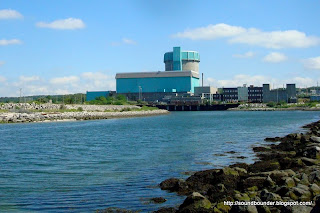
Here’s a picture (from 2010) of the Shoreham power plant, still sitting there idle after all these years.