The Government Goes Full "Washington Monument" To Avoid Any Spending Cuts

CBO figures for the 2012 fiscal year just ended show cash basis spending of $3.54 trillion, revenues of $2.45 trillion, and a one-year cash deficit of $1.09 trillion.   Proposed tax increases on high earners promise to bring in maybe a tenth of that, less than $100 billion per year, at some potential loss to future growth.   Other pre-scheduled tax increases in the fiscal cliff (i.e., restoring 1990s tax rates on the middle class and letting the AMT hit several million more people) are things no one believes will actually happen.  Just perhaps, it is time to consider cutting spending.  Say, by around $1 trillion per year. 

The so-called "fiscal cliff" comes with about $100 billion of pre-arranged spending cuts.  That's less than 3% of annual Federal spending, and only about a tenth of what it would take to approach cash basis budget balance, even while continuing to ignore the ongoing problem of entitlement acceleration.  But $100 billion in cuts would be a start.  In my opinion any large organization that tries can cut 3% of its spending in a way that nobody will really notice.  Needless to say, the prospect of these minimal cuts is throwing the Federal bureaucracy and its allies in the press into spasms in their efforts to defend every last dollar of spending.  

To the defenders of spending, the main question is whether these insignificant 3% cuts should be characterized as "devastating," "drastic," or "draconian."  A google search of "fiscal cliff devastating cuts" returns 30 million hits, an example being this from the White House (via CNN Money) in September:  "The White House budget office, in a report mandated by Congress, said the cuts "would have a devastating impact on important defense and nondefense programs."  A similar search for "fiscal cliff drastic cuts" returns 1.45 million hits.  Example (from the Council on Foreign Relations):  "Democrats [are] pushing for more revenue as part of any deal to avert the drastic mandatory cuts."   Draconian is running a distant third, with only 223,000 hits in response to "fiscal cliff draconian cuts"; but you have to save a word like "draconian" for special situations, as in this from the mayor of Providence, Rhode Island at the Huffington Post:  "The fiscal cliff would have profound and draconian consequences for the City of Providence."

How to turn 3% cuts into "devastating," "drastic," and "draconian"?  The answer is the "Washington Monument strategy," by which the bureaucracy, instead of doing its job and finding ways to minimize the impact of the cuts, instead maneuvers to maximize the impact and visibility of the cuts ("We'll have to close the Washington Monument!"), in order to build up public pressure to avoid them.  For example, this from Mayor Taveras of Providence:  "Here in Providence, these cuts would hit hardest our most vulnerable citizens: children in low-income households, senior citizens, individuals in need of substance abuse counseling."  Actually the cuts wouldn't hit any of these things at all if Providence stopped wasting its money on outrageous pensions for its public workers and instead used its own money to provide the services to "our most vulnerable citizens."  Or here we have USA Today reporting on threats from FAA and TSA of cutbacks in air travel if the cuts are allowed to proceed.  "FAA could be forced to close more than 100 smaller airports. . . .  TSA could lay off thousands of baggage screeners. . . ."  Those services were provided privately until just a few years ago.  Now that they are Federally provided, they are the perfect way to threaten to inconvenience the public to get support for other spending the public doesn't even know about.

Readers of this blog do not need to be reminded that the Federal government cut its level of spending by 50% twice in the twentieth century -- first in 1921, and then in 1946-47 (in the demobilization from World War II).  Both times the economy took off into a prolonged boom.  Time to do it again.


Which Is Better, Responsible Behavior or Irresponsible Behavior?

My daughters separately refer me to this article from last Sunday's New York Times Magazine:  God Save The British Economy, by Adam Davidson.  

This is the story of an American economist, one Adam Posen, who finds himself appointed as a member of the Monetary Policy Committee of the Bank of England in an era of Tory government.  It seems that the Cameron government has come to office committed to a program of "austerity."  Great word, "austerity."  As in, "The economy's only chance to return to long-term growth, Cameron argued, would be a painful, but brief period of austerity."  As soon as they use that word (it appears upwards of 30 times in the story) you know where this is coming out.  "Austerity" -- how cruel! how heartless!

Posen figures out that there is an alternative to "austerity," known here as "stimulus."  Seems to be working in Japan.  (I can't believe that Japan is the best example they could find of the benefits of "stimulus."  Isn't that a clear indication that there is no actual success?)   The MPC starts taking votes on monetary policy, and before you know it it's going 8 to 1 against Posen every time.  But he's a principled chap, and sticks to his guns.   There isn't a real end to the story.  But, according to the author, the tide of proper world thinking is now turning against "austerity" and toward "stimulus."

In the 2010 mid-term elections, U.S. voters flooded Congress with Tea Party-friendly candidates.  Many carried the mandate to halt further government stimulus.  Since then, though, an increasing number of global economic policy leaders have turned on austerity.  Earlier this year, in a remarkable joint statement, the I.M.F., along with the World bank, World Trade Organization and eight other major economic institutions, warned that austerity was hurting global growth and raising unemployment.  They asked the world's major economies to embrace stimulus.

Whatever you think of the loaded terms "austerity" and "stimulus" (I would prefer "responsible behavior" and "irresponsible behavior"), you can't get away from the fact that these policies are the opposite of each other.  They cannot both be right.  If one of them is right, then the other is a fallacy.  

Which one is the fallacy?  It's not too hard to figure out.  "Stimulus" as an ongoing economic policy implies an ever-increasing occupation of the economy by the state.  If that worked, North Korea and Cuba would be great economic successes.  Look around and figure out which are the most dynamic and successful economies:  the United States for 200 years after its founding (with the exception of the depression), Britain (before the socialists took over after World War II, and again for a period after the Thatcher reforms), Hong Kong, Singapore, post-war Germany, Australia, Canada (under current Conservative government).  What is the key thing they have in common?  Low occupation of the economy by the government.  What happens when there is high occupation of the economy by the state?  Even putting aside the disaster of communism, consider the likes of Greece, Spain, Argentina, Venezuela.  

Yes, when the state cuts back its spending, the first thing that occurs is that some people get laid off.  If you measure gdp by counting a dollar of government spending as equal to a dollar of private spending (which is how all gdp accounting is done) then when the state cuts spending you will measure an immediate drop in the economy.  The accounting is fallacious.  A dollar of government spending is not equal to a dollar of private spending, but nobody knows any other way to measure it.  To restore a dynamic economy, resources must  be redeployed from the inefficient uses to which government spending has put them, and into the private economy.  Call it "austerity" if you want.  I call it responsible behavior. 

So then, who has been duped by the conventions of gdp accounting (or by general predilection for big government) into falling for the fallacy that endlessly increasing government spending is a positive for an economy.  Well, according to Davidson, the I.M.F., the World Bank, the World Trade Organization, and "eight other major economic institutions," -- not to mention, of course, Davidson himself, the New York Times and essentially all other major media.  Oh, and don't forget President Obama and his administration.  Yikes!  It's no wonder there's not much constituency for a big shrinkage of the government.  We'll just have to wait until the Ponzi scheme starts to crash.  Meanwhile, if you are getting the idea that almost all of our highly credentialed intellectuals are just plain wrong about just about everything important, you are right!

Global Warming Mini Round-up

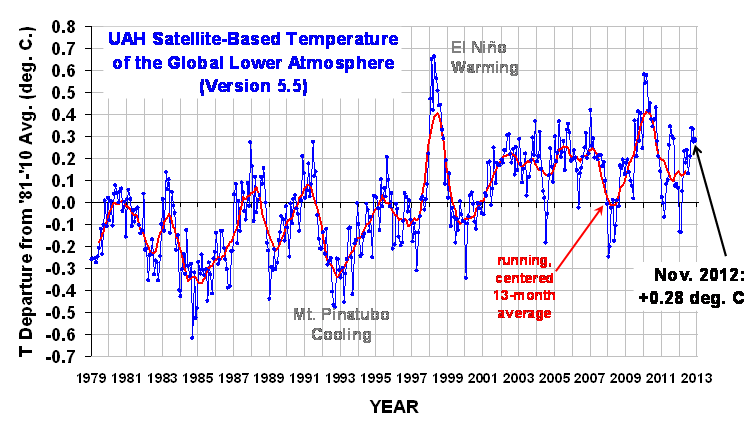
The survival of the world through the Mayan apocalypse reminds us to check back in on the mother of all end-of-days prophesies, global warming.   Global warming promoters have put out models projecting warming of 2 deg to 5 deg C by the end of the century.  That would be .2 to .5 deg C per decade.  How's that going?

Here and below is the latest graph from UAH, one of the organizations that processes and publishes the most accurate data on world air temperatures, derived from "microwave sounding units" on satellites.  

Looks like the latest temperature is actually down about .4 deg C from the peak reached fifteen years ago in early 1998.  If the world were warming at the rate of 2 deg C per century, we should be up .3 deg C since early 1998; if it were warming at 5 deg C per century, we should be up by .75 deg C since then.   So the predictions of doom are off by anywhere from .7 deg C to 1.15 deg C in fifteen short years.  When can we declare the hypothesis falsified?

Christopher Monckton of Benchley, writing at Watts Up With That, uses the occasion to mock those who continue to believe the prophesies in the face of mounting contrary evidence.  What we need to do, he says, is to provide a "diplomatic rat hole," that is, a way for the true believers and promoters to climb down gracefully now that they have been proven wrong.

Maybe so, but the promoters don't seem ready to go quietly just yet.  Looking at the Cabinet of the United States of America, we have Energy Secretary Steven Chu, who now wants to talk about anything but temperatures.   Here is a report from the Hill about Chu speaking at an "energy forum" back in April 2012:

Energy Secretary Steven Chu said . . . that scientific evidence of climate change is getting more and more powerful. . . .  "Over the last couple of years, the dispassionate, hard science evidence has been mounting, increasing," said Chu. . . .  "[Sea level] is rising even faster than we thought.  The number of violent rainstorms have increased faster than we thought," he said at the event in New York, adding that though there are "bumps and wiggles" that are not understood, trends are clear in the long term.

Got that?  Fifteen years of declining temperatures are mere "bumps and wiggles" that are not understood, but we know that warming is occurring by looking at sea level and counting the "number of violent rainstorms."  Given that the forum was hosted by the New York Times, apparently no one was so impolite as say out loud that the right way to determine whether the atmosphere is warming is to measure the temperature.

And now we have John Kerry nominated for Secretary of State.  If possible, John Kerry is even more of a true believer in global warming than Chu.  But, you say, why does that matter, given that Kerry's job as Secretary of State will have little or nothing to do with climate change?  Well, Kerry certainly doesn't see it that way.   Among many of Kerry's over-the-top pronouncements, check out this one from the Huffington Post in 2009:

Make no mistake: catastrophic climate change represents a threat to human security, global stability, and -- yes -- even to American national security.
Climate change injects a major new source of chaos, tension, and human insecurity into an already volatile world. It threatens to bring more famine and drought, worse pandemics, more natural disasters, more resource scarcity, and human displacement on a staggering scale. We risk fanning the flames of failed-statism, and offering glaring opportunities to the worst actors in our international system. In an interconnected world, that endangers all of us.

Get ready for climate change to become the number one issue at State.  And don't worry:  you can be sure that Kerry will be one hundred percent impervious to the evidence that the global warming is not actually occurring.

Closer to home, we have our very own Assemblywoman from Greenwich Village, Deborah Glick, devoting the better part of her current newsletter to her opposition to "fracking" for natural gas based on the supposed threat of greenhouse warming:

Methane is the most destructive of the greenhouse gases.  Not only is methane released through melting of polar ice caps, it is also released through the use and extraction of natural gas. . . .   An ancillary result of the use of natural gas is the release of methane into the atmosphere when it is burned. The release of methane is only exacerbated if the gas is obtained through hydrofracking. 

Do you get the strong impression from that, as I do, that poor Ms. Glick does not know that "natural gas" and "methane" are the same thing, and that burning natural gas/methane creates CO2 and water, not methane?  Well, which is worse, that, or not knowing that the increase in global temperatures ceased 15 years ago?  You decide!

And finally, from the letters to the editor page of the New York Times today, we have more opposition to fracking from none other than Yoko Ono, identified only as "a co-founder of Artists Against Fracking."  The New York Times is way, way too cool to admit that they know that Yoko Ono is some kind of celebrity.  

Industry documents show that 6 percent of the wells leak immediately and that 60 percent leak over time, poisoning drinking water and putting the powerful greenhouse gas methane into our atmosphere.  We need to develop truly clean energy, not dirty water created by fracking.

Thanks Yoko.  And by the way, would you be kind enough to identify which kind of "truly clean energy" would be acceptable to you and your gigantic carbon footprint?  Much appreciated.

UAH_LT_1979_thru_Nov_2012_v5.5.png

Merry Christmas From Greenwich Village!

We're not known here for our over-the-top Christmas decorations.  But here are a few homes and stores dressed well for the holiday:

West side of Bleecker St. at Perry St.

East side of Bleecker St. at Perry St.

West side of Bleecker St. at Charles St.

North side of Charles St. between Bleecker St. and West 4th St.

Northeast corner of Charles St. and West 4th St.

Just In Case You Thought There Was Some Chance That The Economy Might Start Improving In 2013

The U.S. economy has now completed a full four plus years of stagnation.   Always before in downturns (with the single exception of the Hoover/Roosevelt ten year war against capital in the 1930s) the economy has hit bottom and recovered rapidly.  Won't it finally get going some time soon? Sadly, there is every reason to think that it will not.

Start with the broadest aspects of macroeconomic policy.  On a cash basis we have trillion dollar plus annual deficits.  Nothing about the "fiscal cliff" negotiations even treats this issue as if it were a significant problem.  Tax increases on high earners might reduce the cash basis deficit by 5% or so at unknown cost of undermining incentives for investment.  The real annual deficit, taking account of reasonable accruals for unfunded health and retirement obligations, is more like $7 trillion per year, and the proposed tax increases on high earners will address less than 1% of that amount.  The Fed proposes to monetize essentially all of the cash basis deficit to maintain zero interest rates.  

Does anyone actually believe that these huge deficits and this money printing year after year constitute some kind of "stimulus" to the economy -- what I call "fake Keynesianism"?  If you do, kindly look at Japan, now going into year 23 of stagnation and doubling down yet again on the exact same failed policies.  In reality the huge deficits represent the displacement of efficient and dynamic private economic activity with wasteful and inefficient government spending, a massive and ever-growing drag on the economy.  

And just in case the private economy actually shows some signs of starting to overcome the government's crowding it out, the ideologue Obama bureaucracy is going to make sure that that won't happen.  The latest bad news comes from the Federal Court of Appeals for the D.C. Circuit, which last week denied rehearing en banc of a case challenging the unbelievable EPA "greenhouse gas" regulations under the Clean Air Act (CAA).  In essence, the D.C. Circuit has upheld the EPA's position that under the CAA it can regulate and require permits for any economic activity emitting as little as 100 tons of CO2 per year.  Just about every business meets this criterion -- every factory, every office building, every school, every hospital.  Your household might even meet this criterion if you do a reasonable amount of breathing, driving, flying, and you use light, heat, air conditioning, refrigeration and computers.   EPA itself estimates that the number of entities that would require permits if it exercised its maximum authority would be "millions."  Anyway, the only thing standing in the way of this steamroller of economic destruction is the Supreme Court, and, for reasons set forth below, I wouldn't count on rescue from that direction.

There is a tortured history leading to this latest D.C. Circuit opinion, and I'll give just the briefest summary.   CO2 -- a colorless, odorless gas with no harmful health effects -- is emitted in large amounts in the 90 +/- % of economic activity not powered by nuclear, hydro, wind or solar.  The only knock on CO2, if it is a knock, is the alleged threat of global warming.  After the global warming scare got going in the 90s, and in the face of pressure from environmental groups, the EPA during the G.W. Bush administration declined to undertake regulation of CO2 as a "pollutant" under the CAA.  A coalition of environmental groups sued, and was then joined by several blue states, led by Massachusetts (Romney was governor!), seeking to force the EPA to regulate.  After the D.C. Circuit issued an ambiguous decision, the plaintiffs petitioned to the Supreme Court.  In a 5-4 decision in 2007, the Supremes held that CO2 met the CAA definition of pollutant and ordered the EPA to regulate unless it determined that CO2 did not "endanger public health or welfare."  The Supreme Court decision came just in time for the Obama EPA to take over.   No amount of lack of evidence of warming was going to convince the Obama EPA to forego this opportunity for power.  The "endangerment" finding came out in December 2009. 

At that point the EPA had to confront the problem that if CO2 is a pollutant and if it were to follow the literal words of the CAA, regulators would need to consider and issue or deny literally millions of permits.  Not even possible!  They addressed this problem by coming up with the so-called "Timing and Tailoring Rules," under which they basically say that we'll start by requiring permits for facilities issuing 75,000 tons of CO2 per year and up, and then later (but we won't say when!) gradually clamp down on smaller and smaller emitters until everyone in the country has to answer to us.  Another coalition of opponents sued (this time business groups and red states), but a panel of the D.C. Circuit upheld the EPA back in June.  Then last week the full D.C. Circuit denied rehearing en banc.  Two judges (Brown and Kavanagh) issued spirited dissents, but to no avail.  Nowhere left to go but back to the Supremes, where the only question is whether Justice Kennedy has yet figured out that he got scammed back in 2007.  Don't count on it. 

So unless by some miracle the Supreme Court turns it around, the EPA (along with equally committed brethren in state environmental regulators) now has won the authority to veto essentially any and all economic activity.   These are zealots who think that economic activity is evil and that by shutting it down they are "saving the planet."  They have no idea that they are impoverishing the people.  Literally trillions of dollars of economic activity are at stake.   

So is there any real chance of the economy getting going in the next four years?  Unlikely.

There Are Two Ways Of Looking At The World -- Gun Rights Edition

As I have written before, for example here, when it comes to politics there are two diametrically opposite ways of looking at the world.  One way is the progressive orthodoxy, pervasive here in Manhattan, and the other way is my way, probably best called libertarian.  The difference has been on full display in the recent debate over gun control in the aftermath of the shootings in Sandy Hook, Connecticut.

Both philosophies start from the premise that human society is filled with flawed behavior and unfair results.  In the progressive view, there is a simple solution to every such human problem:  the government can fix it with new laws ordering people to behave properly, or alternatively through the power to spend money.  The libertarian view sees major problems with these seemingly simple solutions, including that many people do not obey rules, that government actors are themselves flawed and often corrupt, that people engage in evasive strategies, that there are endless unintended consequences, and that the effort to make things perfect through more rules actually makes things worse because of loss of freedom.

Consider the recent debate over gun control.  Probably the leading spokespersons for the progressive position have been President Obama and Mayor Mike Bloomberg of New York.  I’ll let them speak for themselves.  Here are excerpts from President Obama’s speech at Sandy Hook a few days after the shootings:

[T]here have been an endless series of deadly shootings across the country. . . .  We can't tolerate this anymore. These tragedies must end. And to end them, we must change. We will be told that the causes of such violence are complex, and that is true. . . . . But that can't be an excuse for inaction. Surely, we can do better than this. If there is even one step we can take to save another child, or another parent, or another town . . .  then surely we have an obligation to try. 

Mayor Bloomberg issued a statement shortly after the tragedy.  Here are key excerpts:

President Obama rightly sent his heartfelt condolences to the families in Newtown. But the country needs him to send a bill to Congress to fix this problem. Calling for ‘meaningful action’ is not enough. We need immediate action. We have heard all the rhetoric before. What we have not seen is leadership – not from the White House and not from Congress. That must end today.

That captures the progressive view perfectly.  You “send a bill to Congress” and that will “fix the problem.”  No ifs, ands, or buts.  Of course everyone will do what Congress orders them to do, and law enforcement will perform flawlessly.

Unfortunately I think things are a lot more complicated than that.  The best statement I have seen of the other side of the question comes from a guy named Larry Correia, writing at a site called Monster Hunter Nation.  His post is long and should be read in full.  Here are some excerpts:

Police are awesome. I love working with cops. However any honest cop will tell you that when seconds count they are only minutes away.

In the case of Sandy Hook, it took the police  a full 20 minutes to arrive.  That was plenty of time for the shooter to kill 26 people, whether or not he had some fancy “assault weapon.”

The average number of people shot in a mass shooting event when the shooter is stopped by law enforcement: 14. The average number of people shot in a mass shooting event when the shooter is stopped by civilians: 2.5. The reason is simple. The armed civilians are there when it started. . . . 

Gun Free Zones are hunting preserves for innocent people. . . .

The man that attacked the midnight showing of Batman didn’t attack just any theater.  There were like ten to choose from.  He didn’t attack the closest.  It wasn’t about biggest or smallest.  He attacked the one that was posted NO GUNS ALLOWED.

There were four mass killing attempts this week.  Only one made the news because it helped the agreed upon media narrative.

1. Oregon.  NOT a gun free zone.  Shooter confronted by permit holder.  Shooter commits suicide.  Only a few casualties.

2. Texas.  NOT a gun free zone.  Shooter killed immediately by off duty cop.  Only a few casualties.

3. Connecticut.  GUN FREE ZONE.  Shooter kills until the police arrive.  Suicide.  26 dead.

4.  China.  GUN FREE COUNTRY.  A guy with a KNIFE stabs 22 children.

So what exactly is the legislation that will “fix the problem”?   The proposals on the table, generally involving renewing the lapsed Federal restrictions on “assault weapons,” are completely meaningless in my view.  They certainly would not have had any meaningful effect in the Connecticut event.

Is there an alternative proposal?  Ban gun ownership by civilians entirely and authorize the police to search everyone’s house and seize the weapons?  Then we have a world where millions of law-abiding citizens have their guns taken and guns are owned only by the police and by the worst of violent criminals, who of course will pay no attention to the ban.  Improvement?

The most amazing aspect of this is that the leading spokespersons for the progressive position all have their own armed protection.  President Obama has the secret service.  Mayor Bloomberg has 24-hour armed protection from the New York City police.  Diane Feinstein, leading Senate proponent of new gun restrictions, is a gun permit holder.  Love this picture from Instapundit.  Is President Obama's life more important than mine, or yours?


gunsmakeuslesssafe.png